

Key Takeaways
- Dealer financing is convenient but often includes a markup added to the lender's base rate.
- Getting pre-approved through a bank or credit union lets you negotiate the car price separately from the loan.
- Manufacturer-sponsored promotional rates (e.g., 0% APR) can only be accessed through dealer financing.
- Credit unions frequently offer lower rates than banks, especially for members with good credit.
- Comparing both options before signing can meaningfully reduce how much you pay over the life of a loan.
- Your credit score affects rate offers from both sources - check it before applying anywhere.
Option A
Dealer Financing
The convenient, one-stop option arranged at the lot.
Best for: Buyers who want to handle everything in one place or who qualify for manufacturer-subsidized promotional rates.
Option B
Bank or Credit Union Financing
The pre-arranged loan that gives you negotiating leverage.
Best for: Buyers who want rate transparency and stronger negotiating position before stepping onto a dealership lot.
If you qualify for a manufacturer's promotional APR offer
Dealer Financing
Promotional rates like 0% or 1.9% APR are only available through the manufacturer's captive lender, accessed at the dealership. No outside lender can match them.
If you want the strongest negotiating position at the dealership
Bank or Credit Union Financing
Arriving with a pre-approval letter lets you separate the loan conversation from the vehicle price negotiation, keeping the process clearer and more controllable.
If you have limited credit history or a lower credit score
Dealer Financing
Dealers work with a network of lenders and may find approval options that a single bank or credit union would decline outright.
If minimizing total interest paid is your top priority
Bank or Credit Union Financing
Credit unions in particular often offer rates below what dealers pass through, and there's no dealer markup built into the rate.
How Each Financing Path Works
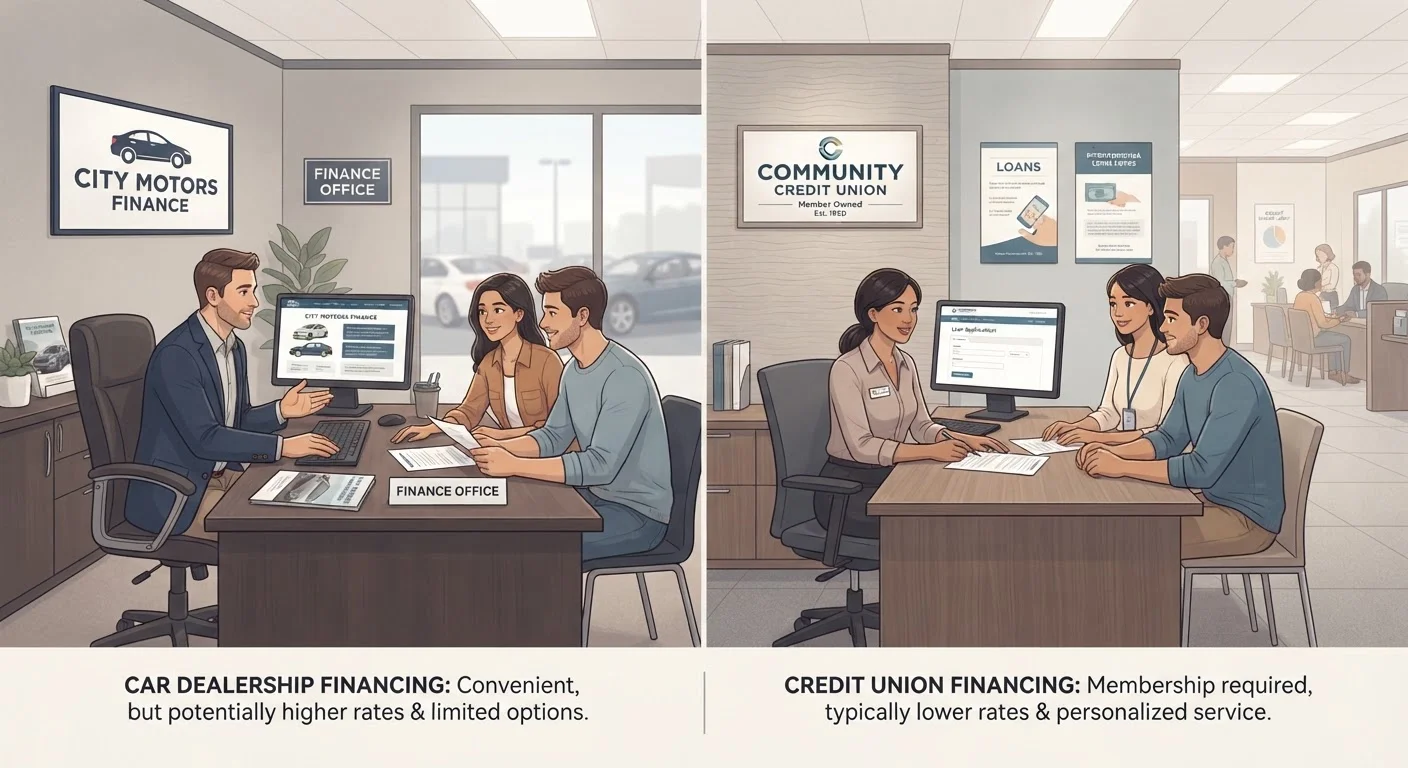
When you finance a car through a dealership, the dealer submits your application to one or more lenders - banks, captive finance arms (like a manufacturer's own lending division), or finance companies. The lender approves a rate, and the dealer typically has the ability to mark that rate up before presenting it to you. The difference between the lender's approved rate and what you're quoted is called the dealer reserve, and it's a source of dealer profit on the financing side of a deal.
When you arrange financing through your own bank or credit union before visiting the lot, you go through the application process directly with that institution. If approved, you receive a pre-approval offer - sometimes a check or a commitment letter - specifying the maximum loan amount and your interest rate. You bring that to the dealership and use it like cash, then decide at signing whether to use it or accept a dealer-arranged alternative that genuinely beats it.
As part of the full car-buying process, understanding financing options early gives you more control over the final cost of ownership.
Where Dealer Financing Has the Edge
Dealer financing isn't inherently bad - it has specific situations where it's genuinely advantageous.
- Promotional rates: Manufacturers periodically offer deeply discounted APRs - sometimes 0% - through their captive lending arms. These promotions are only accessible through the dealership, not through outside lenders. If you qualify, they can represent real savings versus any rate a bank or credit union could offer.
- One-stop convenience: For buyers who find the process overwhelming, handling the loan, registration paperwork, and vehicle purchase in one place reduces the number of steps involved.
- Broader lender access: Dealers work with many lenders simultaneously. If your credit profile is thin or imperfect, a dealer may find an approval that a single lender you approached directly would have declined.
That said, it's worth reviewing the fine print on fees and add-ons that often get bundled into dealer-arranged financing packages at signing.
| Criterion | Dealer Financing | Bank / Credit Union |
|---|---|---|
| Rate transparency | Rate may include dealer markup | Rate is quoted directly to you |
| Access to promotional APRs | Yes - manufacturer offers available | No - not eligible |
| Negotiating leverage | Lower - loan tied to sale | Higher - pre-approval separates both |
| Approval flexibility | Multiple lenders via dealer network | Single institution's criteria |
| Typical rate competitiveness | Varies widely by dealer/lender | Often lower, especially credit unions |
| Process convenience | All handled at the dealership | Requires a separate application step |
Where Your Own Lender Has the Edge
For most buyers who have an established credit history, getting at least one pre-approval before visiting a dealership is worth the effort.
- No markup: The rate your bank or credit union quotes is what you pay. There's no dealer reserve built in.
- Negotiating clarity: When you already have financing lined up, you can focus the dealership conversation on the vehicle price and trade-in value without those figures getting blurred by monthly payment math.
- Credit union rates: Credit unions are member-owned nonprofits and often carry lower auto loan rates than commercial banks. If you're a member of one, it's worth getting a quote.
Before you shop, researching financing options at home first helps you walk in with a realistic benchmark.
~80%
New car buyers who finance through a dealer
Federal Reserve data consistently shows the majority of new vehicle purchases are financed at the point of sale through dealer-arranged credit.
1-2.5%
Typical dealer markup range on loan rates
The Consumer Financial Protection Bureau has noted that dealer reserve markups commonly fall in this range above the lender's approved base rate, though practices vary.
Key Terms to Understand Before You Apply
Comparing loan offers requires understanding what you're actually comparing. A lower monthly payment doesn't always mean a cheaper loan - a longer repayment term stretches out interest costs even at the same rate. Similarly, an APR (Annual Percentage Rate) includes fees that a bare interest rate quote may not.
For a plain-language breakdown of these concepts, see auto loan terms first-time buyers often misunderstand. Understanding APR, loan term, and how principal paydown works will help you evaluate any offer - dealer or direct - on equal terms.
Rate Shopping Doesn't Hurt Your Credit the Way You Might Think
Many buyers avoid applying to multiple lenders out of fear of damaging their credit score. In practice, most credit scoring models treat multiple auto loan inquiries made within a 14-45 day window as a single inquiry. This is specifically designed to allow rate shopping. Checking your own credit beforehand with a soft inquiry has no impact on your score at all.
One practical step: apply for pre-approval with your bank or credit union before visiting dealerships. Most auto loan pre-approvals involve a hard credit inquiry, but multiple auto loan inquiries made within a short window (typically 14-45 days, depending on the credit scoring model) are often counted as a single inquiry for scoring purposes.