

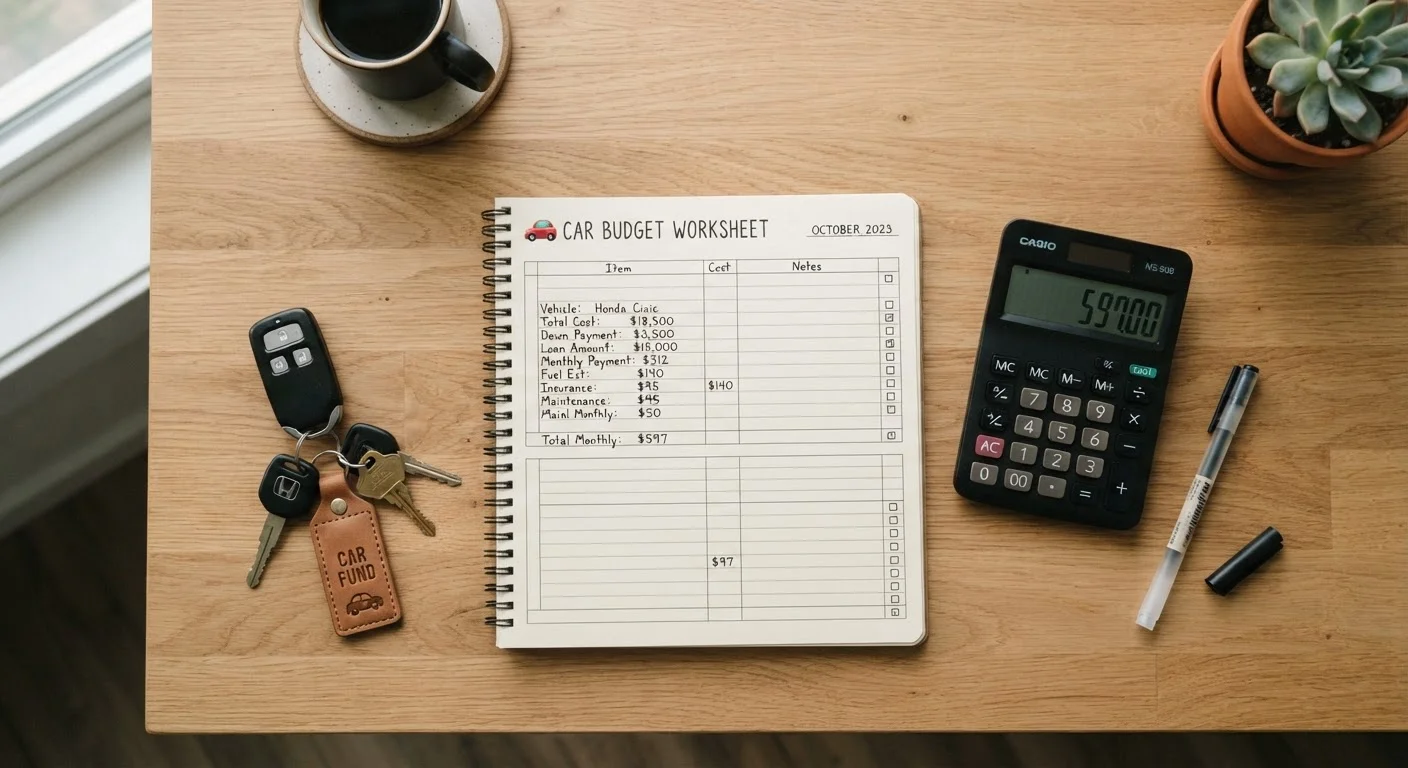
Key Takeaways
- Car ownership costs go well beyond the monthly loan payment - fuel, insurance, maintenance, and registration all add up.
- Breaking costs into monthly equivalents makes irregular bills easier to plan for and absorb.
- A dedicated car fund prevents surprise bills from derailing your broader household budget.
- Most drivers underestimate ownership costs by a wide margin when they focus only on the loan payment.
- Reviewing your car budget annually keeps estimates accurate as costs and driving habits change.
What you will need
Why a Car Budget Needs More Than a Loan Payment
When most people ask "Can I afford this car?", they mean: "Can I cover the monthly payment?" That framing misses most of what a vehicle actually costs. Insurance, fuel, routine maintenance, tires, registration fees, and unexpected repairs are all real, recurring expenses - and they often add up to more than the loan itself.
Depreciation, insurance, fuel, and maintenance all hide beneath the purchase price - and together they can easily double what you thought you were committing to. This guide gives you a step-by-step method to map every cost, convert irregular bills into monthly figures, and build a realistic car budget before a single surprise hits.
What you will need
How to Build Your Car Budget Step by Step
Work through these steps with a notepad or a simple spreadsheet. You don't need special software - just honest numbers and a little research.
List Every Cost Category
Start by writing down every expense a vehicle can generate. Use this as your master checklist:
- Loan or lease payment (if financing)
- Auto insurance (liability, collision, comprehensive)
- Fuel
- Routine maintenance (oil changes, filters, fluid top-ups)
- Tires (replacement and rotation)
- Registration and licensing fees
- Emissions or safety inspections (where required)
- Repairs (brakes, belts, electrical issues)
- Parking and tolls
- Roadside assistance or extended warranty (if applicable)
Don't skip a category because it feels unlikely. New owners are especially prone to overlooking several of these line items.
Assign a Monthly Dollar Figure to Each Category
For bills that arrive monthly (insurance, loan payment), the number is straightforward. For annual or irregular costs, divide the expected annual total by 12.
- Fuel: Divide your monthly miles by your vehicle's mpg, then multiply by your local gas price. Example: 1,000 miles ÷ 28 mpg × $3.50/gallon = roughly $125/month.
- Tires: A set of four mid-range tires might cost $600-$900 installed. If you replace them every four years, that's $12-$19/month to set aside.
- Registration: Look up your state's fee schedule. Divide the annual cost by 12.
- Maintenance: A reasonable starting estimate for a newer vehicle is $500-$900/year, or about $40-$75/month. Older vehicles or those with higher mileage will trend higher.
- Repairs: Industry data suggests budgeting $50-$100/month for unplanned repairs, adjusted up for vehicles over 100,000 miles.
See what affects tire replacement frequency and costs for a more detailed breakdown of that one line item alone.
Add Up Your True Monthly Total
Sum all the monthly figures from Step 2. This number - not just the loan payment - is what car ownership costs you each month. Compare it against your household income and other fixed expenses to assess affordability honestly.
A commonly cited general guideline is that total transportation costs (all vehicles, not just one) should stay below 15-20% of take-home pay. That's a rough reference point, not a rule - your situation may warrant a different ceiling based on housing costs, debt obligations, and income stability.
Open a Dedicated Car Fund
Set up a separate savings account - distinct from your everyday checking account - and label it specifically for car expenses. Each payday, transfer the monthly equivalent of your irregular costs (tires, repairs, registration, inspections) into this account.
When a bill arrives, pay it from this fund. The goal is to stop treating car repairs as emergencies and start treating them as planned expenses. Staying on top of scheduled maintenance also reduces the frequency and severity of unplanned repair bills.
Review and Adjust Your Budget Annually
Car costs shift over time. Insurance rates change at renewal. Fuel prices fluctuate. An aging vehicle needs more maintenance. Revisit your budget once a year - or any time a major cost changes - and update each line item with fresh estimates.
If you're shopping for a different vehicle and want to stress-test your budget before committing, the Car Buying Basics hub covers how to evaluate total cost of ownership before you sign anything.
Estimate First, Then Verify
It's fine to start with rough estimates for each cost category - the goal at first is just to get every line item on paper. Once you have a draft total, spend 15 minutes verifying the two or three biggest line items (insurance, fuel, maintenance) with real quotes or recent receipts. Accuracy matters more for large costs than small ones.
Managing Irregular Costs and Unexpected Repairs
The hardest part of car budgeting isn't the predictable monthly bills - it's the lumpy, irregular ones. Registration may come once a year. Tires may need replacing every three to five years. A timing belt or brake job can arrive with little warning. Hidden expenses most drivers underestimate.
The practical fix is a car sinking fund - a separate savings account where you park the monthly equivalent of those irregular costs. When the bill arrives, the money is already there. Aim to keep at least one to two months' worth of total car costs in this fund as a buffer. If building a broader household budget is a priority, the Budgeting Basics hub covers strategies for tracking and categorizing all your spending.
Don't Drain Your Car Fund for Other Bills
The car fund only works if it stays earmarked for car expenses. Raiding it to cover unrelated shortfalls leaves you back where you started when the next repair bill arrives. If your overall budget is tight, that's a signal to revisit total spending - not to cut the car fund.