

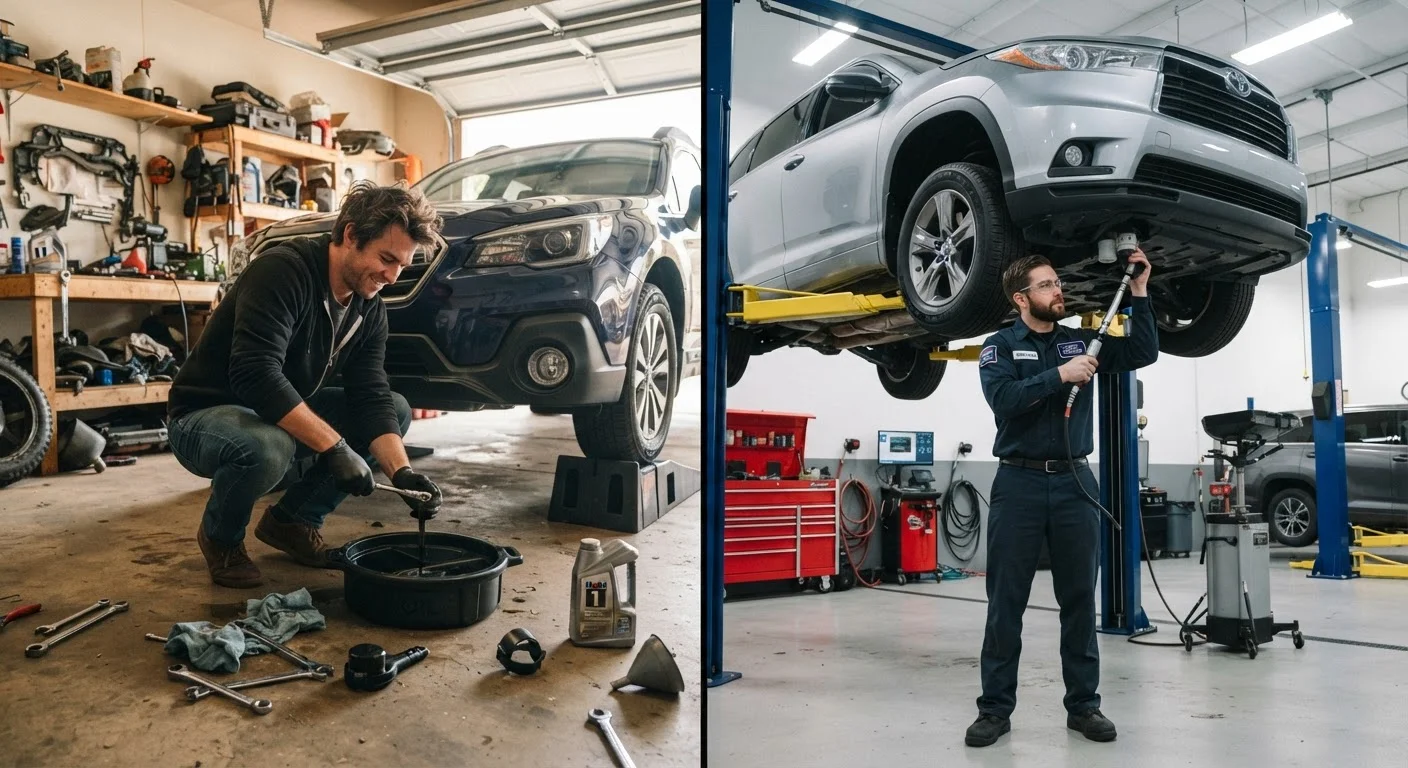
Key Takeaways
- DIY maintenance can save money on simple tasks like oil changes, air filters, and wiper blades.
- Safety-critical systems - brakes, steering, suspension - should generally be handled by a qualified mechanic.
- Mistakes on complex repairs can cost far more than the professional labor you were trying to avoid.
- Your vehicle's warranty terms may require documented professional service for certain maintenance items.
Eliminates labor markup on routine service tasks
Shop labor rates typically range from $80 to $150 per hour or more depending on location and shop type. Handling straightforward tasks yourself removes this cost entirely.
Builds familiarity with your specific vehicle
Performing your own maintenance gives you direct insight into your car's condition - you may notice worn belts, leaking seals, or loose connections that a quick shop visit might miss.
Flexible scheduling on your own timeline
DIY work doesn't require booking an appointment or waiting in a service queue, which can be especially useful for time-sensitive fluid top-offs or minor fixes.
Low barrier for a defined set of basic tasks
Jobs like replacing air filters, wiper blades, or battery terminals require minimal tools and are well-documented in owner's manuals and manufacturer service guides.
Safety-critical errors can have serious consequences
Improperly installed brake components or incorrectly torqued wheel fasteners can fail while driving. The risk is not theoretical - these are the types of errors that cause accidents.
Specialty tools add upfront cost
Many jobs beyond basic maintenance require equipment that can cost as much as - or more than - simply paying a shop for the work, especially if the tool is only needed once.
Incorrect diagnosis leads to wasted parts spending
Without professional diagnostic equipment and training, it's easy to replace components that aren't actually faulty, compounding the cost rather than reducing it.
Warranty documentation requirements may not be met
Some manufacturers require service records from a qualified facility to validate warranty claims; DIY work without adequate documentation can complicate this process.
Our Verdict
DIY car maintenance makes financial sense for routine, low-risk tasks where the learning curve is shallow and the tools are affordable. For anything involving brakes, steering, fuel systems, or advanced diagnostics, professional service is the safer and often more cost-effective choice in the long run. A hybrid approach - handling the easy stuff yourself while budgeting for professional work on complex jobs - tends to deliver the best balance of savings and peace of mind.
Drivers who are comfortable with basic tools, have reliable access to vehicle-specific repair guides, and want to reduce routine maintenance costs without taking on undue safety risk.
Why This Decision Matters for Your Car Budget
Ongoing maintenance is one of the most controllable costs in car ownership, yet many drivers either overpay for jobs they could safely do themselves or underestimate the risk of tackling work that's beyond their skill level. Neither extreme serves your wallet - or your safety.
The core question isn't really "mechanic or DIY?" It's task-by-task: what does this specific job actually require? Complexity, tools, safety risk, and the consequence of an error all vary enormously from one maintenance item to the next. For a broader look at what to expect across the full ownership lifecycle, see the car ownership checklist for first-time buyers.
$500-$700
Estimated average annual vehicle maintenance cost
AAA's ongoing vehicle cost research has consistently placed routine maintenance in this range for a typical passenger car, though costs vary widely by vehicle type and age.
40-50%
Share of a typical repair bill that is labor
Industry estimates suggest labor regularly makes up roughly half of most repair invoices, which is the primary cost DIY maintenance eliminates on suitable tasks.
What DIY Maintenance Can Realistically Save You
Several routine tasks are genuinely straightforward for most drivers with basic mechanical comfort. Engine air filter replacement, cabin air filter swaps, wiper blade changes, and topping off fluids like coolant and windshield washer fluid typically require only a few minutes and simple tools. Oil changes fall into this category for many drivers, though they do require disposing of used oil responsibly through a recycling facility.
Labor accounts for a significant portion of most shop bills. Doing these simpler jobs yourself removes that markup entirely. The savings per job may seem modest - often $20 to $60 - but across several services a year, the totals add up meaningfully.
Eliminates labor markup on routine service tasks
Shop labor rates typically range from $80 to $150 per hour or more depending on location and shop type. Handling straightforward tasks yourself removes this cost entirely.
Builds familiarity with your specific vehicle
Performing your own maintenance gives you direct insight into your car's condition - you may notice worn belts, leaking seals, or loose connections that a quick shop visit might miss.
Flexible scheduling on your own timeline
DIY work doesn't require booking an appointment or waiting in a service queue, which can be especially useful for time-sensitive fluid top-offs or minor fixes.
Low barrier for a defined set of basic tasks
Jobs like replacing air filters, wiper blades, or battery terminals require minimal tools and are well-documented in owner's manuals and manufacturer service guides.
Where DIY Carries Real Risk
Not all maintenance is created equal. Brake system work - pads, rotors, calipers, brake fluid flushes - directly affects your ability to stop the vehicle. Errors here can have serious consequences on the road. Suspension and steering components likewise involve geometry and torque specifications that, if wrong, can cause unpredictable handling. Fuel system work introduces fire risk if done incorrectly.
Advanced diagnostics for warning lights also present a challenge. While an inexpensive OBD-II scanner (a device that reads your car's onboard computer) can retrieve a fault code, interpreting that code accurately and identifying the real root cause often requires professional equipment and experience. Replacing parts based on a misread code is a common and expensive DIY mistake.
Safety-critical errors can have serious consequences
Improperly installed brake components or incorrectly torqued wheel fasteners can fail while driving. The risk is not theoretical - these are the types of errors that cause accidents.
Specialty tools add upfront cost
Many jobs beyond basic maintenance require equipment that can cost as much as - or more than - simply paying a shop for the work, especially if the tool is only needed once.
Incorrect diagnosis leads to wasted parts spending
Without professional diagnostic equipment and training, it's easy to replace components that aren't actually faulty, compounding the cost rather than reducing it.
Warranty documentation requirements may not be met
Some manufacturers require service records from a qualified facility to validate warranty claims; DIY work without adequate documentation can complicate this process.
When a Warning Light Appears
A dashboard warning light doesn't always mean an emergency, but it also shouldn't be ignored or reset without understanding what triggered it. An OBD-II scanner can pull a fault code in seconds, but the code describes a symptom, not necessarily the cause. For any light related to brakes, airbags, or engine misfires, a professional diagnosis is generally the prudent first step before attempting any repair yourself.
Hidden Costs That Can Offset DIY Savings
Tools are the most obvious upfront investment. Some jobs require specialty tools - a torque wrench, a brake caliper piston tool, or a specific socket set - that you may only use once. Factor those costs honestly before assuming DIY is cheaper.
Time is another real cost. A shop might complete a job in 45 minutes; a first-time DIYer can spend an afternoon on the same task. If a bolt strips or a part is installed incorrectly, a return trip to a mechanic to undo the damage can erase any savings entirely.
Finally, check your warranty. New vehicles often require documented, professional maintenance at specified intervals to preserve powertrain or other warranty coverage. Performing DIY service doesn't automatically void a warranty, but failing to keep records that satisfy the manufacturer's requirements can complicate a future warranty claim. For strategies that balance cost savings with smart upkeep, see keeping maintenance costs down without cutting corners on safety.