

Key Takeaways
- Your hand is a built-in, always-available tool for estimating appropriate portion sizes.
- Visual reference guides make portion awareness practical without requiring tracking apps or scales.
- Eating slowly and using smaller plates naturally supports better portion control.
- Understanding portions complements — not replaces — overall balanced eating habits.
- Consistent awareness over time matters more than precision at every single meal.
What you will need
Why Portion Awareness Matters More Than Calorie Math
Most people understand that what they eat matters — but how much they eat is often harder to gauge. Calorie counting can work as a tool, but for many people it's unsustainable, stressful, and disconnected from real-life eating. Portion awareness offers a middle path: building a reliable, intuitive sense of how much you're eating without requiring apps, scales, or meticulous logging.
Research consistently shows that portion sizes in restaurants, packaged foods, and even home cooking have grown significantly over the decades — a phenomenon sometimes called "portion distortion." When large amounts become normalized, it becomes harder to recognize what a reasonable amount actually looks like. This isn't about blame or willpower; it's about recalibrating a sense that has drifted for most of us.
Importantly, portion awareness works best as part of a broader approach to nourishment. If you've noticed that good intentions at mealtimes don't always translate to the outcomes you hope for, our article on why good intentions at mealtime sometimes fall short explores some of the quieter patterns that get in the way.
This Is General Information, Not Medical Advice
The guidance in this article is meant for general educational purposes. Everyone's nutritional needs vary based on age, health status, activity level, and other individual factors. If you have a chronic condition, are pregnant, or have specific dietary concerns, please consult a registered dietitian or your healthcare provider before making changes to how you eat.
Practical Tools and Steps to Get Started
The following steps give you a concrete, low-pressure system for building portion awareness starting today. You'll need very little — mostly your attention and a willingness to practice a few simple habits consistently.
What you will need
Your Hand
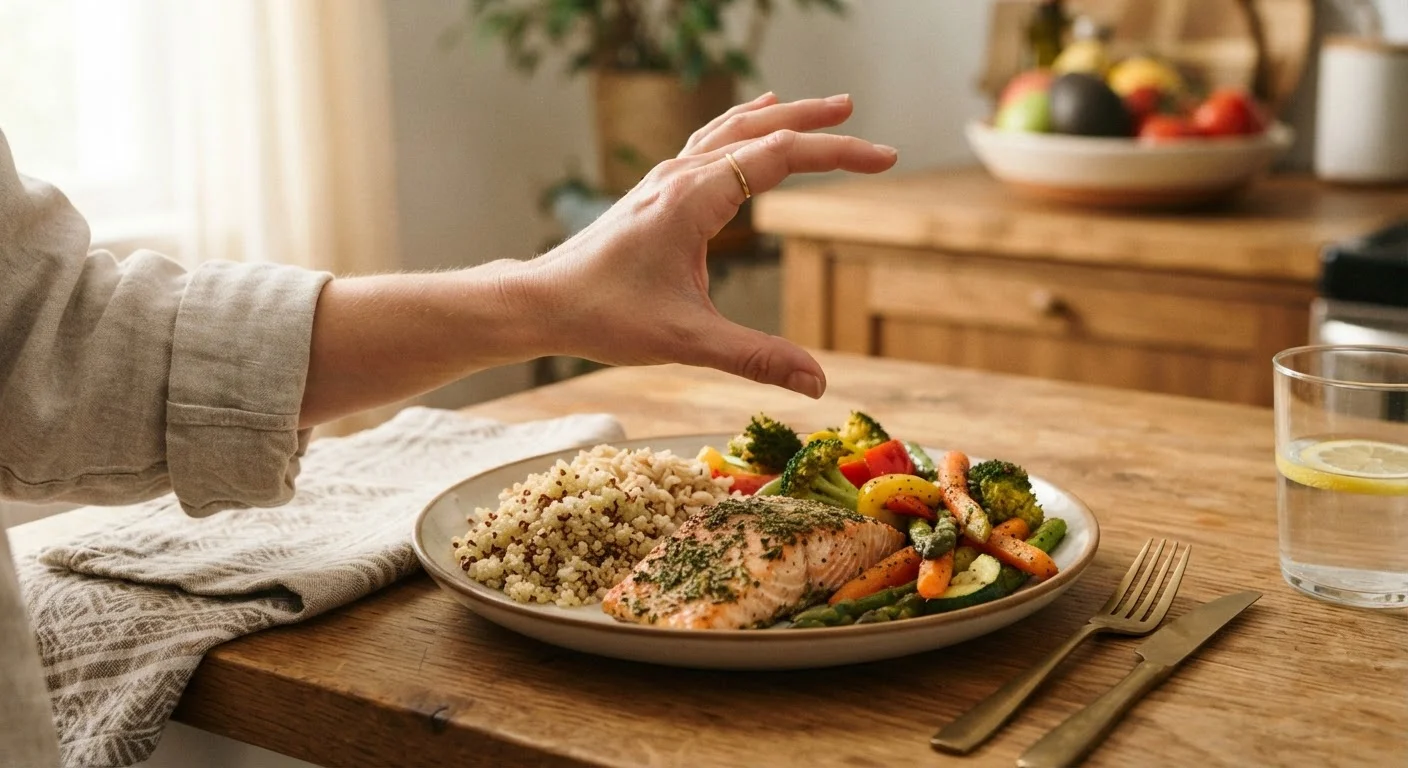
Acts as a built-in measuring guide for proteins, grains, vegetables, and fats — always with you, always scaled to your body.
Standard Dinner Plate (9-inch)
A smaller plate naturally limits how much you can serve yourself, reducing the tendency to overfill.
Measuring Cups (for reference only)
Useful for calibrating your visual estimates a few times so you build an accurate mental picture.
Nutrition Label Guide
Helps you understand what a stated serving size actually looks like for packaged foods.
Learn the Hand-Based Reference Guide
Your hand naturally scales to your body size, making it a remarkably useful measuring tool. Use these general reference points as starting anchors:
- Palm (no fingers): roughly one serving of protein, such as fish, chicken, or beans
- Closed fist: approximately one cup — useful for grains, pasta, or raw vegetables
- Cupped hand: about half a cup — helpful for cooked vegetables or fruit
- Thumb: close to one tablespoon — think nut butters, oils, or salad dressings
- Fingertip: roughly one teaspoon — good for butter or condiments
These are approximations, not exact measurements. The goal is a reliable mental map, not laboratory precision.
Use the Plate Method as a Visual Template
The Plate Method, widely promoted by nutrition organizations including the USDA, gives you an easy visual framework without any counting. When filling your plate, aim for roughly:
- Half the plate: non-starchy vegetables (leafy greens, broccoli, peppers, carrots)
- One quarter: lean protein (poultry, fish, legumes, eggs, tofu)
- One quarter: whole grains or starchy foods (brown rice, quinoa, sweet potato, whole-wheat bread)
A small side of healthy fat — like a drizzle of olive oil or a few slices of avocado — rounds things out. This approach structures your plate proportionally rather than by weight, making it intuitive and sustainable.
Read Packaged Food Labels for Serving Context
When eating packaged or processed foods, the nutrition label is your clearest reference point. Before eating, check the serving size listed — this tells you what all the nutritional values are based on. A bag of crackers might list a serving as 15 crackers, but many people eat significantly more without realizing it.
You don't need to track every gram. Simply glancing at the serving size and comparing it to what you're actually plating creates useful awareness over time. Our guide to reading nutrition labels walks through how to interpret those numbers quickly and confidently.
Slow Down and Notice Hunger Signals
Portion control isn't only about what's on your plate — it's also about giving your body time to register fullness. It takes roughly 15–20 minutes for satiety signals to travel from your stomach to your brain. Eating quickly bypasses this feedback loop entirely.
A few practical habits that help:
- Put your fork down between bites
- Take a two-minute pause midway through your meal and check in with how you actually feel
- Avoid eating while distracted by screens — distraction is consistently linked to eating more
These habits support the portion work you've already done and are a natural complement to balanced eating on a busy schedule.
Build Portion Awareness Into Your Routine Gradually
Lasting habits form through repetition, not willpower. Rather than overhauling every meal at once, apply one or two of these strategies consistently until they feel automatic, then add another. Start with whichever feels least disruptive — perhaps just using the Plate Method at dinner — before expanding to other meals.
If food budget is part of your consideration, better portion awareness often has a positive side effect: less waste and more meals from the same groceries. Our guide to stretching a grocery budget explores this connection further.
Consistency Beats Perfection Every Time
You don't need to nail portions at every single meal. Research consistently suggests that overall dietary patterns over days and weeks matter more than any one meal. If you overeat at lunch, simply return to your normal awareness at dinner — no guilt needed.
Avoid Turning Awareness Into Anxiety
Portion awareness is meant to reduce stress around food — not increase it. If monitoring your food intake starts to feel compulsive or distressing, that's a signal to pause and speak with a healthcare professional. Healthy eating should support your wellbeing, not undermine it.
This article is for general informational and educational purposes only and does not constitute medical or dietary advice. Individual nutritional needs vary. Please consult a qualified healthcare provider or registered dietitian for guidance specific to your health circumstances.