

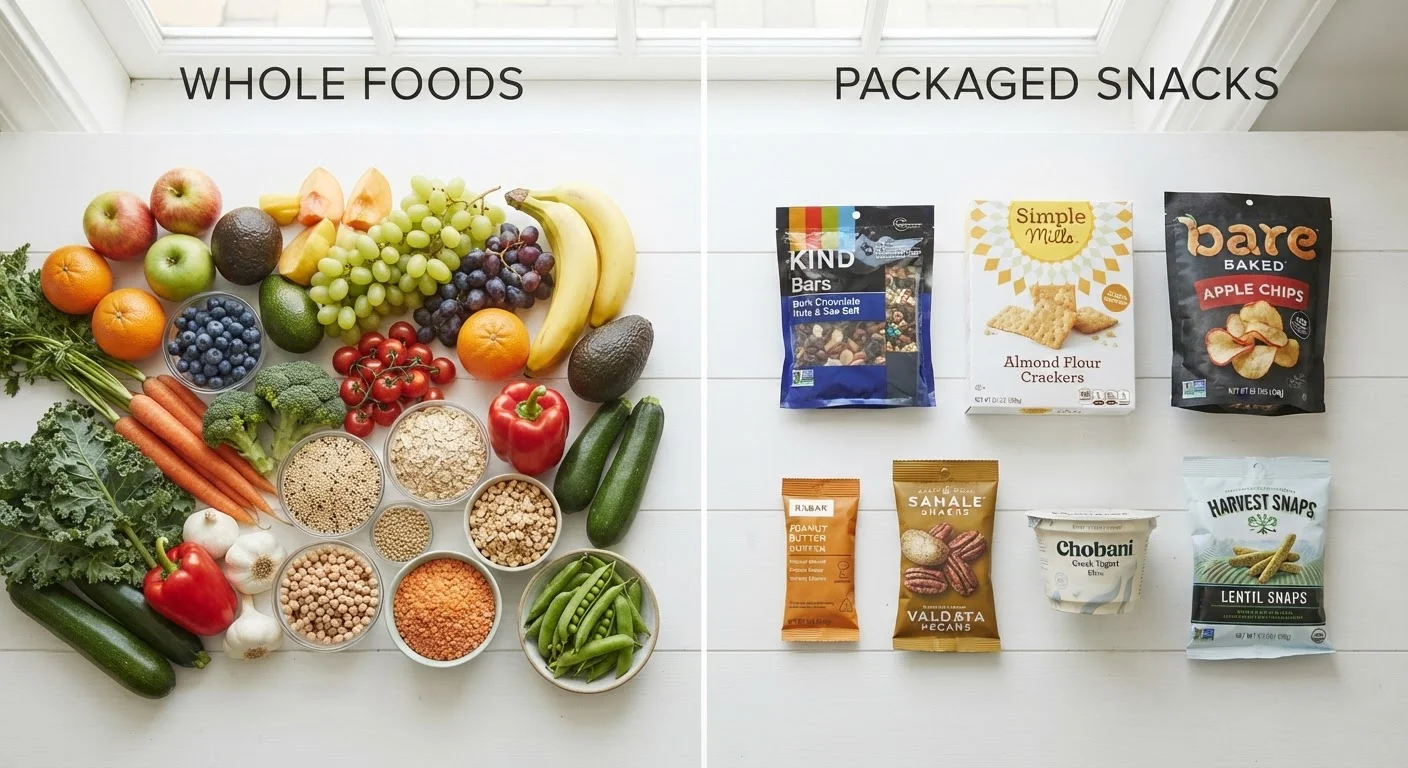
Key Takeaways
- Whole foods retain most of their natural nutrients, fiber, and beneficial plant compounds.
- Processing exists on a spectrum — not all processed foods carry the same nutritional drawbacks.
- Ultra-processed foods are linked in research to higher intakes of sodium, added sugars, and refined fats.
- Balancing both categories thoughtfully is more realistic and sustainable than eliminating one entirely.
- Reading nutrition labels helps you identify where a processed food falls on the quality spectrum.
Option A
Whole Foods
Minimally altered, nutrient-dense foods as nature provides them.
Best for: People building a foundation of consistent, balanced nutrition through everyday meals.
Option B
Processed Foods
Convenient, shelf-stable options that vary widely in nutritional quality.
Best for: Busy households balancing time and budget constraints, particularly when choosing minimally processed options.
If you want to maximize nutrient density per calorie
Whole Foods
Whole foods deliver vitamins, minerals, fiber, and antioxidants with minimal added sodium or sugar — hard to replicate in highly processed alternatives.
If convenience and shelf life are non-negotiable for your household
Processed Foods
Minimally processed options like canned legumes, frozen vegetables, or oats offer genuine nutritional value with far greater practicality.
If you're building long-term, sustainable eating habits
Whole Foods
Research consistently associates diets rich in whole foods with better long-term health outcomes, as noted in broad dietary pattern studies.
If you're on a tight budget and time is limited
Processed Foods
Strategically chosen processed foods — frozen produce, dried beans, whole-grain bread — stretch grocery budgets without sacrificing core nutrition.
What Do These Terms Actually Mean?
The terms "whole foods" and "processed foods" get used constantly, but they're not always well defined. Whole foods are foods in their natural or near-natural state — think fresh vegetables, fruit, eggs, plain nuts, legumes, and unrefined grains. They haven't been significantly altered from how they occur in nature, so their original nutrient profile stays largely intact.
Processed foods cover a wide range. The NOVA classification system, developed by nutrition researchers, sorts foods into four groups from minimally processed (frozen peas, pasteurized milk) to ultra-processed (packaged snack cakes, flavored chips). The key insight: processing itself isn't automatically harmful — pasteurizing milk makes it safer; freezing vegetables preserves nutrients. The concern rises with ultra-processed foods, which typically contain additives, refined ingredients, and formulations designed to encourage over-consumption.
Understanding this spectrum is the starting point for making sense of nutrition labels and dietary guidance. For a deeper look at how common nutrition claims can mislead, see this guide to misunderstood nutrition facts.
Head-to-Head: Key Nutritional Differences
The nutritional gap between whole and processed foods becomes clearest when you compare specific attributes side by side.
| Criterion | Whole Foods | Processed Foods |
|---|---|---|
| Fiber content | Generally high; intact | Often reduced or removed |
| Added sugars | Absent or minimal | Frequently added, especially ultra-processed |
| Sodium levels | Naturally low | Often significantly elevated |
| Vitamins & minerals | Naturally present; varied | May be partially lost; sometimes re-added |
| Antioxidants & phytonutrients | Abundant in plant foods | Often diminished with processing |
| Shelf life | Generally shorter | Extended via preservatives or packaging |
| Convenience | Requires more prep time | Ready to eat or quick to prepare |
Fiber is a useful illustration. A medium apple contains roughly 4–5 grams of fiber along with vitamins and antioxidants. Commercially produced apple juice — even 100% juice — typically has the fiber stripped away and delivers a more concentrated sugar load without the satiating bulk. Similarly, whole-grain oats contain beta-glucan (a type of soluble fiber) that influences cholesterol metabolism; a heavily sweetened instant oat packet may retain some grain but adds significant sugar in the process.
57%
Share of U.S. calories from ultra-processed foods
Research published in BMJ Open estimated that ultra-processed foods account for roughly 57% of energy intake among U.S. adults.
~70%
Of U.S. sodium intake from processed/restaurant foods
The CDC has noted that most sodium in the American diet comes from packaged, processed, store-bought, and restaurant foods rather than home cooking.
2–3x
Higher fiber intake linked to whole-food diets
Dietary surveys consistently show that people eating predominantly whole foods report fiber intakes closer to recommended levels than those with high ultra-processed food consumption.
Sodium is another marker worth tracking. Many canned soups, frozen entrees, and packaged snacks contain sodium levels that account for a substantial portion of the daily amount most health organizations suggest as reasonable. Whole foods — fresh produce, unprocessed proteins — contain naturally occurring sodium at much lower levels.
Where Processed Foods Fit in a Realistic Diet
Nutrition education sometimes frames whole versus processed as a strict moral binary, but everyday eating rarely works that way. Most households rely on some processed foods — and that's not inherently problematic. Canned tomatoes, frozen broccoli, plain yogurt, whole-grain bread, and canned beans are all technically processed, yet each contributes real nutritional value.
The practical question isn't whether a food is processed, but how extensively it's been processed and what's been added or removed. Checking the ingredient list offers useful information: a shorter list of recognizable ingredients generally signals less intensive processing. High placement of added sugars, sodium, or partially hydrogenated oils in the ingredient list is worth noting.
The 'Natural' Label Isn't a Guarantee
Foods labeled 'natural' are not subject to a strict regulatory definition by the FDA for most products. A food can carry that label and still contain added sugars, refined oils, or high sodium. Checking the Nutrition Facts panel and the ingredient list gives you more reliable information than front-of-package claims alone.
If you're curious about how different eating approaches incorporate these principles, research-supported eating patterns offer a helpful frame. For practical grocery planning, weekly grocery planning for nutritional balance provides a structured starting point.
This article is for general informational and educational purposes only and is not a substitute for personalized medical or nutrition advice. Consult a qualified healthcare professional or registered dietitian for guidance tailored to your individual health needs.