

Key Takeaways
- Pre-qualification relies on self-reported financial information and involves no credit check or document review.
- Pre-approval requires verified income, assets, and a hard credit pull — making it far more credible to sellers.
- In competitive markets, many sellers will not consider offers from buyers without a pre-approval letter.
- Pre-approval letters typically expire within 60 to 90 days, so timing matters.
- Neither letter guarantees final loan approval — the underwriting process happens after an offer is accepted.
Option A
Pre-Qualification
The quick, self-reported starting point.
Best for: First-time buyers who want a rough idea of their budget before diving into serious house hunting.
Option B
Pre-Approval
The lender-verified, document-backed commitment.
Best for: Buyers ready to make competitive offers and demonstrate genuine purchasing power to sellers.
If you're just starting to explore what you might afford
Pre-Qualification
Pre-qualification gives you a low-effort ballpark figure with no impact on your credit score, making it a useful first step.
If you're ready to tour homes and make offers
Pre-Approval
Pre-approval signals to sellers and agents that your finances have been verified, dramatically strengthening your offer in any market.
If you're buying in a competitive or low-inventory market
Pre-Approval
Sellers in fast-moving markets routinely pass over pre-qualified buyers. A pre-approval letter is often the minimum threshold for serious consideration.
What Each Term Actually Means
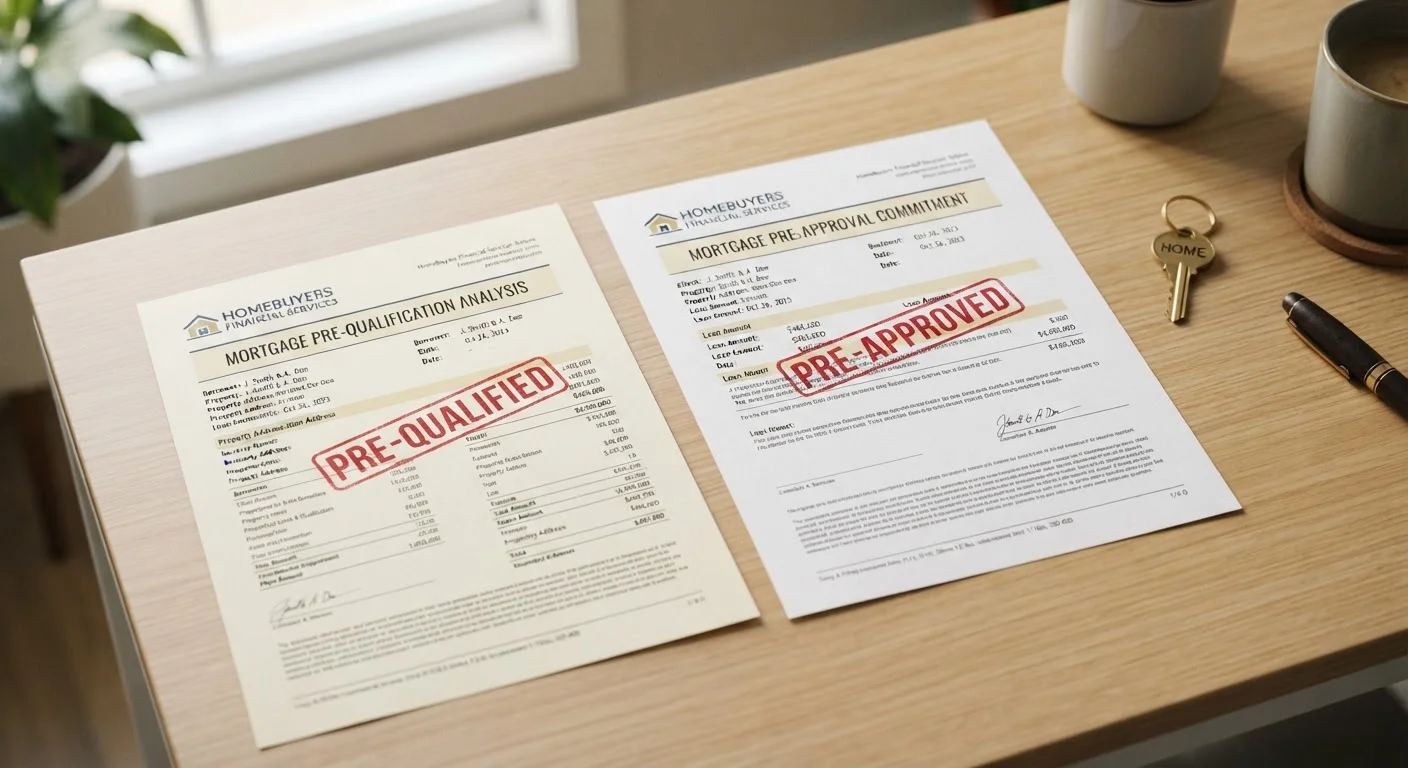
These two terms are often used interchangeably in casual conversation, but lenders and sellers treat them very differently. Understanding the distinction before you start touring homes can save you from losing out on a property you love.
Pre-qualification is an informal estimate of how much you might be able to borrow. A lender asks you — verbally or through an online form — about your income, debts, and assets. No documents are required, and typically no credit check is run. The resulting figure is a rough estimate, not a commitment. It tells you where to start, not where you stand.
Pre-approval is a formal review. The lender collects documentation — pay stubs, W-2s, tax returns, bank statements — and runs a hard credit inquiry. An underwriter or automated system evaluates your actual financial profile. If approved, you receive a conditional commitment letter stating the loan amount you qualify for, subject to finding an eligible property and completing full underwriting.
Think of pre-qualification as a self-assessment and pre-approval as an audit. One is something you tell a lender; the other is something a lender verifies.
| Criterion | Pre-Qualification | Pre-Approval |
|---|---|---|
| Information Required | Self-reported income, debts, assets | Verified documents (pay stubs, tax returns, bank statements) |
| Credit Check | Usually soft inquiry or none | Hard credit inquiry |
| Time to Complete | Minutes to hours | 1–3 business days |
| Weight with Sellers | Low — unverified estimate | High — lender-verified commitment |
| Expires | No formal expiration | Typically 60–90 days |
| Loan Guarantee? | No | No — final approval still required |
Why Sellers and Agents Care
From a seller's perspective, a pre-qualification letter provides little reassurance. Because the information is unverified, a buyer could be overstating their income or underestimating their debt — meaning the deal could fall apart once a lender looks at the actual numbers.
A pre-approval letter, by contrast, means a lender has already done the vetting. Sellers know the buyer's finances have been reviewed and that financing is far more likely to close. In markets where multiple offers are common, listing agents routinely advise sellers to decline or deprioritize offers that arrive without a pre-approval.
60–90
Days a typical pre-approval letter remains valid
Most mortgage lenders issue pre-approval letters valid for 60 to 90 days before requiring updated financial documentation.
3–5 pts
Approximate credit score impact of a hard inquiry
According to FICO, a single hard inquiry typically lowers a credit score by fewer than five points for most consumers.
For buyers, this distinction also affects negotiating posture. A pre-approved buyer can move quickly when the right home appears, which matters in markets where desirable properties attract offers within days of listing. See our guide to homeownership costs to understand the full financial picture before committing to a loan amount.
The Process, Timing, and What to Watch For
Pre-qualification can often be completed in minutes through a lender's website. Pre-approval typically takes one to three business days, depending on how quickly you can gather and submit documentation and how busy the lender is.
Key considerations:
- Credit impact: Pre-qualification usually involves a soft inquiry (no score impact). Pre-approval involves a hard inquiry, which may temporarily lower your credit score by a few points. Multiple hard inquiries from mortgage lenders within a 14- to 45-day window are generally treated as a single inquiry by scoring models — so shopping lenders won't compound the impact significantly.
- Expiration: Pre-approval letters typically expire in 60 to 90 days. If your home search extends beyond that window, you'll need to renew — which may require updated documents.
- Conditions still apply: A pre-approval is not a loan guarantee. Final approval depends on the property appraising at or above the purchase price, a clear title search, and no significant changes to your financial situation before closing.
Before submitting any loan applications, it helps to run through a structured financial checklist. Our pre-purchase checklist can help you confirm your finances are in order.
Shopping Multiple Lenders Is Smart
Getting pre-approved by more than one lender allows you to compare interest rates, fees, and loan terms — which can meaningfully affect your total borrowing cost. Credit scoring models generally treat multiple mortgage-related hard inquiries made within a short window (14 to 45 days, depending on the model) as a single inquiry, so comparison shopping has a limited effect on your score.
This article is for general informational purposes only and does not constitute financial, mortgage, or legal advice. Speak with a licensed mortgage professional or financial adviser to evaluate your specific situation.