

Key Takeaways
- Start with your net (take-home) income, not your gross salary, as your baseline figure.
- Separating fixed expenses from variable ones makes it easier to find room to cut.
- Assigning every dollar a category — including savings — closes the gaps that lead to overspending.
- A budget is a living document; reviewing it monthly is what makes it stick.
- You do not need specialist software — a notebook or free spreadsheet works perfectly.
What you will need
Why a Monthly Budget Matters
A monthly budget is simply a plan that tells your money where to go instead of wondering where it went. Without one, it's easy to feel like income disappears without explanation — even when earnings are adequate. Research in personal finance consistently links deliberate spending plans to reduced financial stress and stronger progress toward goals like an emergency fund, debt reduction, or a home purchase.
If saving for a home is on your horizon, solid budgeting is a foundational step — see the guide to buying a home for how financial readiness fits into that process.
Use the 50/30/20 Framework as a Starting Point
Many personal finance educators suggest allocating roughly 50% of take-home pay to needs, 30% to wants, and 20% to savings and debt repayment. Think of this as a reference point rather than a rigid rule — your actual splits will depend on income, location, and goals. For a deeper look at what these ratios mean in practice, see how household budget ratios work.
Budgets don't require complex software or a finance background. The core skill is simply knowing what comes in and making deliberate decisions about where it goes. The six steps below walk you through exactly that.
What You'll Need Before You Start
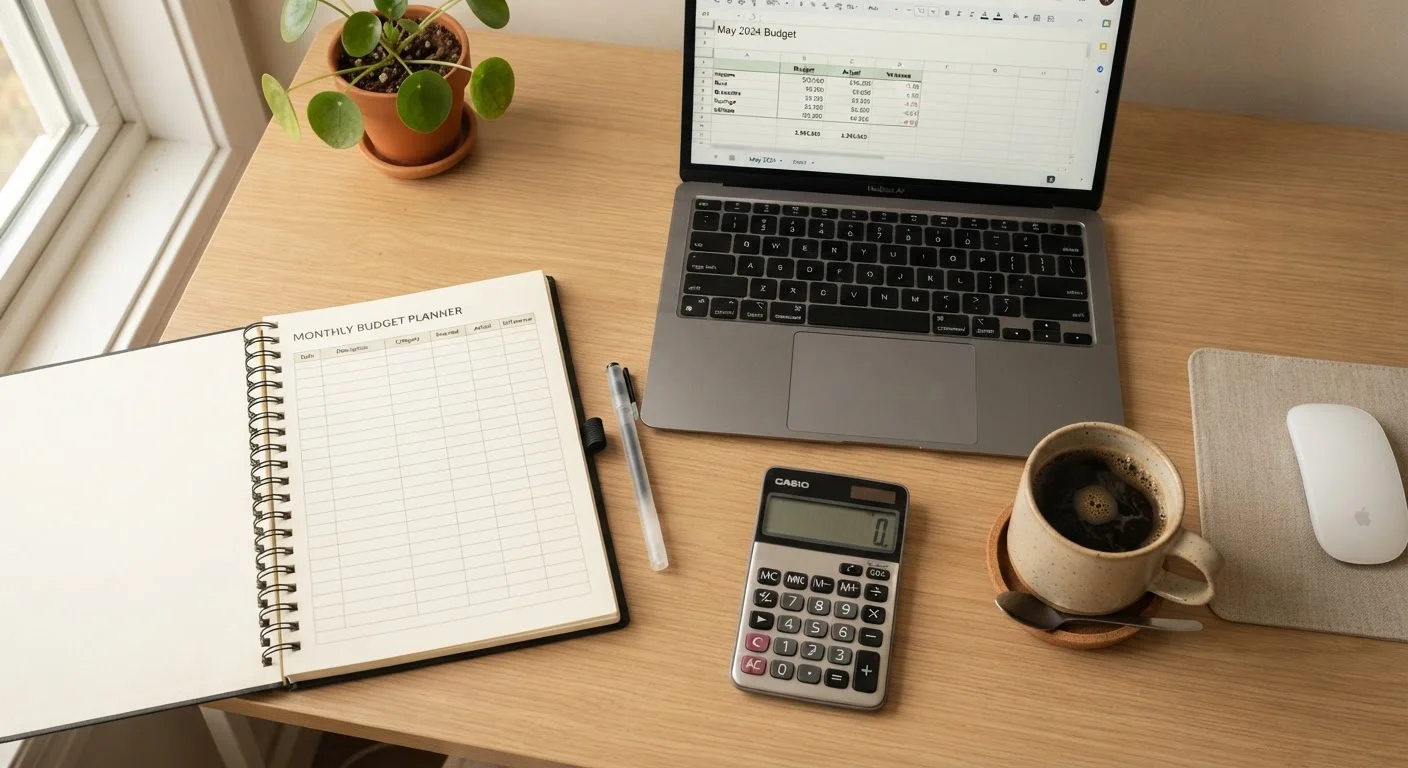
Gather your materials before sitting down to build the budget — having everything on hand prevents you from stopping halfway through.
What you will need
Bank or credit card statements
Reveal actual spending patterns across recent months so categories reflect reality.
Spreadsheet (e.g. Google Sheets or Excel)
Organises income and expense rows, calculates totals automatically, and is easy to update.
Calculator
Helps convert annual or weekly figures into monthly equivalents.
Pen and paper
A perfectly adequate low-tech alternative to a digital spreadsheet for drafting your first budget.
This Is Education, Not Personalised Advice
This article provides general financial information for educational purposes only. It is not tailored financial, tax, or legal advice. Every household's situation is different. For guidance specific to your circumstances, consult a qualified financial professional.
The Six Steps
Follow these steps in order. Each one builds on the last, so skipping ahead can leave gaps that undermine the whole plan.
Calculate your total monthly take-home income
List every source of money that lands in your account each month: wages, freelance payments, side income, benefits, and any regular transfers. Use net income — the amount after taxes and deductions — not your gross salary. If your income varies month to month, average your last three months and use that figure as a conservative baseline.
List all fixed monthly expenses
Fixed expenses are costs that stay the same every month: rent or mortgage, loan repayments, insurance premiums, and subscriptions. Write down each one with its exact amount. These are non-negotiable line items — they must be covered before anything else is allocated.
Estimate variable and discretionary spending
Variable expenses fluctuate month to month: groceries, gas, dining out, clothing, and entertainment. Pull up two or three months of statements and average each category. Be honest — underestimating here is the most common reason first budgets fail.
Assign a savings and debt-repayment line
Treat savings and any extra debt repayment as fixed expenses, not what's left over. Decide on a monthly savings target — even a modest amount builds the habit. If you carry high-interest debt, allocate a specific payment beyond the minimum. The concept of paying yourself first formalises this idea: fund savings before spending on discretionary items.
Balance income against total expenses
Add up all your fixed, variable, and savings lines. Subtract the total from your monthly take-home income. The result should be zero — meaning every dollar is assigned a purpose. If you have a surplus, decide deliberately where it goes (additional savings, a goal fund). If you're in deficit, revisit variable spending line by line and look for reductions.
Track spending and review at month's end
A budget written once and never checked is just a wish list. During the month, record actual spending in each category — a spending tracker simplifies this considerably. At month's end, compare actuals to your plan, note where you drifted, and adjust the following month's figures. Use the monthly budget review checklist to structure that process.
Don't Forget Irregular Expenses
Annual costs like car registration, holiday gifts, or insurance premiums can wreck a budget if ignored. Divide each by 12 and treat that monthly fraction as a fixed expense so you're never caught off guard.
Keeping the Budget Working Over Time
Setup is just the beginning. Budgets that stick are revisited regularly, adjusted when life changes, and treated as a flexible tool rather than a rigid rulebook. If a category consistently runs over, that's information — it may mean your estimate was off, or it may mean a genuine spending habit to address.
For the practices that help households stay on track beyond the first month, explore habits that keep a budget working long-term. And if you want to go deeper on how spending categories and budget ratios interact, smart spending principles offer useful context.
This article is for general informational and educational purposes only and does not constitute personalised financial advice. Consult a qualified financial professional for guidance tailored to your individual situation.