

Key Takeaways
- Zero-based budgeting assigns every dollar of income a job, ending each month with a balance of zero.
- The envelope method uses physical (or virtual) cash envelopes to cap spending in specific categories.
- Zero-based budgeting works on paper or in apps and suits detail-oriented planners.
- The envelope method is most effective for curbing habitual overspending in daily expense categories.
- Both methods require an honest accounting of monthly income and regular spending review.
- Neither system is universally superior — the right fit depends on your habits and financial goals.
Option A
Zero-Based Budgeting
The meticulous, every-dollar-accounted-for system.
Best for: People who want a detailed, comprehensive plan that assigns every dollar of income to a specific purpose each month.
Option B
The Envelope Method
The tactile, cash-in-hand spending control system.
Best for: People who struggle with overspending on day-to-day categories and benefit from a physical, visible limit on their cash.
If you want total visibility over every dollar you earn and spend
Zero-Based Budgeting
Zero-based budgeting forces you to account for every dollar across all categories — bills, savings, debt, and discretionary spending — giving you a complete financial picture each month.
If you consistently overspend on groceries, dining, or entertainment
The Envelope Method
Physical or virtual envelopes create a hard stop when money runs out, making overspending in problem categories structurally harder to do.
If you prefer a digital or spreadsheet-based budgeting workflow
Zero-Based Budgeting
Zero-based budgeting translates naturally to spreadsheets and budgeting apps, making it easy to track and adjust without handling physical cash.
If you respond better to tangible, concrete spending limits
The Envelope Method
Seeing and touching physical cash — or watching a digital envelope deplete — is a powerful psychological cue that abstract bank balances often are not.
If you have irregular income or variable monthly expenses
Zero-Based Budgeting
Zero-based budgeting is flexible enough to be rebuilt from scratch each month, making it easier to adapt when income or expenses fluctuate significantly.
How Each System Works
Understanding how these two methods function at a mechanical level helps you decide which one fits your real life — not just the theory.
Zero-Based Budgeting (ZBB) starts with your total monthly income and works downward, assigning every dollar to a category until you reach zero. That doesn't mean spending everything — savings, emergency fund contributions, and debt payments each count as a "job" for a dollar. The goal is intentionality: no dollar goes unassigned. You typically rebuild this budget fresh at the start of each month, which makes it especially useful when income or expenses vary. It pairs well with spreadsheets or budgeting apps.
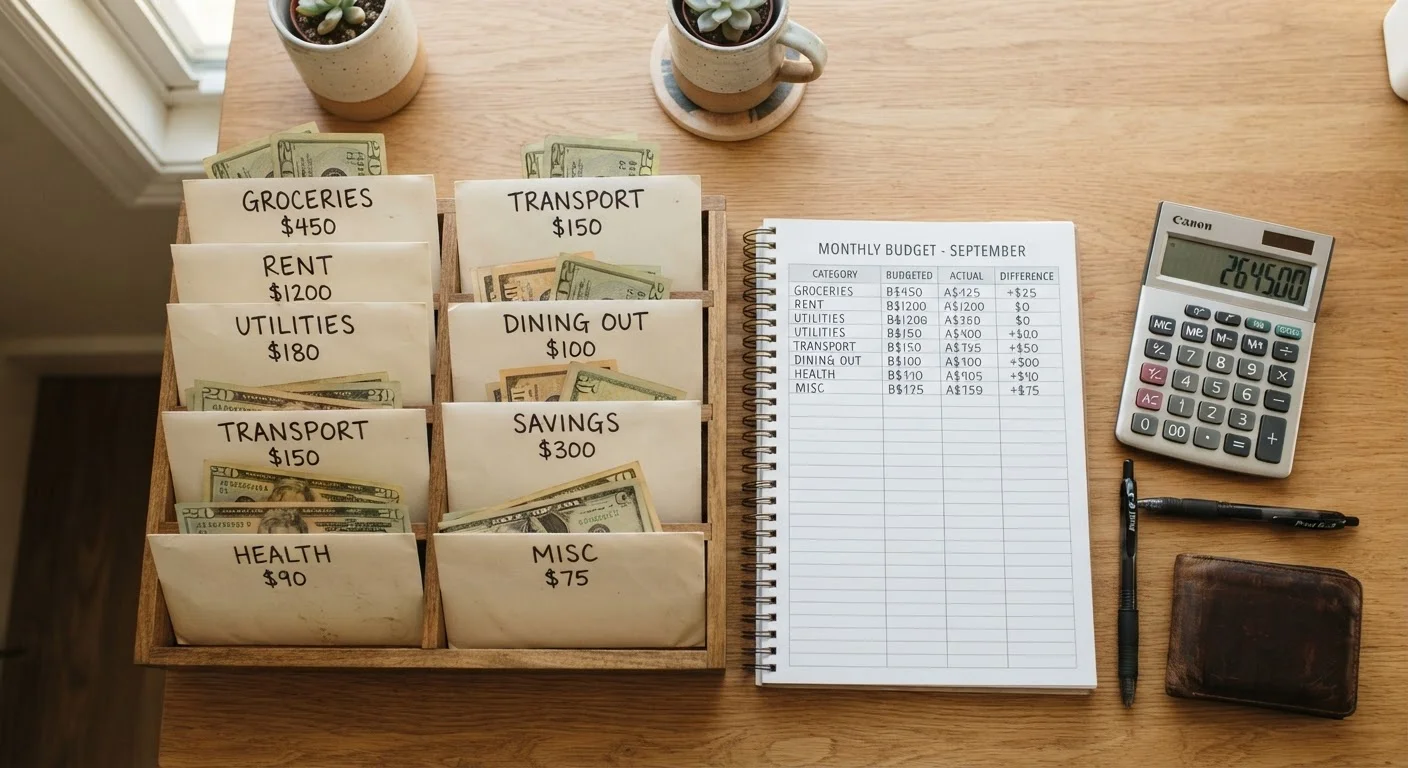
The Envelope Method works differently. After identifying your spending categories — groceries, gas, dining out, entertainment — you withdraw the budgeted cash amount for each and place it in a labeled envelope. When the envelope is empty, spending in that category stops for the month. Some people use a digital version, moving money into virtual sub-accounts or using envelope-style apps instead of physical cash.
Both systems require you to know your monthly income and have a realistic sense of your regular expenses. If you're just getting started, the foundational steps in household budgeting are a helpful place to begin before choosing a method.
| Criterion | Zero-Based Budgeting | The Envelope Method |
|---|---|---|
| Core principle | Assign every dollar a purpose | Cap spending with physical cash limits |
| Best for | Detail-oriented, whole-budget planners | Curbing habitual overspending in daily categories |
| Setup complexity | Moderate — requires full income/expense mapping | Low — start with just a few envelopes |
| Works with digital tools | Yes — spreadsheets and apps | Partially — digital envelope apps exist |
| Handles irregular income | Yes — rebuilt fresh each month | Less easily — works best with predictable income |
| Covers all expense types | Yes — bills, savings, debt, discretionary | Primarily variable, cash-friendly categories |
| Psychological mechanism | Intentional planning and accountability | Tangible, visible spending limits |
Key Differences and Trade-Offs
Each method has genuine strengths — and real limitations worth knowing before you commit.
Zero-based budgeting gives you a comprehensive plan that covers everything: fixed bills, variable spending, savings goals, and debt. Its main drawback is time investment. Building a zero-based budget from scratch each month can take 30–60 minutes, and it requires discipline to revisit and adjust mid-month when reality doesn't match the plan.
The envelope method is simpler to start and creates immediate behavioral friction around overspending. Its limitation is practical: it works best for cash-friendly, variable spending categories. It's less useful for bills paid by automatic transfer, subscriptions, or online purchases. Carrying cash also introduces security considerations that not everyone is comfortable with.
For a broader look at how these and other approaches compare, see the full comparison of common budgeting frameworks. And if you're weighing the general costs and benefits of tightly controlled budgeting, the pros and cons of strict budgeting offers a balanced perspective.
Digital Envelope Apps Are a Middle Ground
If the envelope method appeals to you but carrying physical cash doesn't, digital envelope apps let you allocate money into virtual categories and track depletion in real time. This preserves the psychological benefit of a hard spending cap without requiring cash withdrawals. For a side-by-side look at cash envelopes versus digital tracking tools, see cash envelopes vs. digital budget trackers.
Choosing the Right System for Your Habits
The most effective budgeting method is the one you'll actually use consistently. Consider these practical factors when making your choice.
Use zero-based budgeting if: you have a stable enough income to plan the full month in advance, you're comfortable with numbers and spreadsheets, or you have multiple financial goals — like paying down debt while building an emergency fund — that need careful allocation.
Use the envelope method if: you find it difficult to stay within spending limits on everyday categories, you respond better to concrete cues than abstract numbers, or you're new to budgeting and want to start with just two or three spending categories before expanding.
Some people combine both: a zero-based plan for the overall monthly picture, with envelope-style cash controls for the categories where they tend to overspend most. This hybrid approach is worth considering if neither pure method feels like a perfect fit. Budget-stretching strategies can also help you get more from whichever system you choose.
~30%
Americans with a detailed monthly budget
Gallup polling has consistently found that fewer than one-third of U.S. adults maintain a detailed household budget, suggesting significant room for improvement in personal financial planning.
2x
Likelihood of meeting savings goals with a written plan
Research from financial planning organizations generally finds that people with a written budget or spending plan are substantially more likely to report meeting their savings targets than those without one.
This article is for general informational and educational purposes only and does not constitute personalized financial advice. For guidance tailored to your specific financial situation, consider consulting a qualified financial professional.