
Booking Direct vs. Using a Flight Search Engine: What Changes and What Doesn't

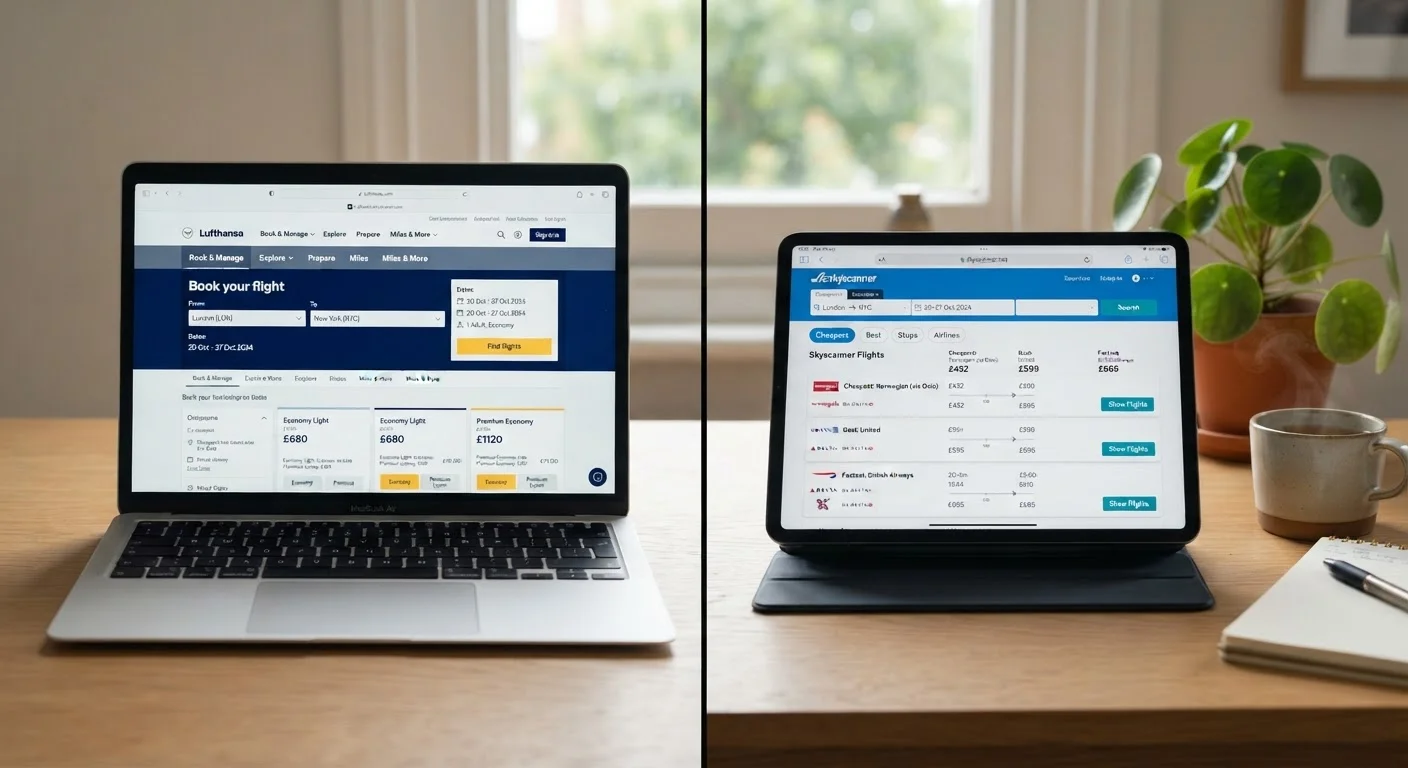
Key Takeaways
- Booking direct with an airline typically gives you cleaner access to customer service and loyalty programs.
- Flight search engines aggregate fares across carriers, making it easier to compare options quickly.
- The lowest displayed fare on a search engine may not reflect total cost once fees are added.
- Some airlines offer fares or perks exclusively through their own websites.
- Disruptions and cancellations are generally easier to resolve when booked directly with the carrier.
- Using both tools together — searching wide, then booking direct — is a practical strategy many travelers use.
Option A
Booking Direct with the Airline
The straightforward, relationship-first approach.
Best for: Travelers who prioritize customer service access, loyalty perks, and easier changes or refunds.
Option B
Using a Flight Search Engine
The wide-net, comparison-first approach.
Best for: Travelers who want to survey multiple airlines and routes in one place before deciding where to buy.
If you're a frequent flyer trying to earn or protect loyalty miles
Booking Direct with the Airline
Direct bookings are more reliably coded to earn loyalty miles and elite qualifying credits; third-party bookings can complicate or block accrual.
If you're comparing multiple routes or airlines for an unfamiliar destination
Using a Flight Search Engine
Search engines let you view dozens of fare combinations simultaneously, saving time you'd otherwise spend checking each airline individually.
If you anticipate needing to change or cancel your ticket
Booking Direct with the Airline
When plans shift, dealing directly with the carrier avoids the middleman layer, which can slow down refunds and rebooking during disruptions.
If you're building a budget trip with flexible dates and multiple stopover options
Using a Flight Search Engine
Search tools with flexible-date calendars surface lower-fare windows across carriers that would take much longer to find manually.
What Each Approach Actually Does
When you book directly with an airline, you're transacting on the carrier's own platform — their website or app. Your booking record lives with them, your payment goes to them, and any service issues are handled by their team. When you use a flight search engine, you're using a third-party tool that pulls fare data from multiple airlines and, in many cases, redirects you to the airline site to complete the purchase — or in some cases, processes the booking itself.
That distinction matters more than most travelers realize. A search engine is primarily a discovery tool. Think of it like a price-comparison lens rather than a store. Some platforms are purely informational and always hand you off to the airline; others act as booking agents and hold your reservation themselves. Knowing which type you're using changes what happens if something goes wrong.
For a broader look at how aggregator tools compare to searching manually, see our guide to price-comparison tools vs. manual searching.
| Criterion | Booking Direct | Flight Search Engine |
|---|---|---|
| Fare coverage | One airline only | Multiple airlines at once |
| Customer service access | Direct, no intermediary | May require going through platform first |
| Loyalty mile accrual | Typically full credit | Varies; sometimes reduced or ineligible |
| Exclusive airline fares | Often available | Not always displayed |
| Flexible-date fare calendar | Available on some airlines | Common feature on most platforms |
| Disruption rebooking | Handled directly by airline | May involve platform as intermediary |
| Total price transparency | Fees shown during checkout | Fees may appear only at click-through |
Where the Real Differences Show Up
Customer service and disruptions. This is where booking direct tends to have a clear edge. If your flight is cancelled or significantly delayed, airlines are required to rebook or refund passengers — but if your ticket was issued by a third party, the airline may refer you back to that intermediary first. That extra step can cost hours during an already stressful situation.
Fare visibility and flexibility. Search engines shine at showing you what's available across the market at a glance. Most have flexible-date tools that let you see a calendar of prices, which is genuinely useful when your travel window has wiggle room. However, not every fare on a search engine is current — data can lag, and the price you click through to may differ slightly from what was displayed.
Loyalty program credit. Most major airlines credit miles when tickets are booked through approved channels. Third-party bookings are sometimes ineligible or earn at a reduced rate depending on the fare class and the platform. If accumulating miles matters to you, confirm mileage eligibility before finalizing through any intermediary.
Exclusive fares. Some carriers offer web-only fares or member-only pricing only through their own site. These won't always appear on aggregators. If you've done your search-engine research, it's worth checking the airline's own site before purchasing.
~30%
Share of US flights booked via OTAs
Industry estimates suggest roughly 30% of US airline tickets are purchased through online travel agencies or aggregators rather than directly through carriers.
2–5%
Potential fare gap between channels
Consumer research has found that direct airline fares and aggregator fares can differ by a few percent in either direction, making channel comparison worthwhile for larger purchases.
What Doesn't Change Regardless of Where You Book
The underlying fare rules — the conditions governing changes, cancellations, and refunds — are set by the airline and travel with the ticket regardless of where you buy it. A non-refundable basic economy fare bought through a search engine is just as non-refundable as one bought on the airline's website. The ticket type is what governs flexibility, not the booking channel.
Similarly, checked baggage fees, seat selection costs, and onboard policies are the same whether you booked direct or through a third party. A search engine that shows a lower headline fare may simply not be displaying ancillary fees upfront. Always compare total costs, not just the base fare. Our pre-booking checklist for evaluating a flight deal walks you through this assessment step by step.
A Note on 'Redirect' vs. 'Agent' Bookings
Some search engines always redirect you to the airline's own site to complete payment — in that case, your booking is directly with the carrier. Others process the reservation themselves, making them the ticketing agent. The distinction affects who you contact if something changes. Look for language like 'you'll be redirected to the airline' versus 'complete your booking here' before entering payment details.
The practical approach many experienced travelers use: search wide using an aggregator to identify competitive fare windows and routes, then check the airline directly before purchasing. For a closer look at how different platforms index fares, see our comparison of flight search tools.
If you're also weighing booking platforms for accommodations, a similar dynamic applies — our direct vs. third-party guide for budget stays covers that trade-off in detail.