

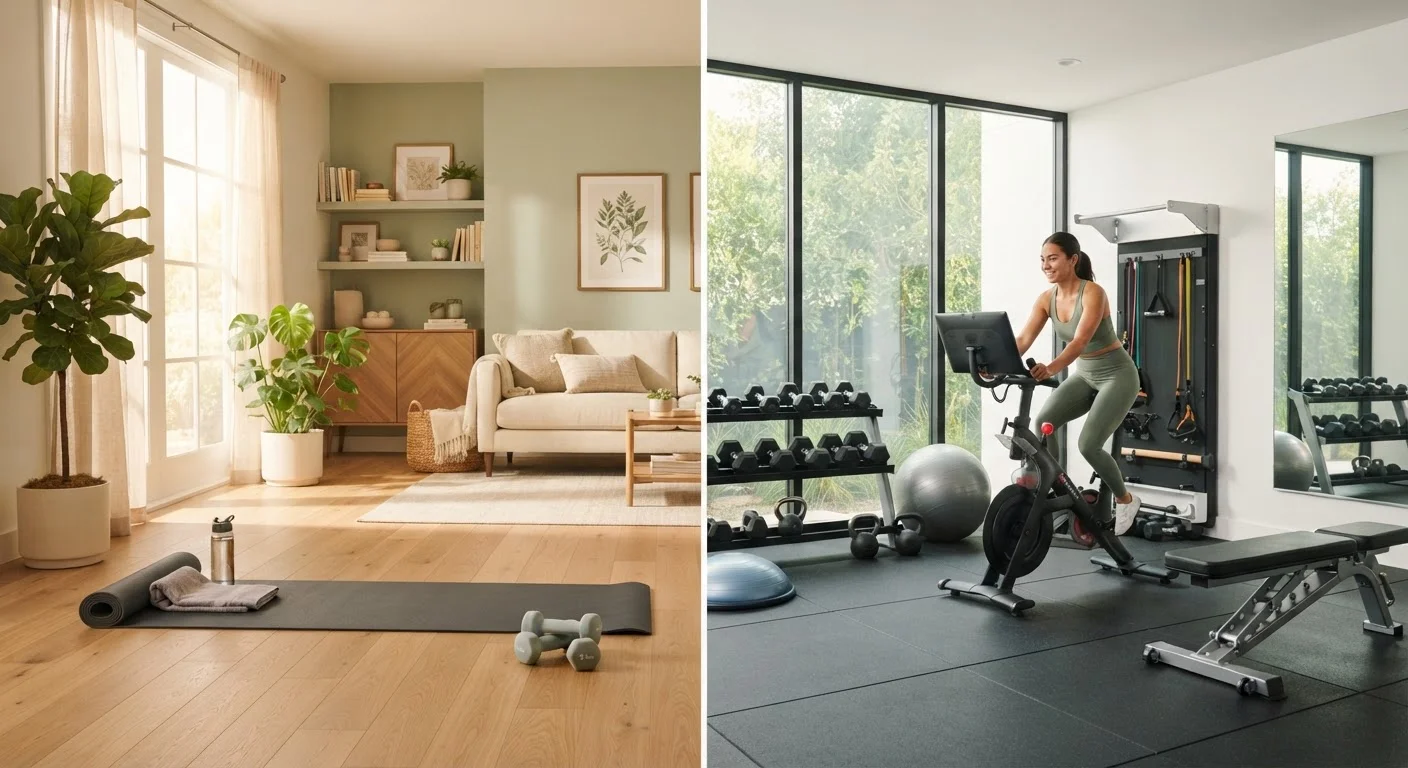
Key Takeaways
- Consistency matters far more than location — the setting you'll actually use regularly wins.
- Home workouts remove commute time and cost barriers, but require self-motivation and some planning.
- Gyms offer a wider range of equipment and a social environment, but come with fees and travel time.
- Both approaches can produce real fitness results when paired with realistic, sustainable habits.
- Your schedule, budget, and personality are the most reliable guides for choosing between the two.
Option A
Home Workouts
The flexible, low-barrier option you can start today.
Best for: People with unpredictable schedules, tight budgets, or a preference for privacy while exercising.
Option B
Gym Sessions
The structured, equipment-rich environment for focused training.
Best for: People who thrive on routine, benefit from variety of equipment, or need external motivation to stay consistent.
If your schedule is unpredictable or you have limited free time
Home Workouts
Eliminating commute time removes the biggest barrier between you and movement. A 20-minute home session you complete beats a gym visit you never make.
If you need variety of equipment to stay engaged
Gym Sessions
Access to cables, machines, free weights, and cardio equipment in one place supports a wider range of training styles and keeps routines from feeling stale.
If budget is a primary concern
Home Workouts
Bodyweight exercises require zero equipment and zero recurring cost. A modest set of resistance bands or adjustable dumbbells can expand options affordably over time.
If external structure and social accountability help you stay consistent
Gym Sessions
Being around others who are exercising can provide meaningful motivation. Group classes and staff support also add structure that's hard to replicate at home.
If you're managing a beginner fitness journey with low confidence
Home Workouts
Starting privately at home removes the self-consciousness many beginners report at gyms, making it easier to build the habit before moving to a more public setting.
Why the Debate Exists — and Why It's More Personal Than You Think
The question of where to work out sounds simple, but it sits at the intersection of budget, lifestyle, personality, and goals. There's no objectively superior answer — and that's actually good news. It means you get to choose what genuinely fits your life rather than conforming to someone else's routine.
It's worth noting upfront that common fitness myths — like the idea that a gym membership is necessary to get results — often create unnecessary pressure before you've even laced up your shoes. The evidence consistently shows that regular, moderate movement in almost any setting supports meaningful health benefits, according to guidance from the CDC and the American College of Sports Medicine.
What the research does emphasize is consistency over perfection. A sustainable routine in a setting you enjoy and return to repeatedly will outperform an intensive plan you abandon after three weeks.
A Note on 'Enough' Exercise
Current public health guidelines generally recommend around 150 minutes of moderate-intensity aerobic activity per week for adults, along with muscle-strengthening activities on two or more days — though individual needs vary. Both home workouts and gym sessions can meet these benchmarks equally well. What the setting can't substitute for is movement itself: neither option works unless you show up regularly. Always consult a healthcare provider about what activity levels are appropriate for your specific health situation.
Head-to-Head: The Real Trade-Offs
Breaking down the two options side by side helps cut through the noise. Neither column is a clean winner — it depends heavily on which factors matter most to you.
| Criterion | Home Workouts | Gym Sessions |
|---|---|---|
| Upfront cost | Low to none (bodyweight) or modest equipment | May require membership joining fee |
| Ongoing cost | None beyond optional equipment | Monthly or annual membership fees |
| Commute time | Zero | Travel to and from the facility |
| Equipment variety | Limited unless you invest significantly | Broad — machines, free weights, cardio |
| Privacy | Complete | Shared, public environment |
| Social motivation | Requires self-direction | Ambient motivation from others present |
| Schedule flexibility | Any time, any day | Bound by facility opening hours |
| Expert guidance access | Via video or online resources | In-person trainers often available |
Cost deserves a closer look because it's rarely straightforward on either side. Home workouts may have upfront costs — a mat, resistance bands, or a set of dumbbells — but no ongoing membership fees. Gym costs vary widely by location and facility type; many community recreation centres and YMCAs offer significantly lower rates than commercial chains, so it's worth researching local options before assuming a gym is unaffordable. For general cost-comparison thinking, comparing prices across options before committing can surface alternatives you didn't know existed.
Making the Most of Home Workouts
Home workouts succeed or struggle largely on structure. Without a scheduled time and a rough plan, it's easy to let sessions drift or disappear entirely. A few practical habits make a real difference:
- Designate a consistent space, even if it's just a cleared patch of floor. A dedicated spot signals to your brain that it's time to move.
- Keep sessions realistic in length. Twenty to thirty minutes of focused movement is entirely sufficient for general health, especially when you're building a new habit.
- Use free resources thoughtfully. Video-guided workouts (available on many platforms) can provide the structure and variety that a trainer would offer in person.
If you find traditional exercise formats unappealing altogether, it may help to explore movement ideas beyond conventional workouts — many of which are perfectly suited to a home or neighbourhood setting.
Getting More from Gym Sessions
For people who choose the gym, the environment itself is a resource — but only if you use it intentionally. A few approaches help:
- Go at a time that fits your energy, not just your schedule. Some people focus better in the morning; others find evening sessions more sustainable.
- Start with a simple plan. Wandering between machines without a purpose tends to shorten sessions and reduce results. Even a basic structure — warm-up, two or three exercises, cool-down — provides enough direction to keep sessions productive. If you're not sure whether to start with cardio or resistance training, this breakdown for beginners can help clarify the choice.
- Don't overlook recovery. Whether you train at home or at the gym, rest days are a genuine part of the process, not a sign of weakness.
~73%
Adults who cite convenience as a top exercise barrier
Research published in health behaviour journals consistently identifies time and convenience as among the most commonly reported obstacles to regular physical activity.
150 min
Recommended weekly moderate aerobic activity for adults
The U.S. Department of Health and Human Services Physical Activity Guidelines for Americans recommend this target for general health maintenance in healthy adults.
This article is for general informational and educational purposes only and is not a substitute for professional medical or fitness advice. Consult a qualified healthcare provider before beginning any new exercise programme, particularly if you have existing health conditions.