

Key Takeaways
- A mortgage lets you buy a home by borrowing money and repaying it gradually over many years.
- Your monthly payment typically covers principal, interest, taxes, and insurance — often called PITI.
- Amortisation means early payments are mostly interest; later payments shift toward reducing the principal.
- Escrow accounts hold funds for property taxes and insurance, managed by your lender or servicer.
- Your interest rate and loan term significantly affect how much you pay over the life of the loan.
Mortgage
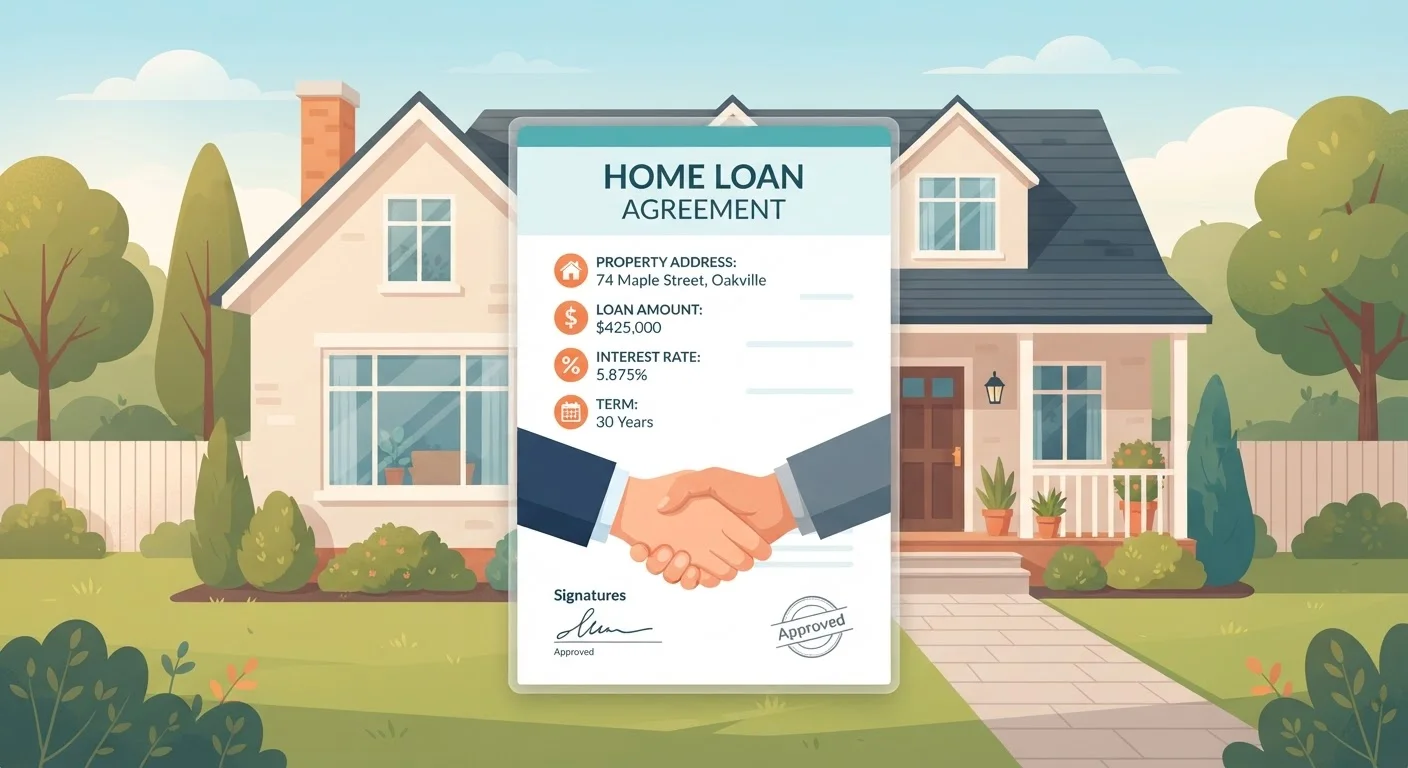
A mortgage is a loan specifically used to purchase real estate — typically a home. The property itself serves as collateral, meaning the lender can take ownership if the borrower stops making payments. Borrowers repay the loan over a set period, usually 15 or 30 years, through regular monthly payments that cover both the amount borrowed and interest charges.
Legally, a mortgage creates a lien on the property title, which is released only once the loan is fully repaid. The two core documents in a mortgage transaction are the promissory note (your repayment promise) and the mortgage deed (the lender's security interest).
The Core Idea: Borrowing Against the Home Itself
When most people buy a home, they don't pay the full price upfront. Instead, they borrow the majority from a lender — a bank, credit union, or mortgage company — and agree to pay it back over time. That arrangement is a mortgage.
What makes a mortgage different from a personal loan is collateral. The home you're buying secures the debt. If you stop making payments, the lender has the legal right to foreclose — take back the property and sell it to recover what's owed. This security is what allows lenders to offer large loan amounts at relatively lower interest rates compared to unsecured borrowing.
Before closing, you'll contribute a down payment — your share of the purchase price paid upfront. The mortgage covers the remainder. For example, on a $350,000 home with a 10% down payment, you'd borrow $315,000.
Mortgage Pre-Approval vs. Pre-Qualification
You may hear both terms during the home-buying process. Pre-qualification is an informal estimate of what you might borrow based on self-reported information. Pre-approval involves a formal credit check and document review, giving sellers much greater confidence that your financing is real. Most real estate agents recommend getting pre-approved before making offers in competitive markets.
Breaking Down Your Monthly Payment
Your monthly mortgage payment is often referred to by the acronym PITI, which stands for:
- Principal: The portion that reduces your loan balance.
- Interest: The lender's fee for the loan, calculated as a percentage of your remaining balance.
- Taxes: Property taxes collected on behalf of your local government.
- Insurance: Homeowners insurance, and private mortgage insurance (PMI) if your down payment was under 20%.
Taxes and insurance are typically held in an escrow account — a separate account your lender manages. Rather than paying a large property tax bill twice a year yourself, you contribute a monthly share that the servicer pays when the bill arrives.
30 years
Most common U.S. mortgage loan term
The 30-year fixed-rate mortgage is the most widely used loan structure among American homebuyers, according to federal housing finance data.
~64%
Share of U.S. homes with a mortgage
According to U.S. Census Bureau data, roughly two-thirds of owner-occupied homes carry an outstanding mortgage, underscoring how central this instrument is to American homeownership.
20%
Down payment threshold to avoid PMI
Industry standard practice holds that borrowers who put down less than 20% of the purchase price are generally required to carry private mortgage insurance (PMI) on conventional loans.
How Amortisation Works — and Why It Matters
Amortisation describes how your loan is repaid in scheduled installments over its term. Although your monthly payment stays the same throughout a fixed-rate loan, the split between principal and interest changes every month.
In the early years, the interest portion is large because your balance is high. As you pay down the principal, interest charges shrink and more of each payment reduces your balance. By the final years of a 30-year mortgage, the majority of each payment goes toward principal.
This is why making extra principal payments early in the loan term can significantly reduce the total interest you pay and shorten your payoff timeline. Even small additional amounts applied to principal can have a measurable effect over a 30-year horizon.
Understanding this structure also clarifies why refinancing early into your loan — when you still carry a high balance — may reset significant interest costs. See our guide to fixed-rate vs. adjustable-rate mortgages to understand how your rate type affects the overall cost of borrowing.
Request a Loan Amortisation Schedule
Before closing, ask your lender for a full amortisation schedule — a table showing how each payment is split between principal and interest over the life of the loan. Reviewing this document helps you understand exactly how much total interest you'll pay and what effect extra payments would have. Many lenders provide this for free as part of your loan disclosures.
Beyond the Mortgage: The Full Cost of Owning a Home
A mortgage is the largest monthly expense for most homeowners, but it's far from the only one. Property maintenance, utilities, HOA fees, and capital repairs add real ongoing costs that don't show up in your loan statement.
Separately, it's worth understanding the insurance landscape. Many buyers confuse homeowners insurance (which protects your home and belongings) with mortgage insurance (which protects the lender if you default). They are different products that serve different purposes. Our explainer on homeowners insurance vs. mortgage insurance explains how each works and who it actually protects.
For a comprehensive look at what to budget for month to month and year to year, see the full financial picture of owning a home. And if you're still weighing whether buying makes sense for your situation, reviewing the basics in renting basics can provide useful contrast.
This article is for general informational purposes only and does not constitute financial, legal, or mortgage advice. Mortgage terms, requirements, and costs vary by lender, loan type, and individual circumstances. Consult a licensed mortgage professional or financial adviser before making decisions about your specific situation.