

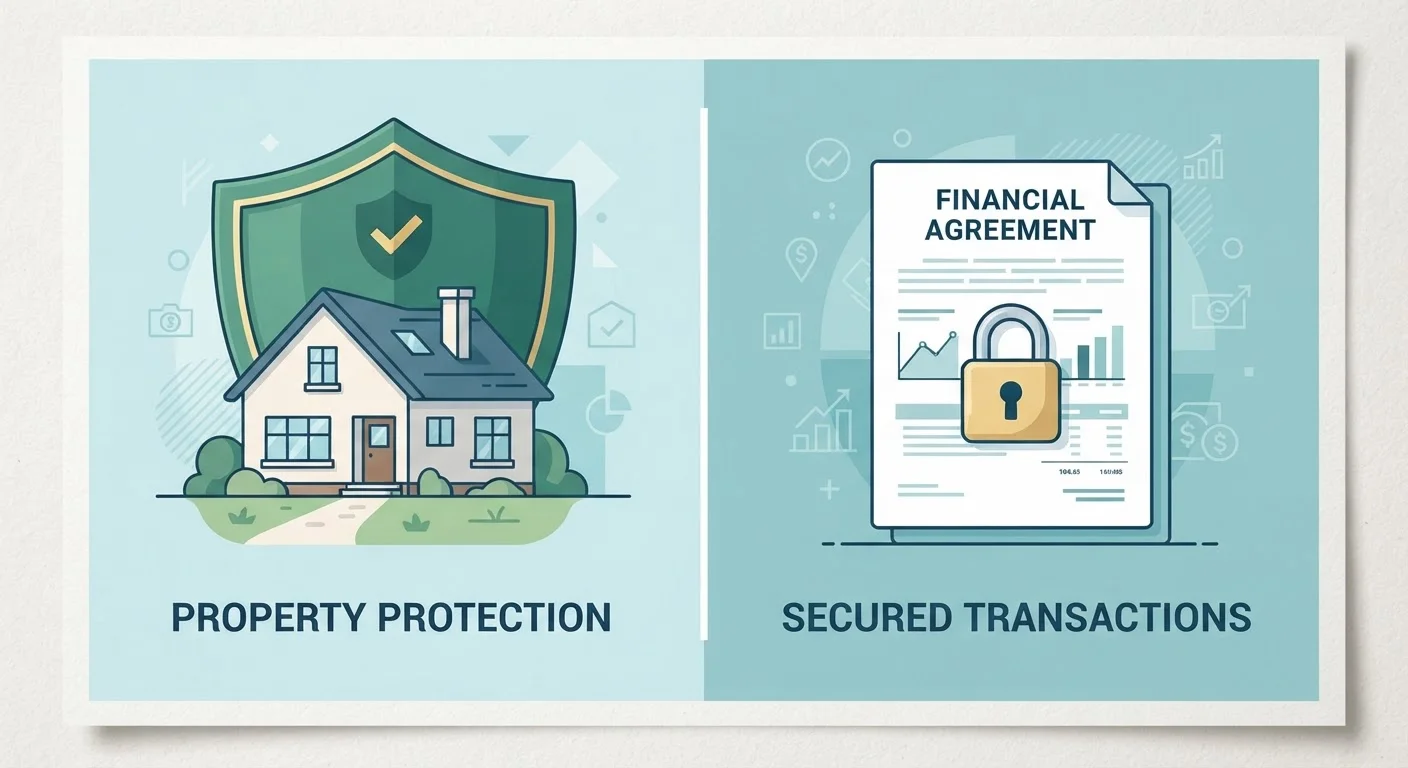
Key Takeaways
- Homeowners insurance protects your home and personal property; mortgage insurance protects your lender.
- Mortgage insurance does not pay for repairs, theft, or liability claims — ever.
- Homeowners insurance is required by virtually all mortgage lenders throughout the loan term.
- Private mortgage insurance (PMI) can often be removed once you reach 20% equity.
- Both costs should be factored into your true monthly housing budget from the start.
Option A
Homeowners Insurance
The policy that protects your property and belongings.
Best for: Any homeowner who wants financial protection against damage, theft, liability, and disaster.
Option B
Mortgage Insurance
The policy that protects your lender, not you.
Best for: Buyers who put less than 20% down and need to satisfy lender risk requirements.
If you want protection for your home's structure and your belongings
Homeowners Insurance
Homeowners insurance is the only policy that actually pays out to you when your property is damaged, stolen, or when someone is injured on your premises.
If you're putting less than 20% down on a conventional loan
Mortgage Insurance
Lenders typically require mortgage insurance in this scenario to offset their risk — it's a condition of loan approval, not an optional add-on.
If you're trying to understand your full monthly housing cost
Homeowners Insurance
Homeowners insurance is a permanent, ongoing cost of ownership and one you actively choose coverage levels for — making it the more impactful policy to understand and shop carefully.
Why the Confusion Exists
Both types of insurance are tied to your home and often appear as line items on your monthly mortgage statement. That proximity makes them easy to conflate. But they are fundamentally different financial products that serve completely different parties.
As part of understanding the full financial picture of owning a home, it helps to treat these two as completely separate costs with separate logic behind them.
| Criterion | Homeowners Insurance | Mortgage Insurance |
|---|---|---|
| Who it protects | You (the homeowner) | Your lender |
| What triggers a payout | Damage, theft, liability, disaster | Borrower default on the loan |
| Who receives the payout | You or your repair contractor | The lender only |
| When it's required | Always, for the life of the loan | Only when down payment is below 20% (conventional) |
| Can it be cancelled? | Your choice, but lender requires it | Yes, once sufficient equity is reached |
| Typical annual cost range | Varies widely by location and coverage | ~0.5%–1.5% of the loan amount |
What Homeowners Insurance Actually Covers
Homeowners insurance is a contract between you and an insurer. If something covered — a fire, windstorm, burst pipe, theft, or a guest's injury on your property — causes financial loss, the policy pays out to you. Most standard policies (called HO-3 policies) cover four main areas:
- Dwelling coverage: Pays to repair or rebuild the physical structure of your home.
- Personal property: Reimburses you for belongings like furniture, electronics, and clothing that are stolen or damaged.
- Liability protection: Covers legal costs if someone is injured on your property and sues.
- Additional living expenses (ALE): Pays for temporary housing if your home is uninhabitable after a covered event.
Floods and earthquakes are almost universally excluded from standard policies and require separate coverage. Lenders require homeowners insurance as a condition of your mortgage — not to protect themselves directly, but to ensure the collateral securing the loan (your house) can be rebuilt if destroyed. You can learn more about how your loan is structured in our guide to what a mortgage actually is and how it works.
~93%
US homeowners with homeowners insurance
According to the Insurance Information Institute, the vast majority of homeowners carry a policy, largely because lenders require it.
$1,428
Average annual homeowners insurance premium (US)
The National Association of Insurance Commissioners has reported average premiums in this range, though costs vary significantly by state and coverage level.
0.5%–1.5%
Typical PMI cost as share of loan per year
The Consumer Financial Protection Bureau (CFPB) cites this range as a general benchmark for conventional loan PMI rates.
What Mortgage Insurance Actually Covers
Mortgage insurance pays your lender — not you — if you default on the loan and the foreclosure sale doesn't recover the full amount owed. It exists entirely to reduce the lender's exposure when a borrower brings a smaller down payment.
There are two main forms:
- Private Mortgage Insurance (PMI): Required on most conventional loans when the down payment is below 20%. PMI is typically added to your monthly mortgage payment. Under the federal Homeowners Protection Act, lenders must automatically cancel PMI once your loan balance reaches 78% of the original home value — though you can request cancellation at 80%.
- MIP (Mortgage Insurance Premium): Required on FHA loans regardless of down payment size. Upfront and annual premiums apply, and removal rules differ depending on when the loan originated and how much was put down.
FHA MIP Removal Rules Differ from PMI
For FHA loans originated after June 2013 with a down payment below 10%, mortgage insurance premiums typically apply for the entire life of the loan. Borrowers seeking to remove MIP often refinance into a conventional loan once they've built enough equity. Rules have changed over time, so verify current guidelines with your lender or a HUD-approved housing counselor.
It's worth noting: if you ever file a claim under homeowners insurance, that payment goes to you (or your contractor). If mortgage insurance is ever triggered, the payment goes entirely to the lender — you receive nothing from that claim.
Costs, Duration, and Your Options
Homeowners insurance premiums vary widely based on location, home value, coverage limits, and claims history. Annual premiums commonly range from several hundred to over a thousand dollars, depending on risk factors like proximity to flood zones or wildfire areas.
PMI typically costs between 0.5% and 1.5% of the original loan amount per year, spread across monthly payments. On a $300,000 loan, that could mean $125–$375 added to your monthly bill until you reach sufficient equity.
Unlike homeowners insurance — which you carry indefinitely as long as you own the home — mortgage insurance is temporary on conventional loans. Building equity through payments, appreciation, or home improvements can accelerate the timeline to elimination. If you're evaluating loan structures that affect how quickly you build equity, see our comparison of fixed-rate vs. adjustable-rate mortgages.
This article provides general educational information about insurance types. Coverage terms, costs, and cancellation rules vary by lender, loan type, insurer, and state. Consult a licensed insurance professional or HUD-approved housing counselor for guidance specific to your situation.