

Key Takeaways
- The 50/30/20 rule splits after-tax income into needs, wants, and savings or debt payoff.
- It is a starting point, not a rigid prescription — percentages may need adjustment for your income level.
- High housing costs or low income can make the 50% needs target difficult to hit.
- The 20% savings allocation can cover an emergency fund, retirement contributions, or debt repayment.
- Several alternative frameworks exist if 50/30/20 does not match your financial situation.
The 50/30/20 Rule
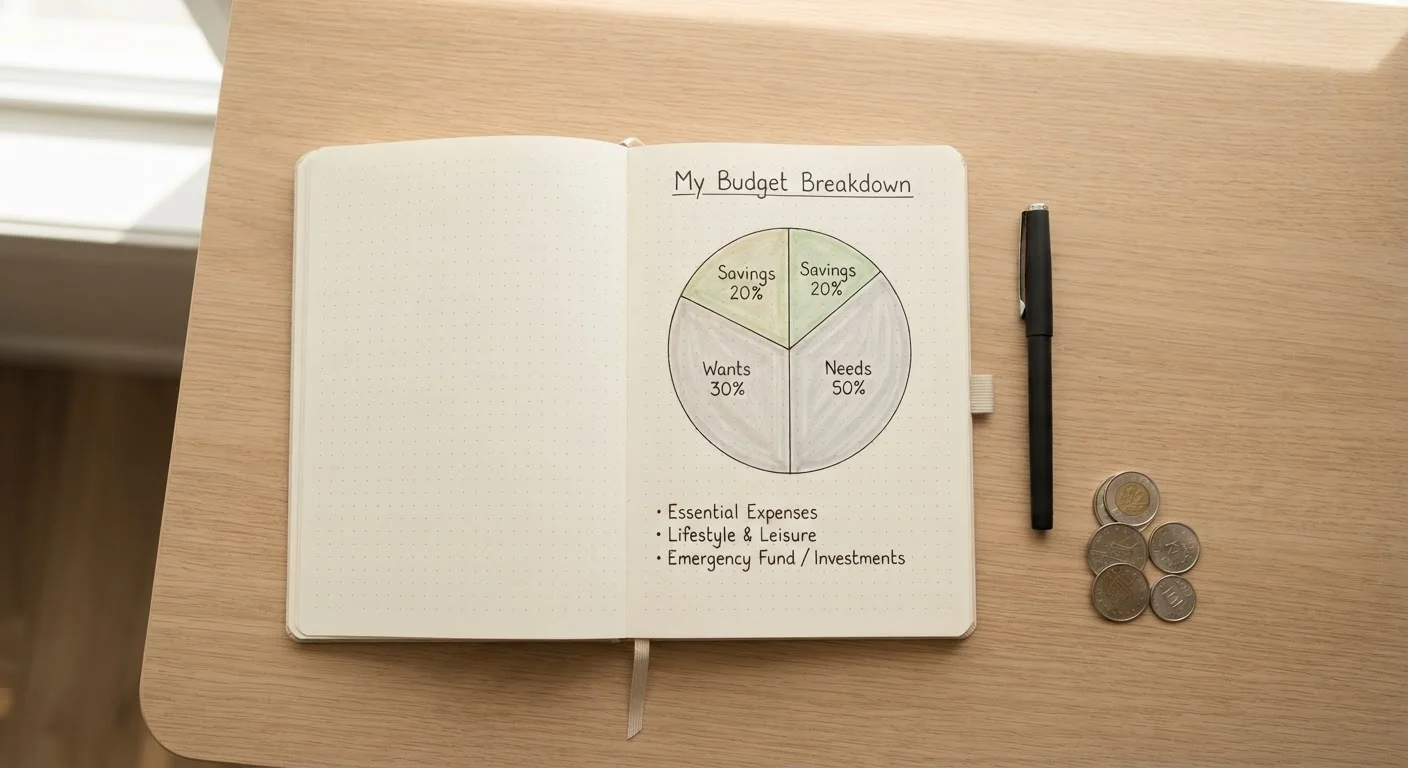
The 50/30/20 rule is a budgeting framework that divides your after-tax income into three categories: 50% for needs (essential expenses), 30% for wants (discretionary spending), and 20% for savings and debt repayment. It gives households a simple percentage-based target without requiring detailed tracking of every dollar. The goal is to create a sustainable balance between living today and preparing for the future.
The framework was popularised by Senator Elizabeth Warren and her daughter Amelia Warren Tyagi in their 2005 book 'All Your Worth,' though the underlying concept of proportional budgeting predates that publication.
How the Three Categories Work
The 50/30/20 rule starts with a single number: your monthly after-tax income. From there, every dollar gets assigned to one of three buckets.
- 50% — Needs: These are expenses you cannot reasonably cut without disrupting your daily life. Rent or mortgage payments, groceries, utility bills, health insurance premiums, minimum loan payments, and necessary transportation all belong here. If an expense would cause serious hardship to skip, it is almost certainly a need.
- 30% — Wants: These are lifestyle choices — dining out, streaming services, gym memberships, travel, hobbies, and clothing beyond the basics. Wants are not frivolous or wrong; they are a normal part of a sustainable budget. The 30% ceiling simply asks you to be intentional about them.
- 20% — Savings and Debt Repayment: This bucket covers your financial future. It can include contributions to an emergency fund, retirement accounts such as a 401(k) or IRA, other savings goals, and extra payments on high-interest debt above the required minimum.
To see this in practice: a household with $4,000 in monthly take-home pay would aim for roughly $2,000 on needs, $1,200 on wants, and $800 toward savings and debt. Understanding how the 20% savings target compares to other common guidelines can help you calibrate this bucket to your goals.
Start With Your Savings Bucket First
A common adaptation of the 50/30/20 rule is to automate your 20% savings contribution as soon as your paycheck arrives — before you pay any other bills. This 'pay yourself first' approach removes the temptation to spend what you intended to save. Even automating a smaller amount initially builds the habit and can be increased over time.
Where the Rule Works — and Where It Struggles
The 50/30/20 framework's greatest strength is its simplicity. It requires no spreadsheets, no category-by-category tracking, and no financial expertise to apply. For someone starting out with budgeting, those qualities matter.
However, the rule has real limitations worth understanding before you adopt it.
When it tends to work well
- Your income is moderate and stable.
- Your housing costs are in line with your local market — generally, a mortgage or rent that does not consume the majority of your paycheck.
- You are looking for a general structure rather than precise control over every dollar.
When it tends to struggle
- Low income: When essential expenses already consume more than half of take-home pay — a common reality for many Americans — the framework's targets become aspirational rather than practical.
- High-cost cities: Rent alone can consume 40–50% of income in many metro areas, leaving little room for the other categories.
- Aggressive savings goals: If you are working toward early retirement or paying down significant debt quickly, 20% may not be sufficient for your timeline.
The 20% Savings Bucket Has Flexibility
The 20% allocation does not have to be split equally between savings and debt. Many financial planning frameworks suggest prioritising high-interest debt (such as credit card balances) before building non-emergency savings beyond a small buffer. Once high-rate debt is cleared, redirecting that money into savings and retirement contributions becomes a natural next step. Your specific priorities will depend on your situation.
If the 50/30/20 rule does not fit your situation, you are not doing something wrong — it simply means a different structure may serve you better. See how other budgeting frameworks compare to find one that fits your life.
Applying the Rule to Your Own Budget
Getting started does not require perfection. The practical steps below help you put the framework into action:
- Calculate your monthly after-tax income. Include all regular income sources — salary, freelance payments, side work — after taxes. Exclude one-time windfalls to keep your baseline realistic.
- Add up your current monthly spending by category. Review one to three months of bank and credit card statements. Group expenses into needs, wants, and savings contributions.
- Compare your actuals to the targets. Most people find their needs or wants exceed the guideline percentages. This is useful information — it shows exactly where adjustments are possible.
- Adjust gradually, not drastically. Cutting wants by 5% in month one is more sustainable than attempting a 30% reduction immediately. Small consistent changes tend to stick.
The wants-versus-needs distinction is often the trickiest part of the exercise. A car payment, for example, may be a need for someone who commutes to work but a want for someone with reliable public transit access. Thinking through how to categorise spending decisions can add useful nuance here.
Once your budget is set, the harder work is maintaining it over time. Consistent habits are what keep a budget functional as life changes — not just the initial setup.
50%
Recommended ceiling for essential expenses
The 50/30/20 framework sets this as the upper target for needs — though many US households exceed it, particularly in high-cost housing markets.
~37%
Average share of income spent on housing alone
According to the U.S. Bureau of Labor Statistics Consumer Expenditure Survey, housing is consistently the largest single spending category for American households.
20%
Target allocation for savings and debt payoff
This is the savings guideline embedded in the 50/30/20 rule, though the appropriate rate varies by individual goals, income level, and existing debt load.
This article provides general financial information for educational purposes and is not personalised financial advice. For guidance specific to your circumstances, consider consulting a qualified financial adviser.