

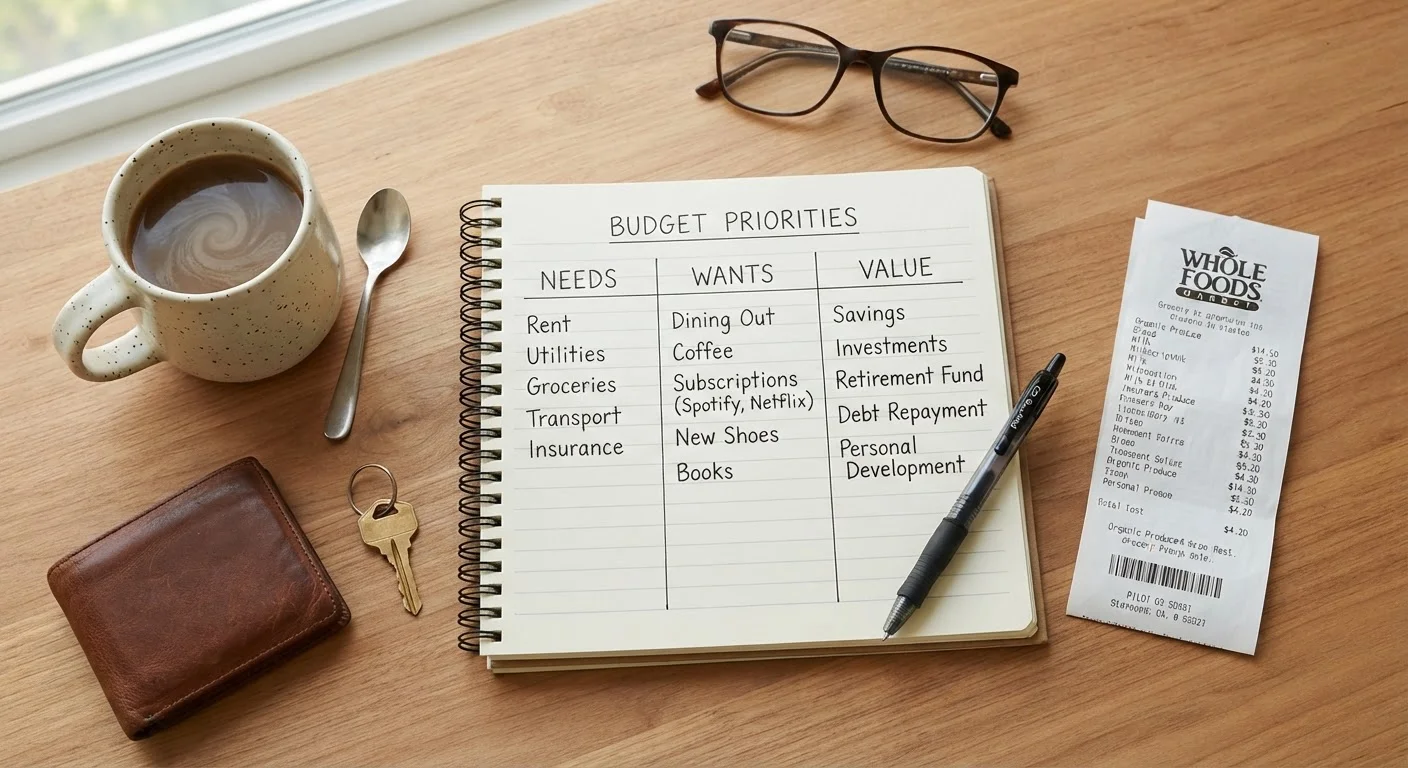
Key Takeaways
- The needs-vs-wants split alone is too blunt to guide most real spending decisions.
- Value — what a purchase actually delivers relative to its cost — is the missing third dimension.
- Something can be a 'want' and still be high value; a 'need' can still be low value if you overpay.
- Applying the framework consistently reduces impulse regret and budget drift.
- Even small purchases benefit from a quick three-question check before you buy.
Needs vs. Wants vs. Value
The needs-vs-wants framework splits purchases into things you must have and things you'd like to have. Adding a third dimension — value — asks whether a purchase delivers meaningful benefit relative to what it costs you in money, time, or trade-offs. Together, the three categories give you a more complete picture for evaluating any spending decision.
In behavioral economics, 'value' is often measured as the ratio of utility gained to resources spent — a concept distinct from price or necessity.
Why the Classic Two-Category Split Falls Short
Most budgeting advice starts with a simple instruction: separate your needs from your wants. Needs get funded first; wants get whatever is left over. It's clean, easy to remember, and widely taught — including in frameworks like the 50/30/20 rule.
The problem is that the binary split doesn't tell you much about whether you're spending wisely within either category. You can fulfill every genuine need and still hemorrhage money on low-quality purchases, redundant subscriptions, or items you needed — but didn't need at that price point.
The two-category model also struggles with the messy middle: purchases that are partly essential, partly discretionary, and whose worth depends heavily on your specific situation. A smartphone can be a legitimate work tool (need) and an entertainment device (want) at the same time, making the binary label nearly useless for deciding what to spend on it.
The Need vs. Want Line Shifts With Context
What counts as a need isn't fixed — it varies by income level, life stage, health status, and location. A car is a genuine need in a rural area with no transit options and a want in a dense city with reliable public transportation. Applying the framework honestly means accounting for your specific circumstances, not an abstract standard.
Introducing the Third Dimension: Value
Value is the ratio of benefit received to cost paid — and cost here means more than just the dollar amount. It includes your time, the opportunity cost of money spent elsewhere, and the mental energy of a complicated purchase or return.
Adding value to the framework creates a 2×2 mental model. Any purchase can be:
- High-need, high-value — the obvious sweet spot (e.g., a well-priced car insurance policy that protects a vehicle you depend on)
- High-need, low-value — a trap many shoppers fall into (e.g., overpaying for a utility plan with features you don't use)
- Low-need, high-value — often worth keeping (e.g., a streaming service you watch consistently for a low monthly fee)
- Low-need, low-value — where most spending regret lives (e.g., a gadget bought impulsively that sits unused)
This last category is where impulse buying does the most damage. The purchase often isn't high on need or value — but it felt urgent in the moment.
Try the 24-Hour Value Check
Before any non-essential purchase over a threshold you set for yourself (many people use $50), wait 24 hours and revisit the three framework questions. Research on purchasing behavior consistently shows that a short pause dramatically reduces regret-driven spending — without requiring you to give up things that genuinely matter to you.
How to Apply the Framework in Practice
The framework is most useful when it becomes a quick habit rather than a lengthy analysis. Before any non-routine purchase, run through three questions:
- Is this genuinely necessary, or discretionary? Be honest — the answer isn't always obvious, but it focuses your thinking.
- What concrete benefit will I get, and for how long? A durable item used daily scores higher than a single-use novelty.
- Is the cost proportionate to that benefit? This is where comparing prices when quality varies becomes part of the process — a higher sticker price can still represent better value if the quality difference is real and meaningful.
For larger decisions, it's worth adding a fourth question: What am I giving up to afford this? Every dollar spent on one thing is a dollar unavailable for something else. Naming the trade-off explicitly — not just feeling it vaguely — makes the decision clearer. See our guide to large purchase decisions for a deeper walkthrough of that process.
33%
Americans who report buyer's remorse monthly
A survey by Slickdeals found roughly one-third of U.S. adults experience regret over at least one purchase per month, with impulse buys cited as the leading cause.
$276
Average monthly impulse spend per U.S. consumer
Research by Finder.com estimated that U.S. consumers spend an average of $276 per month on unplanned purchases — a figure that compounds significantly over a year.
Applying the Framework Across Different Spending Categories
The needs-wants-value check adapts to virtually any spending category:
Groceries: Food is a need, but not all grocery spending is equally valuable. Buying produce you'll use before it spoils is high-value; paying a premium for pre-cut vegetables you could prepare in two minutes is a judgment call that depends on your time constraints.
Subscriptions: Recurring charges are where low-need, low-value spending hides most easily. A quick monthly audit — does this service deliver enough benefit to justify its cost? — often surfaces cancellations that free up meaningful budget.
Housing and transportation: These are needs, but there's often a range of options within that need. The framework helps you assess whether upgrading from a functional option to a premium one generates proportionate value — or whether the extra cost buys features you'll rarely use. The renting vs. buying framework applies similar logic to ownership decisions.
Across all categories, the goal isn't to spend as little as possible — it's to make sure what you spend aligns with what you actually value. That's a meaningfully different, and more achievable, objective for most households.
For more strategies across smart spending, explore our full resource hub.