

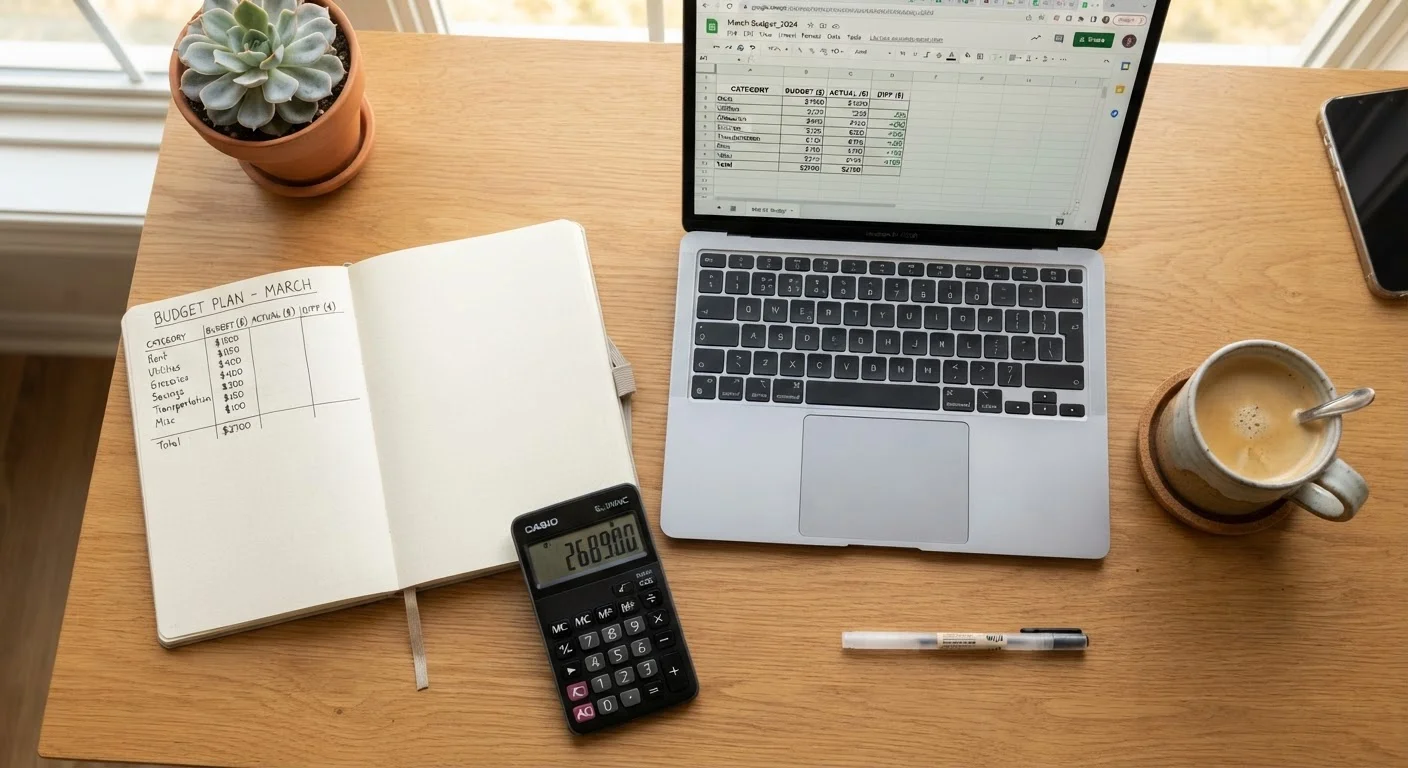
Key Takeaways
- Start with your real take-home pay, not your gross salary.
- Separating fixed and variable expenses reveals where your money actually goes.
- Small, consistent saving habits compound into meaningful financial progress over time.
- A budget is a living document — adjust it whenever your life changes.
- You don't need special software to build a budget that works.
Start here
Why a Budget Matters (Even on a Tight Income)
Next
Step 1: Add Up Your Take-Home Income
Then
Step 2: List Every Expense
Apply it
Step 3: Apply a Simple Framework
Lock it in
Step 4: Build the Saving Habit
Stay on track
Keeping Your Budget Working Over Time
Why a Budget Matters (Even on a Tight Income)
A budget is simply a written plan that tells your money where to go before it disappears on its own. Without one, most people underestimate how much they spend and overestimate how much they save — not because they are careless, but because spending is easy to lose track of when it happens in small amounts throughout the day.
Budgeting is not about restriction. It is about intention. When you decide in advance how much goes toward rent, groceries, and savings, you spend the rest without guilt because you already covered the important things. That shift in mindset — from reactive to planned — is where the real value lies.
For a broader look at building household-level financial clarity, the household budgeting guide covers foundational concepts worth reading alongside this article.
Take-home pay
The amount of money you actually receive after taxes and other deductions have been subtracted from your paycheck. This is the figure you should base your budget on, not your gross salary.
Fixed expense
A recurring cost that stays the same amount each month, such as rent or a car loan payment. These are usually the first things to account for in a budget.
Variable expense
A cost that changes from month to month, such as groceries, gas, or entertainment. These are typically where you have the most flexibility to adjust your spending.
Emergency fund
A reserve of savings set aside to cover unexpected costs — like a medical bill or job loss — without going into debt. Most financial educators suggest building toward three to six months of essential expenses.
Pay yourself first
A savings strategy where you automatically transfer money into savings as soon as you receive your paycheck, before spending on anything else. It removes the temptation to spend that money first.
Net income
Another term for take-home pay — your earnings after all deductions. It represents the real dollars available for budgeting.
Step 1: Add Up Your Take-Home Income
Begin with what actually lands in your bank account — your take-home pay (also called net income), which is your earnings after taxes, Social Security, and any other payroll deductions. Using your gross salary overstates what you have available to spend.
List every income source: your primary job, any side work, government benefits, freelance income, or regular financial support. If your income varies month to month — common for freelancers and hourly workers — use a conservative estimate based on your lower-earning months. The guide to budgeting on an irregular income offers specific strategies for that situation.
Write this total down. It is your budget's ceiling — every dollar you plan to spend or save must fit inside it.
Use Your Lowest Month as Your Baseline
If your income fluctuates, identify the lowest-earning month over the past year and use that figure as your budget baseline. Any month you earn more becomes a bonus you can direct toward savings or debt. This approach prevents shortfalls and removes anxiety about slower periods.
Step 2: List Every Expense
Pull up two or three months of bank and credit card statements. Go line by line and group each expense into two categories:
- Fixed expenses — amounts that stay the same each month, such as rent, loan payments, and insurance premiums.
- Variable expenses — amounts that fluctuate, such as groceries, gas, dining out, clothing, and entertainment.
Don't forget irregular expenses that arrive a few times a year — car registration, annual subscriptions, holiday gifts, medical copays. Divide their annual total by 12 and treat that monthly slice as a real expense. Many first-time budgeters skip this step and find themselves surprised by predictable costs.
A spending tracker walkthrough can help you set up a simple system to capture these details going forward.
Step 3: Apply a Simple Framework
Once you know your income and expenses, you need a structure to organize them. The 50/30/20 guideline is a practical starting point for beginners:
- 50% toward needs — housing, utilities, groceries, transportation, minimum debt payments.
- 30% toward wants — dining out, streaming services, hobbies, travel.
- 20% toward savings and extra debt repayment — emergency fund, retirement contributions, paying down credit card balances faster.
These percentages are guidelines, not rules carved in stone. If you live in a high-cost city, your housing alone may consume more than 50%. Adjust the categories based on your real numbers, not an ideal. What matters is that you consciously allocate every dollar rather than letting spending happen by default.
For a deeper comparison of different budgeting structures, see budgeting frameworks compared.
Avoid Budgeting on Paper Income
Always budget using your take-home pay, not your gross salary or an expected raise that hasn't materialized yet. Budgeting on income you don't have yet is one of the most common reasons first budgets fail. Build your plan around money you can confirm is in your account.
Step 4: Build the Saving Habit
The most reliable saving strategy is deceptively simple: treat savings like a fixed bill. As soon as your paycheck arrives, move a set amount — even $25 or $50 — into a separate savings account before spending anything else. This is often called paying yourself first.
Small amounts feel insignificant in the moment, but consistency is what creates results. Saving $50 a month is $600 a year. That covers an unexpected car repair, a medical copay, or the start of a travel fund. Over time, as your income grows or your debts shrink, you can increase that automatic transfer.
If you are planning a specific financial goal — like saving for a home down payment — the principles in the buying a home guide can help you understand what you are working toward and how much you may need to accumulate.
Keeping Your Budget Working Over Time
A first budget is a draft. Expect to revise it after your first full month. You will likely find categories where you consistently overspend and others where you budgeted too much. That is normal — the goal is accuracy over time, not perfection on the first try.
Schedule a brief monthly review: compare what you planned to spend against what you actually spent. A 10-minute check-in is enough to catch drift early before small overages compound into a real problem.
Life changes — a raise, a new expense, a move — each require a budget update. Treat your budget as a living document rather than a one-time exercise. For practical habits that help budgets stick beyond the first few months, habits that keep a budget working long-term is a useful next read.
This article is for general informational and educational purposes only and does not constitute personalized financial advice. Consult a qualified financial professional for guidance specific to your circumstances.