

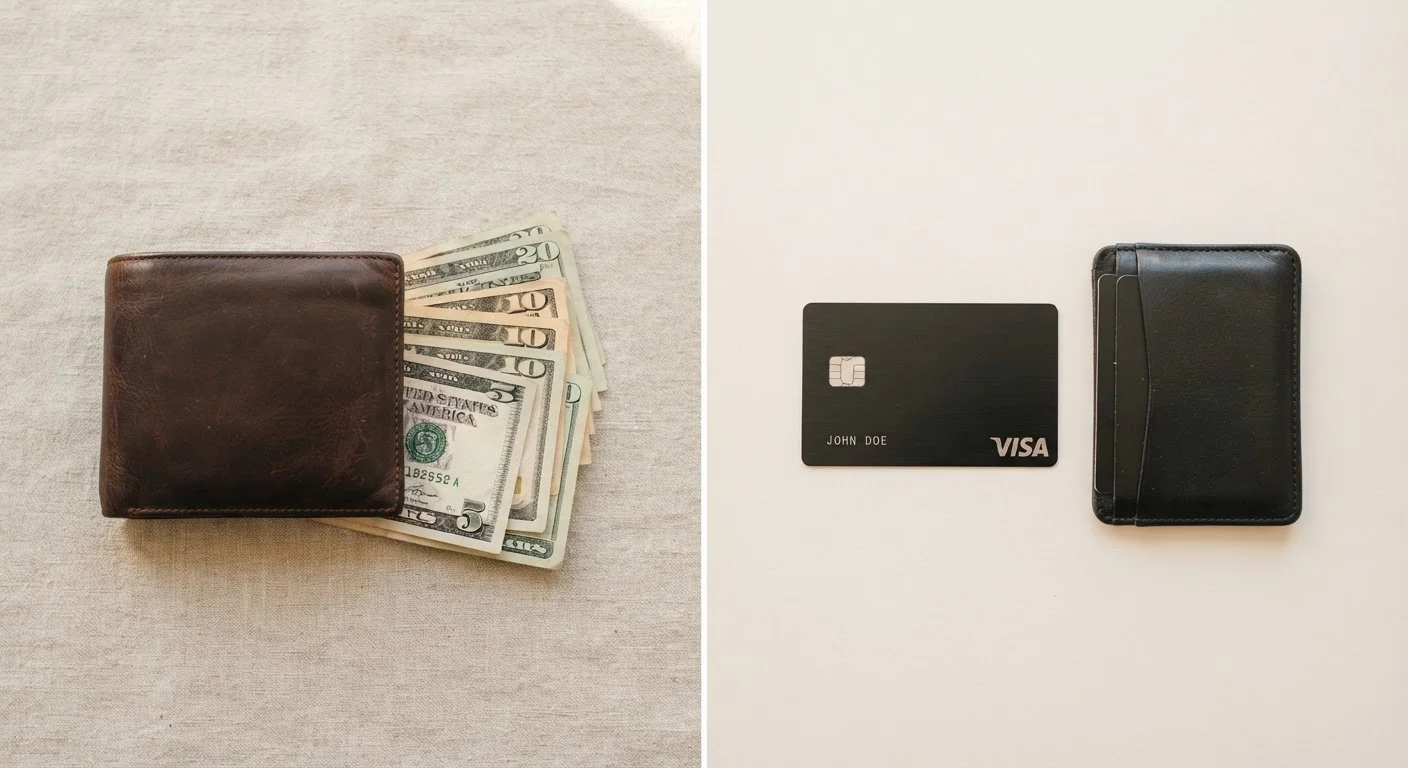
Key Takeaways
- Cash creates a physical spending limit that naturally discourages overspending.
- Credit cards offer consumer protections and fraud liability coverage that cash cannot match.
- Carrying a credit balance from month to month adds interest costs that erode any rewards earned.
- How you pay can subtly influence how much you perceive yourself as spending.
- Neither method is universally superior — your habits and goals determine which fits better.
Option A
Paying Cash
The tangible, spend-what-you-have approach.
Best for: Consumers who want to curb overspending and keep their finances simple and debt-free.
Option B
Using Credit
The flexible, rewards-eligible approach with added complexity.
Best for: Disciplined spenders who pay balances in full and want to build credit history or earn rewards.
If you struggle with overspending or carrying debt
Paying Cash
Spending physical money triggers a stronger psychological awareness of cost, which research suggests helps people spend less overall.
If you pay your balance in full every month
Using Credit
Responsible credit use can build your credit score and may earn rewards, without costing extra if no interest is charged.
If you're making a large one-time purchase online or traveling
Using Credit
Credit cards typically offer stronger fraud protections, dispute rights, and sometimes purchase protection that cash cannot provide.
If you want a simple, no-surprise budgeting system
Paying Cash
Cash-based systems like envelope budgeting give you a hard stop when funds run out, with no statements or interest to track.
The Hidden Psychology of How You Pay
Choosing cash or credit might feel like a trivial logistical decision, but research in behavioral economics suggests it quietly shapes your relationship with money. When you hand over physical bills, there's a measurable psychological friction — sometimes called the "pain of paying" — that makes the cost feel more real. Swiping a card compresses that moment, making it easier to underestimate how much you've actually spent.
This isn't a moral argument about discipline. It's simply how human perception works. If you've ever felt vaguely surprised by a monthly credit card statement, you've experienced this effect firsthand. For readers looking to understand their own spending patterns, impulse buying habits are often intertwined with payment method choices.
| Criterion | Paying Cash | Using Credit |
|---|---|---|
| Spending limit | Hard limit — what's in your wallet | Soft limit — up to your credit line |
| Fraud protection | None — lost cash is gone | Strong — $0 liability with prompt reporting |
| Interest risk | Zero | High if balance carried (often 20%+ APR) |
| Builds credit history | No | Yes, with responsible use |
| Rewards or cash back | None | Possible, if balance paid in full |
| Psychological spending friction | High — spending feels more tangible | Low — easy to underestimate costs |
| Usable for online purchases | No | Yes |
What Cash Does Well — and Where It Falls Short
Cash's biggest strength is its hard limit. You cannot spend money you don't have in your wallet, which makes it a natural budgeting guardrail. It's also universally accepted domestically, leaves no digital trail if privacy matters to you, and involves zero interest risk.
However, cash has real drawbacks. It offers no fraud protection — if it's lost or stolen, it's gone. It earns nothing back. It's impractical for online purchases, large transactions, or travel abroad. And it doesn't contribute to building a credit history, which matters when you apply for a mortgage, auto loan, or rental.
Cash envelope budgeting systems are one structured way to harness cash's natural limits without losing track of spending across categories.
~80%
U.S. adults who own at least one credit card
According to Federal Reserve consumer finance surveys, credit card ownership is widespread across most income brackets in the U.S.
20%+
Average U.S. credit card APR
Federal Reserve data shows average credit card interest rates have climbed above 20% annually in recent years, making carried balances costly.
$6,000+
Average U.S. credit card balance per household
Federal Reserve and industry data consistently show many American households carry revolving credit card debt from month to month.
What Credit Offers — and What It Costs
Credit cards provide genuine practical advantages: fraud liability protection (usually capped at $0 with prompt reporting), purchase dispute rights, extended warranties on some cards, and the ability to build a credit score over time. These aren't perks — for large purchases or travel, they're meaningful financial safety nets.
The catch is interest. The average credit card APR (annual percentage rate — the yearly cost of borrowing) in the U.S. has exceeded 20% in recent years. Any rewards earned are quickly canceled out if you carry a balance. The math only works in your favor if you pay your statement balance in full each month.
When credit is used for big-ticket decisions, such as financing a vehicle, the same trade-offs apply at a larger scale. See how payment structure plays out in a major purchase context in our look at buying vs. leasing a car.
Credit Score Basics: Why It Matters
Your credit score — a numerical summary of your borrowing history — affects your ability to qualify for mortgages, auto loans, and rental agreements, and influences the interest rate you're offered. Responsible credit card use (on-time payments, low utilization) is one of the most common ways to build or maintain a strong score. Cash-only spending has no impact on your credit file, which can be a disadvantage when you need credit for a major purchase.
Making the Decision That Fits Your Situation
There's no single correct answer. The right payment method depends on your habits, your financial goals, and the specific transaction. A useful framework: ask whether you would make the same purchase if you had to pay cash right now. If the answer is no, that's worth examining before reaching for the card.
For everyday discretionary spending, many people find a hybrid approach practical — cash or a debit card for categories prone to creep (dining, entertainment), and a credit card paid in full for fixed, predictable expenses or online purchases where protections matter. The goal isn't to pick a side permanently; it's to pay intentionally.
Whatever system you choose, comparing the real costs of purchases — not just the sticker price — is a foundation of spending wisely. Explore frameworks for doing that in our comparing prices guide.
This article is for general informational and educational purposes only and does not constitute personalized financial advice. Consult a qualified financial professional for guidance specific to your situation.