

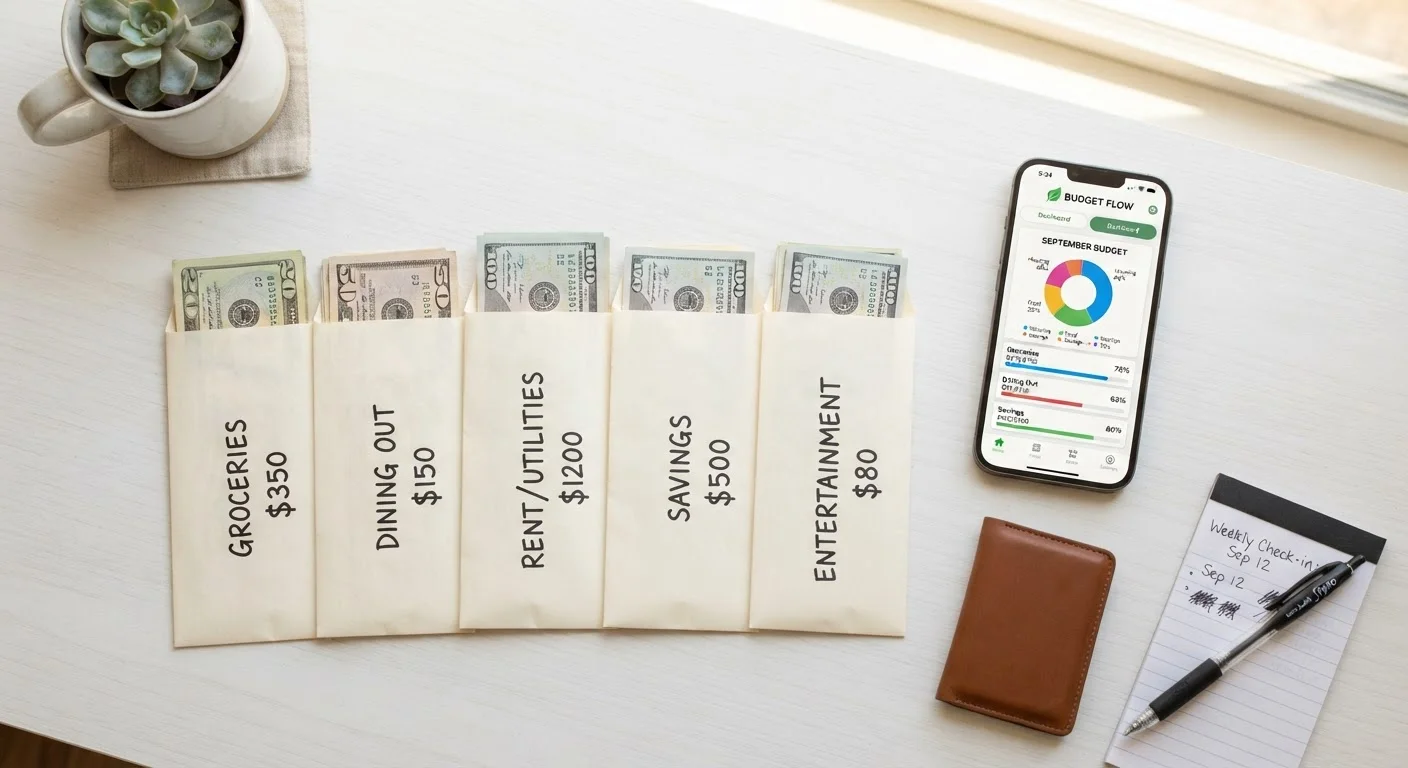
Key Takeaways
- Cash envelopes create a hard spending limit per category — when the envelope is empty, spending stops.
- Digital trackers automate transaction logging but require consistent review to have any impact on behaviour.
- Research suggests handling physical cash activates loss-aversion in ways that card payments do not.
- Digital tools offer real-time reports, goal tracking, and syncing across multiple accounts.
- Neither method works without a realistic budget set up in advance — the tracking system alone isn't enough.
- Many people find a hybrid approach — cash for problem spending areas, digital for everything else — most sustainable.
Option A
Cash Envelope Budgeting
The tactile, friction-based system that makes spending feel real.
Best for: People who overspend on discretionary categories and want a physical barrier to stop impulse purchases.
Option B
Digital Budget Trackers
The automated, data-rich approach that fits a cashless lifestyle.
Best for: People who pay primarily by card and want detailed spending history and category breakdowns at a glance.
If you consistently overspend on categories like dining or entertainment
Cash Envelope Budgeting
Physical cash limits are harder to override in the moment than a digital warning. The friction of running out of cash in an envelope tends to curb overspending more effectively.
If most of your spending happens online or via card
Digital Budget Trackers
Trying to convert all card transactions to cash creates unnecessary friction. A digital tracker fits naturally into a card-based lifestyle and captures all spending automatically.
If you want detailed analysis of where your money goes each month
Digital Budget Trackers
Digital tools generate category reports, trend graphs, and historical comparisons that cash envelopes simply cannot provide.
If you're new to budgeting and struggle with abstract spending limits
Cash Envelope Budgeting
Seeing and touching physical money makes budget limits concrete, which can be especially effective for building discipline early on.
If you manage shared household finances with a partner
Digital Budget Trackers
Most digital tools allow synced access across two users, making it easier to coordinate spending without managing shared physical envelopes.
How Each System Works
Cash envelope budgeting is straightforward: at the start of each pay period, you withdraw physical cash and divide it into labeled envelopes — one per spending category, such as groceries, transport, or dining out. Once an envelope is empty, spending in that category stops until the next period. There's no app required, no login, and no algorithm. The system relies entirely on the tangible reality of money running out.
Digital budget trackers work differently. These tools — which range from simple spreadsheet templates to app-based platforms — connect to your bank accounts and credit cards, categorise incoming transactions automatically, and show you where your money went. Some send alerts when you approach a category limit; others generate monthly spending reports. The system operates in the background, capturing data as you spend in your usual way. For a guided approach to setting one up, see our step-by-step spending tracker walkthrough.
The core difference is when each system intervenes. Cash envelopes intervene before you spend — the limit is physical and immediate. Digital trackers primarily reflect what already happened, meaning the intervention requires you to act on the data you see.
| Criterion | Cash Envelopes | Digital Trackers |
|---|---|---|
| Spending control mechanism | Physical limit — envelope empties | Alerts and reports after spending |
| Works for online/card purchases | No — cash only | Yes — syncs automatically |
| Setup effort | Low — envelopes and cash | Moderate — account linking, categories |
| Spending data and history | None — manual tracking required | Detailed — graphs, trends, reports |
| Works for shared finances | Difficult — physical coordination | Yes — multi-user syncing available |
| Security risk | Lost cash is unrecoverable | Data privacy and account access concerns |
| Requires habit consistency | Moderate — weekly cash withdrawal | High — must review regularly to benefit |
The Psychology Behind Each Method
Behavioural economics research has long documented a "pain of paying" effect: handing over physical cash registers as a tangible loss in ways that tapping a card does not. This isn't a small distinction — it influences how much people spend in the moment. Cash envelope systems exploit this effect deliberately. When the grocery envelope has $20 left, you feel that constraint viscerally at the checkout.
Digital trackers, by contrast, reduce friction at the point of purchase. The spending happens first; the reckoning comes later when you review your reports. This isn't necessarily a flaw — for disciplined reviewers, the data can drive meaningful behaviour change over time. But it does require a consistent habit of opening the app and acting on what you see, rather than just logging in once and forgetting about it.
83%
Of US adults use digital payment methods regularly
According to the Federal Reserve's 2023 Diary of Consumer Payment Choice, card and digital payments now account for the large majority of US transactions.
~18%
Of US consumers use cash for most purchases
The same Federal Reserve survey found cash use in everyday transactions has declined significantly over the past decade across most income groups.
For a broader look at how payment method shapes financial behaviour, our article on cash versus credit covers the psychology in more depth.
Practical Trade-Offs Worth Knowing
Cash envelopes have real limitations. They don't work for online purchases, subscriptions, or bill payments — which make up a growing share of most household budgets. Carrying cash also introduces security concerns; a lost envelope is gone. And the system can feel cumbersome if you're splitting spending across multiple categories each week.
Digital trackers have their own friction points. Auto-categorisation is often imperfect — a grocery purchase at a superstore might get flagged as general retail, skewing your reports. More importantly, a tracker that you don't actively review provides no spending control at all. It becomes a financial diary rather than a budgeting tool.
A Hybrid Approach Is Common
Many budgeters find that using cash envelopes only for their highest-risk spending categories — such as dining out, entertainment, or clothing — while managing fixed bills and subscriptions digitally gives them the best of both systems. This avoids the inconvenience of converting all spending to cash while still applying physical limits where impulse control matters most. It's worth experimenting to find what combination actually changes your behaviour.
Neither system removes the need for a sound underlying budget. Both methods are tools for executing a plan — not creating one. If you're still working out which overall budgeting structure suits your income and goals, our budgeting frameworks comparison walks through the most common approaches side by side.
For those specifically weighing the envelope method against a zero-based structure, zero-based budgeting vs. the envelope method offers a focused comparison of both.
This article is for general informational and educational purposes only and does not constitute personalised financial advice. Consult a qualified financial professional for guidance specific to your circumstances.