

Key Takeaways
- Subscription creep occurs when recurring charges accumulate unnoticed, often costing hundreds of dollars annually.
- Free trials that auto-convert to paid plans are among the most common sources of forgotten charges.
- Auditing your bank and credit card statements monthly is the most reliable way to catch unwanted subscriptions.
- Price increases on existing subscriptions frequently go unnoticed because the change is gradual and automatic.
- Canceling unused subscriptions rarely requires a good reason — stopping payment is always your right.
What Subscription Creep Actually Costs You
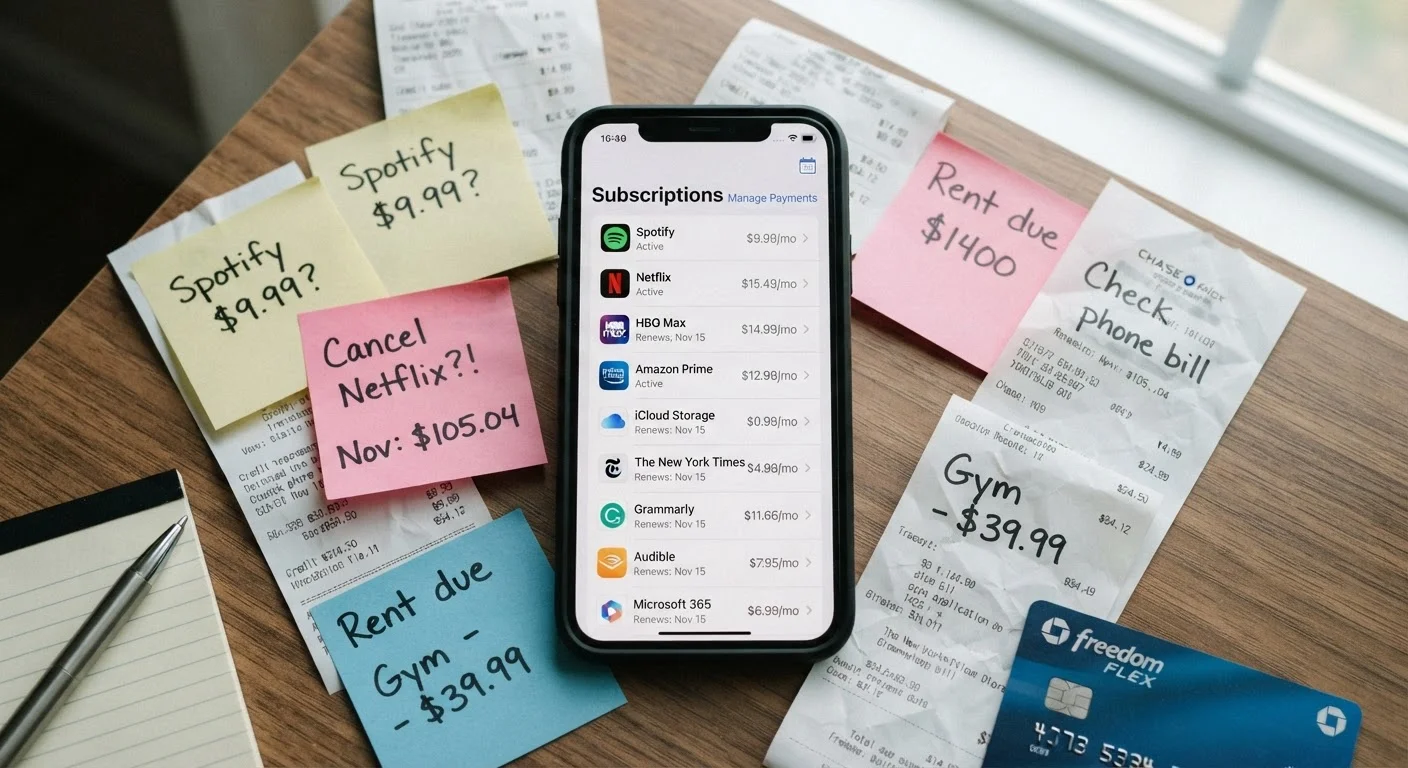
Subscription creep is what happens when small, recurring charges quietly multiply across your accounts until they collectively consume a significant slice of your monthly income. A streaming service here, a cloud storage plan there, a fitness app, a news paywall, a software suite — each feels negligible in isolation. But research by financial services firms has consistently found that consumers underestimate their total monthly subscription spending by a wide margin, often guessing a fraction of what bank statements actually reveal.
The arithmetic is straightforward. If you carry ten subscriptions averaging $12 per month each, that's $1,440 per year — money that leaves your account automatically, before you ever decide to spend it. Unlike a one-time purchase you deliberate over, subscriptions exploit the psychological tendency to treat recurring costs as a fixed, unavoidable part of life. They aren't. Every subscription is a choice you made at some point, and most can be revisited.
For a deeper look at how small recurring costs compound across a household budget, see Small Spending Leaks That Add Up Over a Year.
Signing up for a free trial and forgetting to cancel before it converts to a paid subscription.
Why it happens: Free trials are designed to reduce the friction of trying a product, but billing reminders are minimal and trial end dates are easy to lose track of.
Paying for multiple subscriptions that serve the same function.
Why it happens: Subscriptions are added incrementally over months or years, and it is easy to forget what you already have when a compelling new option appears.
Ignoring price increases on existing subscriptions.
Why it happens: Price change notices are often buried in emails that look like routine marketing, and the increase on any single charge is usually small enough not to trigger an immediate reaction.
Sharing login credentials across a household without tracking who actually uses each service.
Why it happens: Shared access feels efficient, but when use patterns shift — a family member moves out, habits change — no one revisits whether the subscription still makes sense.
Treating a subscription as 'worth it' based on potential use rather than actual use.
Why it happens: People naturally optimise for their ideal selves — the version who works out daily or reads every industry newsletter — rather than their actual habits.
How to Audit and Reclaim Control
The most effective starting point is a full statement audit. Pull the last two to three months of transactions from every bank account and credit card you use, then search for any charge that repeats at regular intervals — weekly, monthly, or annually. Annual charges are especially easy to forget; by the time they reappear, you may not even remember signing up.
$219/month
Average estimated US household subscription spend
A C+R Research survey found US consumers spend an average of around $219 per month on subscriptions, yet most initially estimate their spending at far less.
2–3x
How much consumers underestimate their subscription costs
Multiple consumer finance studies have found people routinely underestimate their total monthly subscription spending by a factor of two to three times.
Create a simple list: the service name, the charge amount, the billing date, and the last time you actually used it. If you cannot recall using a service in the past 30 days, that is a signal worth examining. Ask yourself honestly whether the value you receive justifies the cost — not the value you intended to get when you signed up, but the value you are actually receiving now.
Once you have your list, prioritize cancellations by annual cost rather than monthly cost. A $4.99 charge feels trivial; $59.88 per year for something unused is a real loss. If you find the cancellation process confusing or time-consuming, that friction is often deliberate — companies know that inconvenience reduces churn. Push through it anyway.
For a broader framework on expenses that tend to escape standard budgets, The Hidden Costs Most Budgets Forget to Include offers useful context. And if you're weighing whether a subscription model makes sense versus a one-time purchase, Subscription Pricing vs. One-Time Purchase provides a practical cost-comparison method.
Annual Subscriptions Are Easy to Overlook
Charges billed once a year — for software, cloud services, membership clubs, or premium apps — can be especially hard to spot on a monthly budget review. Because they appear only once, they often fail to trigger the same recognition as monthly charges. Make sure your audit covers a full 12-month window of transactions, not just recent months.
Making subscription review a monthly habit — even a 10-minute scan of your statements — is one of the lower-effort changes that can meaningfully improve your financial picture over time. See Small Daily Habits That Quietly Add Up to Real Savings Over Time for more low-lift routines worth building.
This article is for general informational purposes only and does not constitute personalised financial advice. For guidance specific to your situation, consider consulting a qualified financial professional.