
Subscription Pricing vs. One-Time Purchase: A Framework for Comparing Long-Term Costs

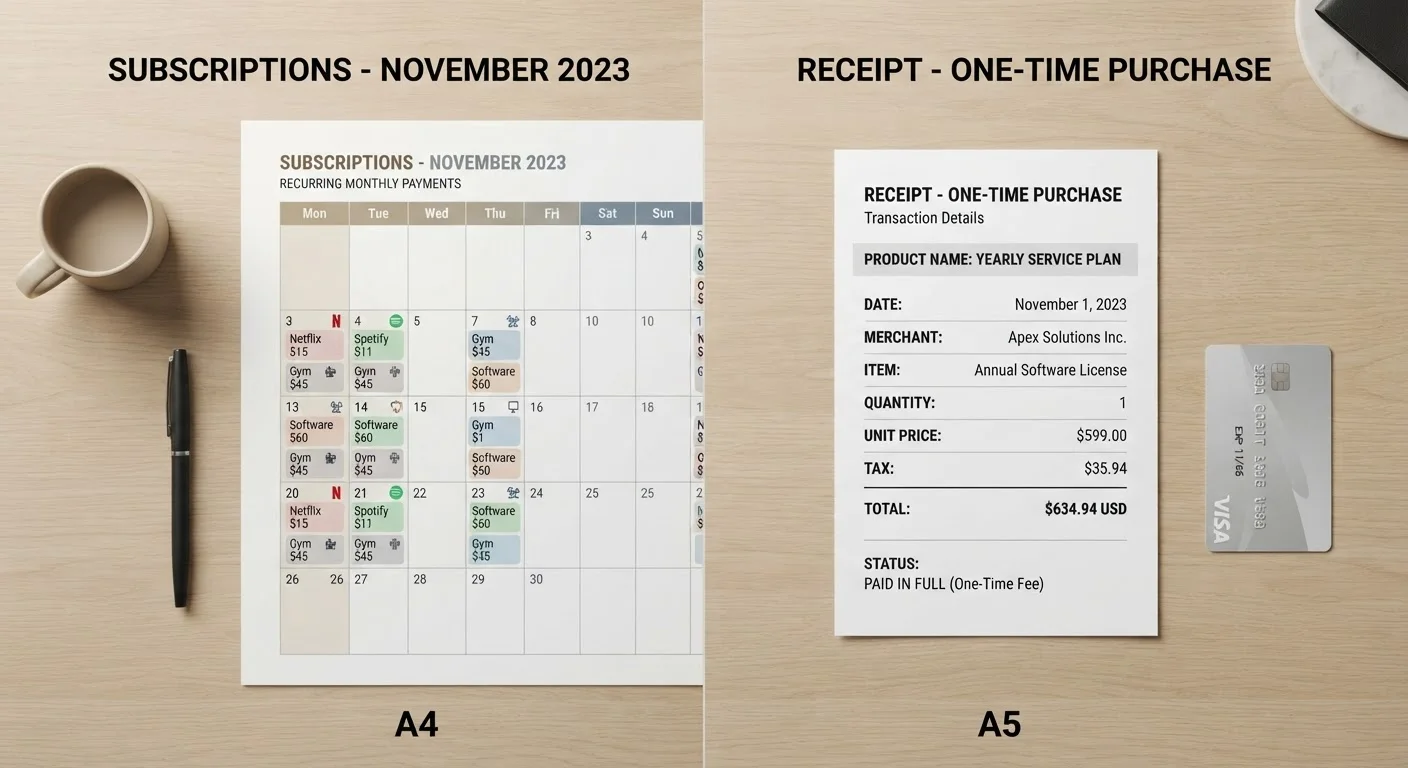
Key Takeaways
- Subscription pricing almost always costs more than a one-time purchase over a multi-year horizon.
- The break-even point — where cumulative subscription fees exceed the one-time price — is the single most useful number to calculate.
- Hidden costs like annual price increases and cancellation friction can significantly inflate a subscription's true lifetime cost.
- One-time purchases carry their own risks: no updates, obsolescence, and a larger immediate cash outlay.
- Your usage duration is the deciding variable — short-term users typically favor subscriptions; long-term users favor ownership.
Option A
Subscription Pricing
The pay-as-you-go model that spreads cost over time.
Best for: Consumers who want low upfront commitment, frequent updates, or services they plan to use only short-term.
Option B
One-Time Purchase
The own-it-outright model that trades a larger payment for long-term savings.
Best for: Consumers who use a product consistently for years and want a predictable, finite total cost.
If you plan to use the product or service for three or more years
One-Time Purchase
Cumulative subscription fees almost always surpass the one-time price within two to four years, making ownership the lower-cost option over a long horizon.
If you need access for a defined short-term project or season
Subscription Pricing
Paying month-to-month for a limited period costs far less than buying outright when you'll stop using the product soon after.
If cash flow is tight and a large upfront payment isn't feasible
Subscription Pricing
Lower monthly payments preserve liquidity even if the lifetime cost is higher — but set a calendar reminder to reassess before the break-even point arrives.
If the product category changes rapidly and staying current matters
Subscription Pricing
Subscriptions often include automatic updates, which can deliver meaningful functional value that partially offsets the higher long-term cost.
If you want cost certainty and no vendor dependency
One-Time Purchase
Ownership eliminates the risk of price hikes, service discontinuation, or losing access if you miss a payment.
Why the Upfront Price Tag Is Almost Always Misleading
When a subscription shows a $12/month price next to a $149 one-time option, the subscription looks like the obvious deal. That perception is exactly what the pricing model is designed to create. The monthly number feels manageable; the lump sum feels painful. Neither impression tells you which option actually costs less.
The only number that matters for a cost comparison is the total lifetime cost — what you will have paid in full, from day one to the day you stop using the product. For subscriptions, that figure is a moving target that rises every month you stay subscribed. For one-time purchases, it is fixed the moment you buy (setting aside any maintenance or upgrade costs).
This same dynamic plays out in other major financial decisions. Our comparison of leasing versus buying a car shows how monthly-payment framing routinely obscures the true long-run cost — the principle is identical here.
| Criterion | Subscription Pricing | One-Time Purchase |
|---|---|---|
| Upfront cost | Low (monthly or annual fee) | Higher single payment |
| Long-term total cost | Rises indefinitely with use | Fixed at point of purchase |
| Break-even risk | Exceeds one-time price in 1–4 years | Pays off after break-even month |
| Price stability | Subject to annual increases | Locked in at purchase |
| Access if you stop paying | Access lost immediately | You retain what you bought |
| Updates and new features | Usually included | Often require new purchase |
| Flexibility to exit | Cancel anytime (in theory) | Resale may recover some cost |
How to Calculate the Break-Even Point
The break-even point is the month at which cumulative subscription payments equal the one-time purchase price. After that month, every additional payment is money you would have saved by buying outright.
The formula is straightforward:
- Divide the one-time price by the monthly subscription fee.
- The result is the number of months before you've spent the same amount under each model.
- If you expect to keep using the product beyond that point, the one-time purchase is cheaper. If not, the subscription wins.
Example: a $180 one-time license versus a $15/month subscription. Break-even = 180 ÷ 15 = 12 months. Use it for more than a year? Buy it. Use it for less? Subscribe.
One important adjustment: factor in annual price increases. Many subscription services raise rates by 5–15% per year. A subscription that costs $15/month today may cost $18–20/month in three years. Recalculate break-even using a projected average monthly cost, not the current promotional rate.
12–24 months
Typical subscription break-even window
In most software and service categories, cumulative subscription fees surpass a comparable one-time license price within one to two years of continuous use.
5–15%
Common annual subscription price increase
Many major subscription platforms have raised base plan prices by this range in recent years, compounding the long-term cost gap versus one-time alternatives.
~40%
Consumers paying for unused subscriptions
Research by financial services firms has consistently found that a significant share of subscribers are paying for services they rarely or never use in a given month.
Hidden Costs on Both Sides of the Ledger
Neither model is as clean as it appears on the surface. Before committing, account for these frequently overlooked factors:
Subscription side
- Price escalation: Introductory rates are often not the long-term rate.
- Cancellation friction: Some services make cancellation deliberately difficult, increasing the likelihood you'll pay for months you don't use.
- Bundling traps: Paying for a bundle to access one feature you need means you're subsidizing features you don't.
- Access loss: If the service shuts down or you miss a payment, your access — and sometimes your data — disappears.
One-time purchase side
- Obsolescence: Software, tools, and devices stop receiving updates, which can render them incompatible or insecure over time.
- Upgrade costs: A new version may require another purchase, effectively restarting the cost clock.
- Upfront cash impact: Paying $200 today has an opportunity cost — that money can't be deployed elsewhere.
For a broader framework on spotting hidden fees across any pricing model, see our guide to comparing prices across stores and channels.
Annual Plans: A Middle-Ground Worth Evaluating
Many services offer a discounted annual plan alongside monthly billing — often 15–25% cheaper per year than paying month-to-month. If you're confident you'll use the service for at least 12 months, an annual plan lowers your effective monthly cost and reduces the gap with a one-time purchase. Just confirm the cancellation and refund policy before committing, since annual plans sometimes offer partial refunds only.
Making the Decision: A Three-Question Test
Once you've run the break-even math, three practical questions sharpen the decision:
- How long will I realistically use this? Be honest. Gym memberships and streaming services are notorious for outlasting actual usage. If you're uncertain, estimate conservatively.
- Does staying current matter? In fast-moving categories — creative software, security tools, cloud-based platforms — a subscription's built-in updates may carry real functional value. In stable categories — a recipe app, a reference tool — updates matter far less.
- What is my cash-flow situation? If the one-time price would strain your budget, the subscription's lower monthly cost has genuine value even if the lifetime total is higher. Just set a hard review date before you cross the break-even point.
The same logic applies when evaluating rent-versus-own decisions in other contexts. Our analysis of renting versus owning beyond the monthly payment walks through a comparable framework for real estate costs.
If you want to streamline the research process itself, price tracking tools versus manual comparison shopping can help you decide how much automation makes sense for your routine.