

Key Takeaways
- Fixed expenses stay the same each month and are harder to reduce without a major lifestyle change.
- Flexible expenses vary in amount and are where most budget adjustments actually happen.
- Identifying which category each bill falls into reveals where real savings potential exists.
- Reducing fixed costs often requires renegotiating contracts or changing living arrangements.
- Even small, consistent trims to flexible spending compound into meaningful annual savings.
Our Verdict
Neither fixed nor flexible spending is inherently good or bad — both are necessary parts of a functioning household budget. The distinction matters because it tells you where you have leverage. Fixed costs require bigger, less frequent decisions to change; flexible costs respond to everyday choices. Understanding both gives you a clearer map of where to focus energy when money is tight.
| Best for | Recommended |
|---|---|
| Those looking for quick, low-friction savings | Targeting flexible expenses first |
| Those seeking larger, longer-term budget relief | Restructuring fixed expenses |
| Those building their first household budget | Mapping both categories before making any cuts |
The Core Distinction: What Makes an Expense Fixed or Flexible
Every expense in your budget behaves in one of two ways: it stays the same regardless of what you do, or it shifts depending on your choices. That single distinction — fixed versus flexible — is the most practical framework for understanding where your money goes and where you actually have room to move.
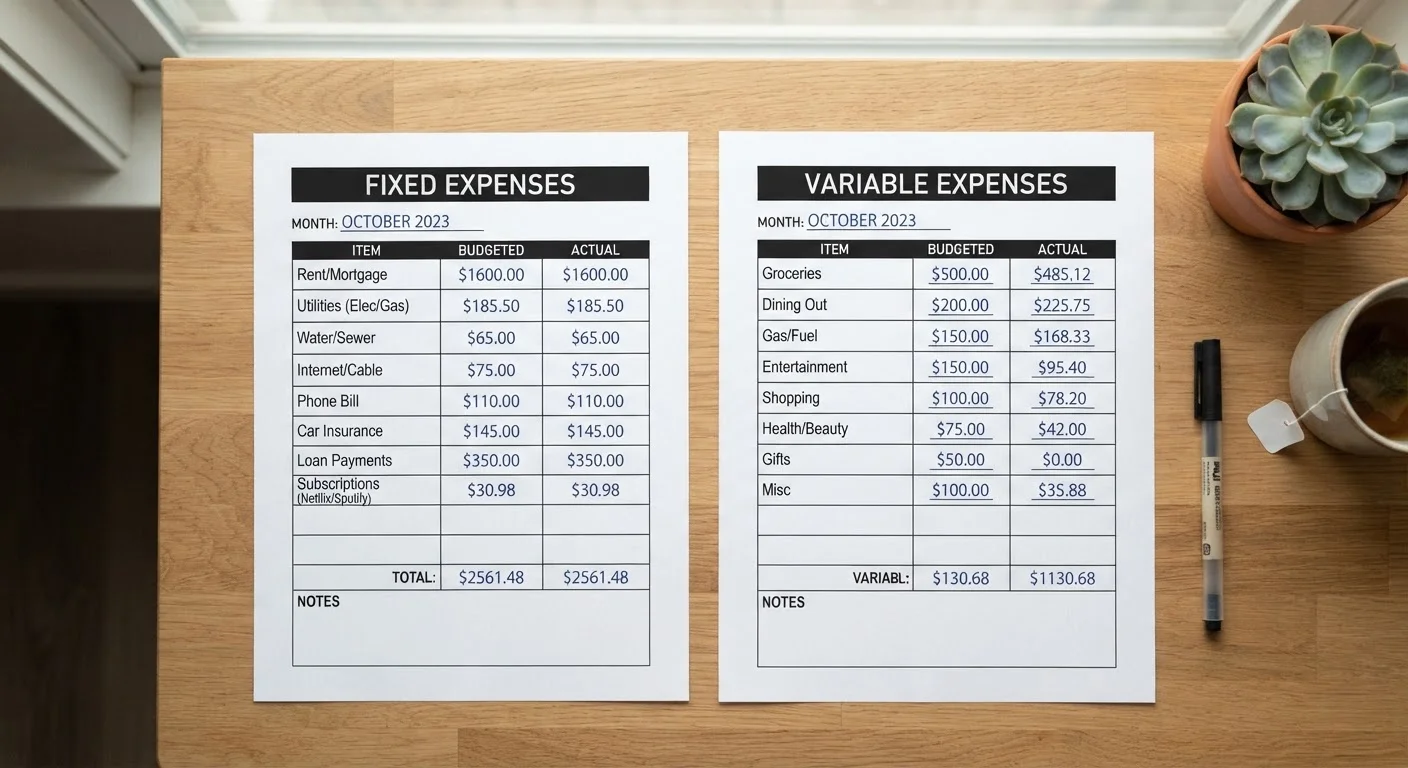
Fixed expenses are costs that recur at a set amount on a predictable schedule. Your rent or mortgage payment, car loan, insurance premiums, and subscription services with locked-in rates all qualify. You've already committed to these amounts — usually through a contract or lease — so changing them requires a deliberate action like refinancing, canceling, or renegotiating.
Flexible expenses (sometimes called variable or discretionary expenses) fluctuate from month to month based on usage or behavior. Groceries, dining out, gas, utilities, clothing, and entertainment typically fall here. You have ongoing, real-time influence over these amounts.
For a deeper breakdown of how these categories are formally defined, see this plain-language reference on fixed vs. variable expenses. And if you want to audit where your money is currently going before making any changes, tracking your monthly spending patterns is a useful first step.
How Fixed and Flexible Expenses Compare Under Budget Pressure
| Fixed Expenses | Flexible Expenses | |
|---|---|---|
| Amount each month | Stays the same | Varies based on behavior |
| Typical examples | Rent, loan payments, insurance | Groceries, dining, gas, utilities |
| Ease of reducing | Difficult — requires contract change | Easier — responds to daily choices |
| Time to see savings | Weeks to months (renegotiation) | Within the current billing cycle |
| Risk if you cut too deep | Disrupts housing, transport, coverage | May affect comfort or lifestyle |
| Best budgeting strategy | Set and review annually | Track and cap monthly |
The table above illustrates a critical pattern: fixed expenses deliver stability but limited flexibility, while variable expenses offer more control but require consistent attention. Neither category is the problem — the mismatch between the two and your actual income is where strain appears.
It's also worth noting that some expenses straddle both categories. Utilities are often described as variable, but a base service charge may be fixed. Streaming subscriptions feel fixed but can be canceled anytime. Knowing where each bill truly sits on the spectrum helps you make sharper decisions.
Start With a Two-Column List
Before making any cuts, write out every monthly expense and label it as fixed or flexible. Even a rough list reveals patterns most people miss — such as how much of their income is already committed before any discretionary spending begins. This simple exercise also shows whether tightening flexible spending alone is enough, or whether a fixed cost needs to be renegotiated.
Where to Find Savings in Each Category
Because fixed and flexible expenses respond differently to budget pressure, the strategies for reducing each are distinct.
Trimming flexible expenses
This is where most people start — and for good reason. Flexible spending responds immediately to behavior changes. Cooking at home more often, consolidating errands to reduce fuel use, or setting a monthly cap on clothing purchases can all produce measurable results within a single billing cycle. The challenge is consistency: flexible expenses tend to creep back up without a tracking system in place.
Reducing fixed expenses
This takes more effort upfront but can yield larger, more durable savings. Options include refinancing a mortgage to a lower rate (see how fixed and adjustable mortgage rates differ for context), shopping for cheaper insurance at renewal, downsizing a vehicle loan, or moving to a lower-cost living situation. These changes require research and often paperwork, but once done, the savings are automatic and ongoing.
Understanding the trade-offs of tightly controlled budgeting can help you decide how aggressively to approach either category.
Building a Budget That Accounts for Both
A realistic budget doesn't treat all expenses the same. It separates fixed commitments from flexible ones, sets expectations accordingly, and leaves room for the unexpected. A common structural approach is to list all fixed expenses first — these are non-negotiable in the short term — then allocate the remaining income across flexible categories.
This separation also makes it easier to respond when income changes unexpectedly. If you know exactly which expenses are locked in, you can quickly calculate your true financial floor and identify how much flexibility you actually have.
For readers exploring specific budgeting methods, envelope budgeting versus zero-based budgeting offers two structured approaches that work well with this fixed-versus-flexible framework. You might also find it useful to build an emergency fund alongside your budget work — understanding the difference between an emergency fund and a savings account explains how the two serve different purposes.
For broader context on spending habits and budgeting strategy, the Budgeting Basics hub and Smart Spending hub offer additional guidance suited to everyday consumers.
This article is for general informational and educational purposes only and does not constitute personalized financial advice. For guidance tailored to your specific financial situation, consider consulting a qualified financial professional.