

Key Takeaways
- Per-unit price reveals the true cost of what you're buying, independent of package size.
- Bigger packages do not always have a lower per-unit cost — verify every time.
- The unit measure must match when comparing two products (e.g., both in price per ounce).
- You can calculate per-unit price yourself by dividing the total price by the quantity.
- Shelf tag unit prices are legally required in many US states, though formats vary by store.
Per-Unit Pricing
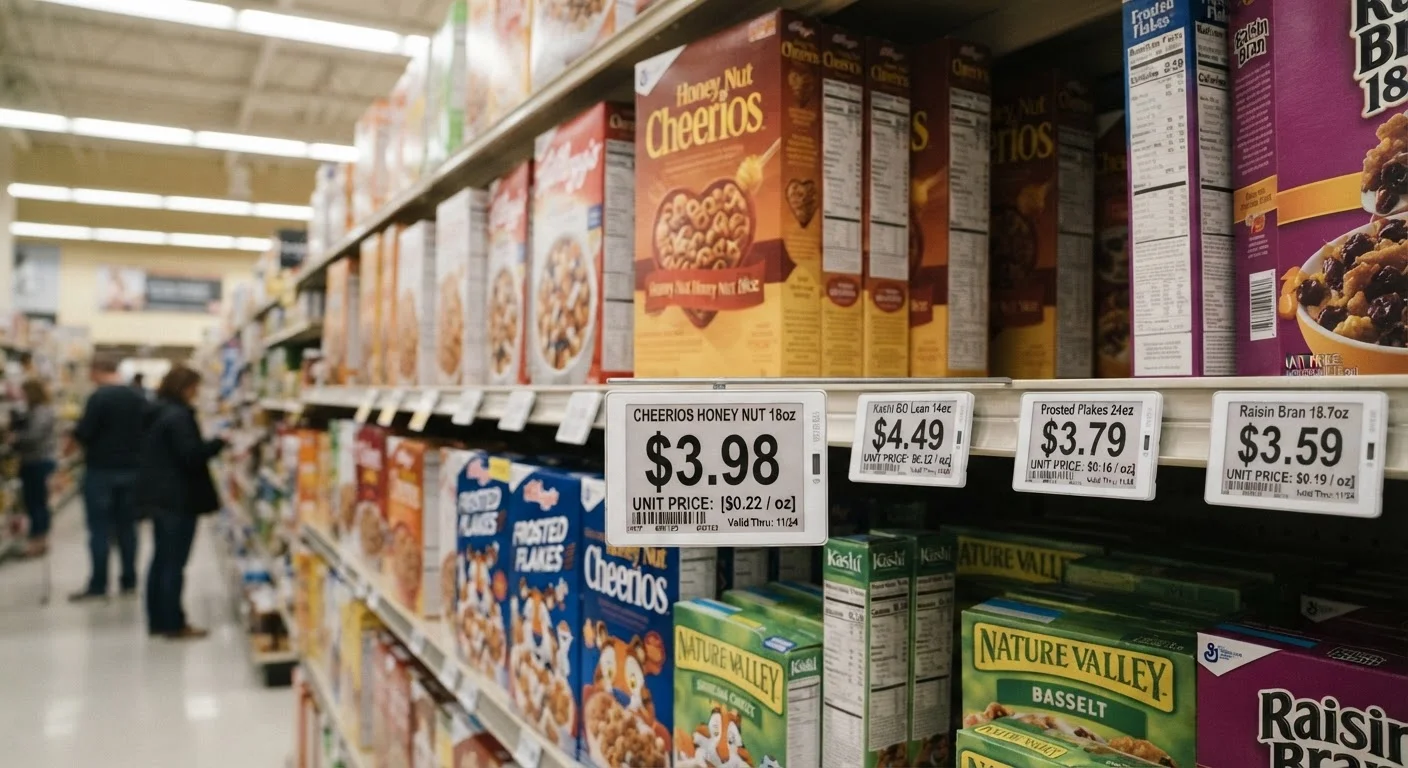
Per-unit pricing is the cost of a product broken down to a single standard measure — such as per ounce, per sheet, per count, or per fluid ounce. It lets you directly compare two items that come in different package sizes without doing complicated math in your head. Most US grocery stores are required to display this figure on shelf tags, usually in smaller print below the main price.
The "unit" varies by product category: weight-based goods use price per ounce or pound, liquid products use price per fluid ounce, and multi-item packages use price per count or per sheet.
Why the Big Price Tag Doesn't Tell the Whole Story
Standing in a store aisle comparing two packages of the same product, most shoppers default to one question: which one costs less? That instinct is understandable, but it routinely leads to paying more per actual unit of product. A $6 bag of coffee isn't necessarily a better value than a $9 bag if the $9 bag contains twice as much.
This is exactly what per-unit pricing solves. Rather than comparing total package prices — which are shaped by packaging decisions, marketing strategies, and retailer choices — per-unit pricing puts everything on the same scale. As part of a broader approach to smart price comparison, it's one of the most direct tools available to everyday shoppers.
32
US states with mandatory unit pricing laws
According to the National Conference of State Legislatures, roughly two-thirds of US states have enacted some form of unit pricing requirement for grocery retailers.
~10–20%
Potential overpayment when ignoring unit price
Consumer research consistently suggests shoppers who rely on package price alone regularly pay 10–20% more per unit than those who compare unit prices directly.
How to Read Per-Unit Pricing on a Shelf Tag
On most US grocery store shelf tags, the per-unit price appears in smaller text — sometimes in a separate box, sometimes along the bottom edge of the label. It usually looks like: $0.22/oz, $0.03/ct, or $1.14/lb. The abbreviations stand for ounce, count, and pound respectively.
The unit measure used depends on the product type. Paper products are typically measured per sheet or per roll. Beverages go by fluid ounce. Dry goods are measured per ounce or pound. Packaged items sold in multiples (like snack packs) often show a per-count figure. When you're comparing two products, always confirm they share the same unit measure before drawing conclusions — comparing price per ounce to price per pound without converting will give you a misleading result.
Use Your Phone as a Price-Per-Unit Calculator
Open your phone's calculator in the store aisle and divide the package price by the quantity shown on the label. This takes under 10 seconds and is especially useful when store tags are missing the unit price or when comparing products across different sections of the store.
Calculating It Yourself When the Tag Falls Short
Shelf tags aren't always consistent. Some stores omit unit pricing on certain products, promotional displays, or clearance shelves. In those cases, the formula is simple:
Per-unit price = Total price ÷ Total quantity
If a 32-oz bottle of dish soap costs $3.84, divide $3.84 by 32 to get $0.12 per ounce. If a competing brand sells a 20-oz bottle for $2.60, that works out to $0.13 per ounce — slightly more expensive despite the lower sticker price. This kind of quick math, easily done on a phone calculator, is the same principle behind comparing prices across stores and channels.
When Bulk Isn't Actually Cheaper — And Other Common Traps
A widespread assumption is that buying in bulk always lowers your per-unit cost. That's often true, but not universally. Retailers sometimes price mid-size packages at a lower per-unit rate than either the small or the large option — a tactic that fits within a broader set of retail pricing strategies designed to nudge shoppers toward certain choices.
Promotional tags can also obscure the math. A "Buy 2 for $5" tag looks like a deal, but if the per-unit price of a single item at $2.49 works out cheaper per ounce than the promo pack, the promotion isn't saving you anything on a per-unit basis. Similarly, store-brand versus name-brand comparisons almost always favor the store brand on per-unit cost — but the shelf tag makes that easy to verify rather than guess.
Waste Can Erase Per-Unit Savings
A lower per-unit price only translates into real savings if you use all of the product. Perishable goods bought in bulk at a lower per-unit cost may end up more expensive overall if a portion spoils before use. Factor in realistic consumption when deciding whether a larger size is genuinely worthwhile.
For a fuller picture of what you're actually paying — including fees and other costs not reflected in shelf pricing — see our guide to total cost vs. sticker price.