

Key Takeaways
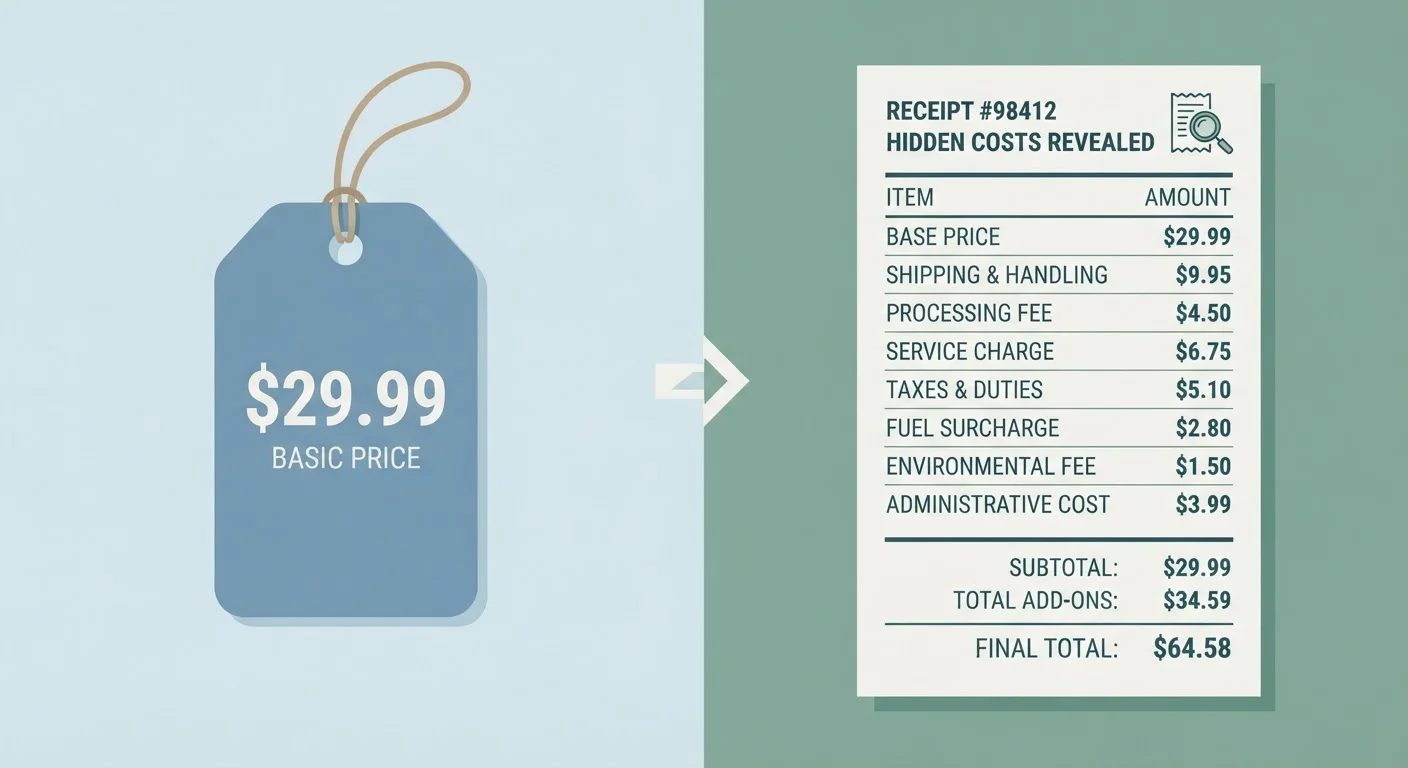
- The advertised price rarely reflects what you'll actually pay at checkout.
- Fees like shipping, sales tax, and installation can add 10–30% or more to a purchase.
- Comparing sticker prices across sellers without accounting for total cost can lead to choosing the more expensive option.
- Recurring charges — subscriptions, maintenance plans — compound over time and belong in any true cost calculation.
- Always calculate the total cost before committing to a purchase, not after.
Total Cost vs. Sticker Price
The sticker price (or listed price) is the number advertised for a product or service. The total cost is what you actually pay once you add shipping, taxes, fees, warranties, and any recurring charges. These two numbers are often very different, and confusing one for the other is one of the most common — and costly — shopping mistakes consumers make.
Economists sometimes call the full amount the 'all-in cost' or 'landed cost.' In retail contexts, the gap between listed and final price is driven by mandatory charges (sales tax) and discretionary add-ons (extended warranties, installation fees).
Why the Listed Price Is Just the Beginning
Retailers, online marketplaces, and service providers all compete on the number you see first — the sticker price. That number is designed to attract attention, and it often does. The problem is that it's rarely what you end up paying.
Sales tax, shipping fees, handling charges, installation costs, and mandatory add-ons all sit between the listed price and the amount that leaves your bank account. When you're comparing two offers purely on the advertised number, you may be comparing apples to something closer to an orange.
Understanding the difference between sticker price and total cost isn't a niche financial skill — it's a practical tool every shopper needs, whether you're buying a blender online or navigating car-buying basics.
~10–30%
Typical gap between listed and final price
Depending on category, taxes and fees routinely add 10–30% or more to a product's advertised price — a pattern documented consistently by consumer research organizations.
45 states
US states with a general sales tax
As of current law, 45 states and the District of Columbia collect a statewide sales tax, meaning most online and in-store purchases carry a tax cost not reflected in listed prices.
Up to 20%
Restocking fees charged by some retailers
Some retailers charge restocking fees of 10–20% on returned items, a cost shoppers rarely factor in when comparing purchase options.
The Most Common Cost Categories Buyers Miss
Several charges consistently catch shoppers off guard. Knowing them in advance puts you in control:
- Sales tax: Rates vary widely by state — from 0% in states like Oregon to over 10% in some localities. A $500 item in a high-tax jurisdiction can cost $550 or more before any other fees.
- Shipping and handling: Particularly for heavy or oversized items, freight charges can rival a meaningful portion of the product's price. Free shipping thresholds also nudge consumers into buying more than they intended.
- Installation and setup fees: Appliances, furniture, and electronics often require professional installation that isn't included in the purchase price.
- Subscription or maintenance costs: A device with a low upfront price may require a monthly service plan to function fully. Over 24 months, those fees can dwarf the hardware cost.
- Return and restocking fees: If the product doesn't work out, returning it may not be free. Some retailers charge 15–20% restocking fees.
For grocery and everyday purchases, per-unit pricing is a related concept worth mastering — it helps you compare true value across different package sizes.
Ask for the 'Out-the-Door' Price
When making any significant purchase — especially vehicles, appliances, or furniture — ask the seller to provide a full itemized quote that includes all fees, taxes, and required charges. This 'out-the-door' figure is the only number worth comparing across sellers. Getting it in writing before you commit prevents last-minute surprises at signing.
How to Calculate Total Cost Before You Buy
The calculation doesn't need to be complicated. A simple mental or written checklist works well:
- Start with the listed price.
- Add your local sales tax rate. Look this up for your zip code if you're unsure.
- Add shipping costs. If the seller offers multiple shipping tiers, use the one that matches your actual timeline.
- Add any mandatory fees — installation, activation, documentation, or service charges disclosed in the fine print.
- Add recurring costs for the period you expect to own or use the product. A two-year subscription plan should be included as part of a two-year total cost, not ignored because it bills monthly.
- Subtract any confirmed rebates or cashback. Only count these if they're already in-hand or clearly guaranteed — not if they depend on mailing in forms or meeting conditions you haven't confirmed.
The result is your true, apples-to-apples number. This is what to use when comparing competing offers.
Applying This Beyond Retail Shopping
The total-cost framework applies across nearly every major purchase category. For vehicles, the sticker price is arguably the least useful single number — registration fees, stamp duty, insurance, fuel, and maintenance stack on top of it. Our guides on the true cost of car ownership and vehicle registration and stamp duty costs walk through those layers in detail.
For housing, a mortgage payment covers principal and interest — but property taxes, insurance, HOA fees, and maintenance are separate costs that substantially change affordability. For travel, a low-fare airline ticket may include fees for baggage, seat selection, and airport transfers that close the gap with a fuller-service carrier.
The principle is consistent: identify all the costs that flow from a purchase decision, total them up, then compare. That's the only number that tells you the real story.
This article is for general informational and educational purposes only. It does not constitute financial or legal advice. Consult a qualified professional for guidance specific to your situation.