
Capsule Hotels, Couchsurfing, and Camping: Unconventional Ways to Cut Accommodation Costs

Key Takeaways
- Capsule hotels offer private sleeping spaces at hostel-dorm prices, especially in urban areas.
- Couchsurfing can reduce accommodation costs to zero but requires effort, trust, and genuine community participation.
- Camping costs vary widely — free dispersed camping exists, but campsite fees, gear, and logistics add up.
- Each unconventional option involves real trade-offs in comfort, privacy, safety, and social dynamics.
- Mixing accommodation styles across a longer trip is often the most practical cost-cutting strategy.
Why Look Beyond the Standard Motel or Hostel?
Most travelers default to hotels or hostels when searching for an affordable place to sleep — and for good reason. They're familiar, bookable in minutes, and easy to compare on price. But sticking only to the obvious options can mean leaving real savings on the table, especially on longer trips or in high-cost cities.
A growing range of alternative lodging styles has moved from niche to practical, available in more destinations than many travelers realize. These aren't just budget workarounds — some offer genuinely distinct experiences alongside the lower price tag. The catch is that each comes with its own set of real-world conditions that affect whether it's right for a given trip or traveler.
This guide covers five unconventional accommodation approaches in plain terms: what they actually involve, what they typically cost (keeping in mind prices vary widely by location and season), and what to watch out for before booking or committing. For a broader look at how lodging choices fit into overall trip costs, see the full picture on budget accommodation.
Capsule Hotels
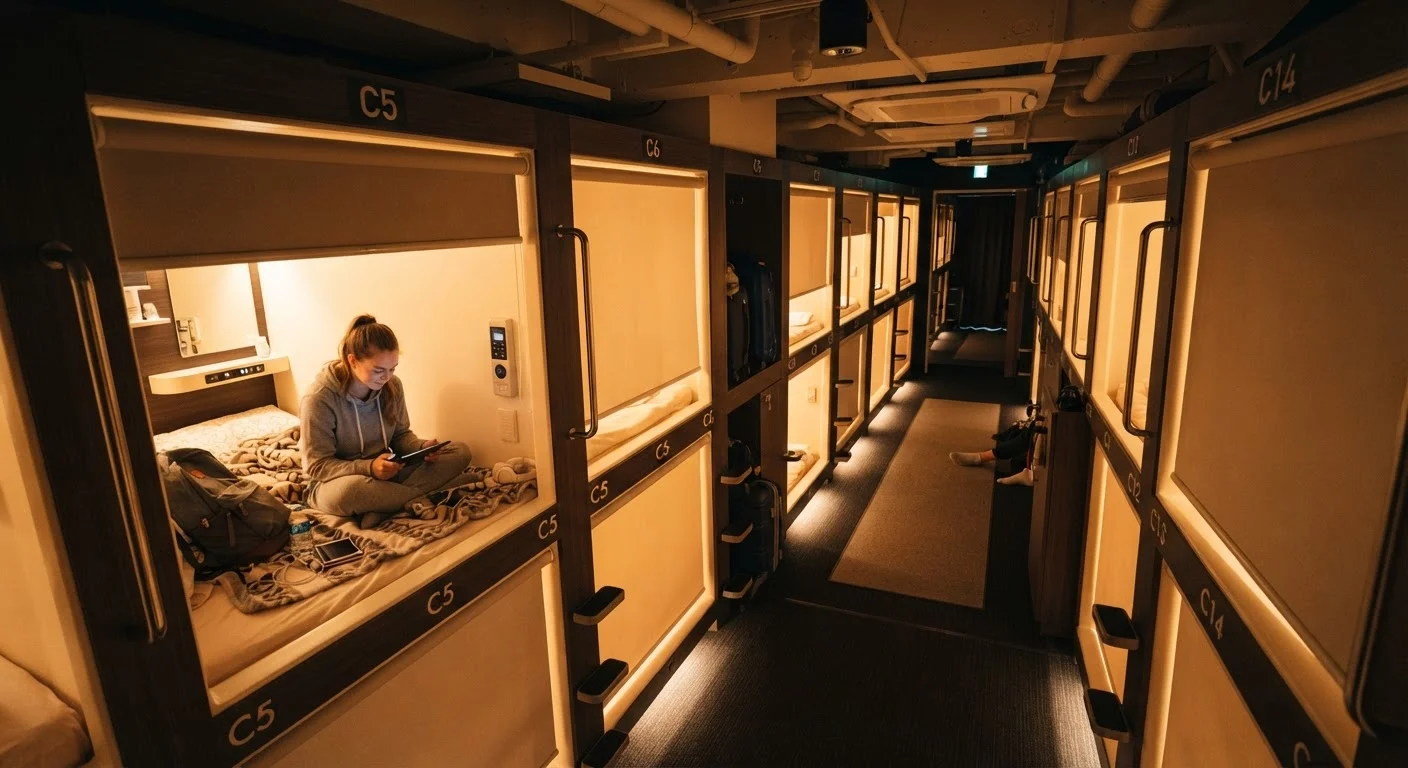
Originating in Japan, capsule hotels offer individual sleeping pods — typically a mattress, reading light, power outlet, and a privacy curtain or door — stacked in rows. Bathrooms, showers, and sometimes lounges are shared. The sleeping space itself is genuinely private in feel, even if the surroundings are communal.
In many Asian cities, capsule rates can be competitive with or lower than standard hostel dorm beds, while offering more personal space. In Western cities where they've appeared, pricing tends to run higher, though often still below a budget private room. Luggage storage is usually available but may be limited in size.
Capsule hotels work well for solo travelers on overnight transit stays or short city visits who want a reliable, private sleeping space without paying for a full hotel room. They're less suited to anyone who is claustrophobic, traveling with a partner, or carrying large bags.
Capsule hotels deliver hostel-level pricing with more personal sleeping space than a shared dorm.
Couchsurfing and Home-Stay Networks
Couchsurfing — staying as a guest in a local's home, typically at no cost — operates through online community platforms where hosts offer a couch, spare room, or floor space to vetted travelers. The model is built on reciprocity: guests are expected to engage genuinely with their hosts, not simply treat the arrangement as a free hotel.
The appeal is obvious: accommodation cost drops to zero. The reality requires more effort. Securing a reliable host in a popular city takes time, good communication, and a completed profile with references. Not every request is accepted. Safety depends heavily on reading reviews carefully and using platforms with verification systems — verify any platform's safety features and trust mechanisms before participating.
This option works best for flexible, social travelers who see the host interaction as part of the experience rather than an inconvenience. It's generally not practical for couples or families, or for trips where arrival times and plans are fixed.
Couchsurfing reduces accommodation cost to zero — but requires time, trust-building, and genuine community participation.
Camping and Dispersed Camping
Camping ranges from developed campgrounds with fee structures, electric hookups, and bathrooms, to free dispersed camping on public land where regulations permit. In the US, dispersed camping on many national forest and Bureau of Land Management (BLM) lands is permitted at no cost, though rules vary significantly by location — always verify current rules with the relevant land management agency before planning a stay.
The per-night cost can be very low or zero, but the full picture includes gear (tent, sleeping bag, pad), transport to the site, and the time cost of cooking and managing logistics without amenities. For travelers who already own gear and are on road trips, camping can be genuinely economical. For those who need to buy or rent equipment, the savings shrink considerably.
Weather, insects, and variable site conditions are real factors. Urban camping is rarely an option, so this approach suits destination-focused or nature-oriented trips rather than city-hopping itineraries.
Free dispersed camping is a real option in the US — but logistics, gear costs, and location limits apply.
Work Exchanges and Volunteer Stays
Platforms facilitating work exchanges connect travelers with hosts — farms, hostels, guesthouses, community projects — who offer accommodation (and sometimes meals) in exchange for a set number of hours of work per day, typically four to five. Tasks vary: gardening, reception shifts, cooking, animal care, or maintenance.
The financial savings can be significant on longer stays, effectively eliminating accommodation costs entirely. The trade-off is flexibility: you're committing to a schedule, a location, and a working relationship. Quality varies widely between hosts, and it's important to read past volunteer reviews carefully and understand expectations before committing.
This works best for slower-paced travel, extended trips, or travelers who want to spend meaningful time in one place. It's not suited to fast-moving itineraries or anyone who needs consistent free time during the day. Budget stay options shift considerably across different travel styles — work exchanges tend to suit solo backpackers most naturally.
Work exchanges can eliminate accommodation costs entirely, but require schedule commitment and careful host vetting.
Overnight Transport as Accommodation
Booking overnight trains, buses, or ferries on legs where these options exist means the transit cost covers both the journey and the night's sleep. A sleeper train between cities, for example, removes a hotel night from the budget while advancing the itinerary — a genuine double-saving when the math works out.
The quality of overnight transport varies dramatically: European rail sleepers with proper beds are very different from a reclining bus seat on a 10-hour coach ride. Factor in sleep quality, arrival time (many overnight arrivals land in the early hours, requiring somewhere to store luggage or kill time), and whether the transport cost is actually lower than a budget room plus a daytime journey.
This approach fits best within longer overland routes where overnight connections exist and where the traveler has flexibility around arrival logistics. It's a genuine cost tool, not a guaranteed saving — run the numbers for each specific route before assuming it's cheaper.
Overnight transport can combine a journey and a night's accommodation into a single cost — but sleep quality varies widely.
Choosing the Right Unconventional Option for Your Trip
No single alternative works for every traveler or destination. Capsule hotels suit urban solo travelers who need convenience and a reliable night's sleep. Couchsurfing rewards those with time, social energy, and flexibility. Camping fits travelers with gear, a vehicle, or access to outdoor destinations — and the ability to handle variable conditions.
Mix Strategies Across a Longer Trip
Rather than committing to one accommodation style for an entire journey, consider using different approaches for different legs. A capsule hotel for a one-night city stop, a couchsurf in a destination where you have more time, camping on a road segment — this kind of mixing tends to produce better overall savings and experience than any single approach alone. Build in enough flexibility in your itinerary to take advantage of options as they arise.
It's also worth remembering that accommodation type is just one part of the cost equation. Where a place sits relative to transit, food, and activities matters too. A free campsite 45 minutes from town by rideshare may not deliver the savings it appears to on paper. How accommodation location affects total trip cost is worth reading before committing to any outlying option.
Travelers who are weighing unconventional stays against more standard hostel options may also find it useful to compare shared dorm vs. private hostel room trade-offs before deciding. And if you're planning a multi-night stay in one city, short-term rentals vs. budget hotels may outperform all of the options listed here on pure per-night value.
Mixing strategies — a capsule hotel in Tokyo, a couchsurf in a smaller city, a night of free camping on a road trip — is often the most practical approach for stretching a travel budget without sacrificing every comfort along the way.