

Key Takeaways
- Car ownership typically costs $10,000-$12,000 per year when all expenses are included, not just the monthly payment.
- Car-free living can reduce transportation spending dramatically, but only in areas with viable alternatives.
- Hidden car costs-depreciation, insurance, parking-are often underestimated by first-time owners.
- Going car-free may require trade-offs in convenience, time, and where you choose to live.
- Hybrid approaches, like one-car households using occasional rideshare, can balance cost and flexibility.
Option A
Car Ownership
The familiar, flexible-but expensive-default.
Best for: Households in areas with limited transit, long commutes, or frequent hauling and family transportation needs.
Option B
Car-Free Living
The leaner, location-dependent alternative.
Best for: People living in walkable cities or dense suburbs with reliable transit, carshare, and bike infrastructure.
If you live in a walkable city with solid public transit
Car-Free Living
Transit passes, carshare memberships, and occasional rideshare almost always cost less than full car ownership in dense urban areas.
If you live in a suburban or rural area with limited transit options
Car Ownership
Without reliable alternatives, car ownership is often a practical necessity rather than a lifestyle choice.
If you want to cut costs but aren't ready to go fully car-free
Car Ownership
Downsizing to one vehicle and supplementing with transit or carshare can meaningfully reduce household transportation costs.
If you're a single adult with a flexible schedule and urban zip code
Car-Free Living
Single-person households tend to see the fastest return on going car-free, since all saved costs benefit one budget directly.
The Full Cost of Owning a Car
Most people think of car ownership in terms of a monthly loan payment. But that figure typically represents only a fraction of what a vehicle actually costs to keep on the road.
According to the American Automobile Association (AAA), the average cost of owning and operating a new vehicle in the U.S. has exceeded $10,000 per year in recent annual studies. That figure bundles together loan payments or lease costs, fuel, insurance, maintenance and tires, registration and taxes, and depreciation-the portion of a car's value it loses over time.
Depreciation alone can account for thousands of dollars annually, especially in the first few years of ownership. Insurance varies widely by state, driver history, and vehicle type, but averages over $1,500 per year nationally. Add parking costs in urban areas and the number climbs further.
For a deeper look at every expense category, see our guide to car ownership costs beginners underestimate. It's easy to focus on the sticker price, but the total cost of ownership goes well beyond the purchase price.
| Criterion | Car Ownership | Car-Free Living |
|---|---|---|
| Typical annual cost | $10,000-$12,000+ | $2,000-$5,000 |
| Upfront commitment | Down payment, financing | Transit pass, bike, or carshare fee |
| Flexibility | High - go anywhere, anytime | Depends on local infrastructure |
| Depreciation exposure | Yes - significant first few years | None |
| Insurance required | Yes - mandatory in most states | No auto insurance needed |
| Maintenance responsibility | Owner's full responsibility | No personal vehicle to maintain |
| Location dependency | Works anywhere | Best in walkable, transit-rich areas |
| Time cost | Traffic, parking time | Transit wait times, transfers |
What Car-Free Living Actually Costs
Ditching a car doesn't mean zero transportation spending-it means replacing one cost structure with another. The key question is whether that replacement is cheaper for your specific situation.
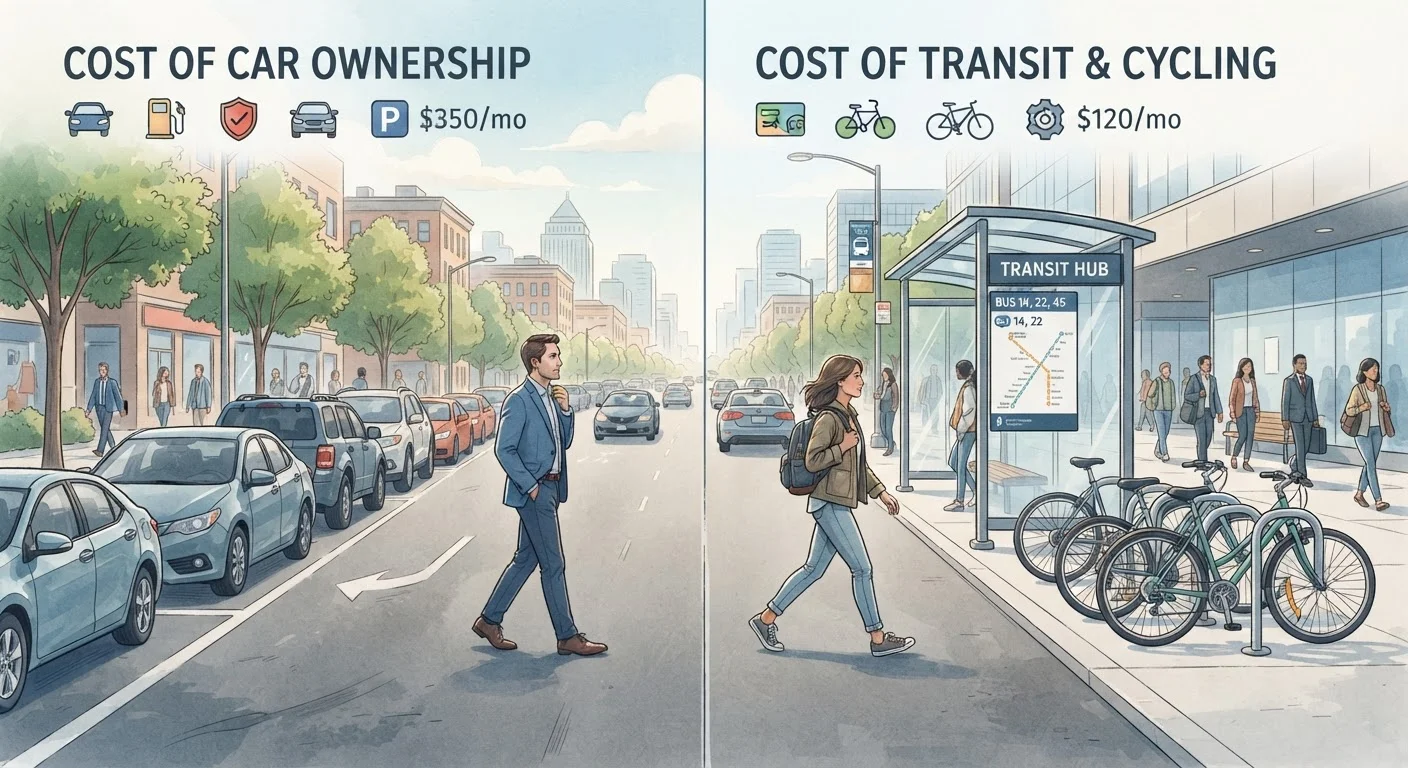
A monthly transit pass in most major U.S. cities runs between $80 and $130. Add occasional rideshare rides, a carshare membership for errands, and perhaps an e-bike or bike maintenance fund, and a realistic annual car-free transportation budget might land between $2,000 and $5,000 depending on usage patterns and city.
That's a significant potential savings compared to $10,000+ per year in car ownership-but it comes with conditions. Car-free living works best where transit is frequent and reliable, destinations are reachable without a car, and the lifestyle is compatible with your work and family situation.
Going car-free in a suburban environment is a different challenge than doing it in a dense city. Our article on living without a car in a suburban area covers what approaches have actually worked for households in those settings.
$10,728
Average annual car ownership cost (AAA)
AAA's annual 'Your Driving Costs' study consistently finds total ownership costs well above what most buyers anticipate.
~$1,500
Average annual U.S. auto insurance premium
The National Association of Insurance Commissioners tracks average auto insurance expenditures; figures vary significantly by state and driver profile.
20-30%
Typical new car depreciation in year one
Many automotive industry analyses estimate a new vehicle loses a significant portion of its value within its first year of ownership.
Trade-Offs That Don't Show Up in the Numbers
Cost is only part of the comparison. Time and convenience are real currencies too.
Car owners gain flexibility-the ability to leave when they want, haul groceries, drive in bad weather, and reach destinations that transit doesn't serve. These advantages are harder to quantify but very real in daily life.
Car-free commuters may spend more time in transit, transfer between routes, or face reliability gaps when systems run late. On the other hand, many car-free people report lower stress from avoiding traffic and reduced financial anxiety from eliminating insurance and loan payments.
Where you live has an outsized influence on these trade-offs. Households reconsidering a second vehicle-not necessarily all car ownership-often find a middle path. Our article on one car vs. no car explores how families are navigating that decision.
For those who want to explore what's available beyond traditional ownership, the full map of modern transportation alternatives outlines options from e-bikes to transit passes. And if you're curious how rideshare, carshare, and rental differ in practice, see how rideshare, carshare, and rental actually affect your wallet.
A Middle Path Worth Considering
Many households don't face a binary choice between full ownership and going entirely car-free. Reducing from two vehicles to one, combining ownership with transit for commuting, or using carshare for occasional needs can deliver real savings while preserving flexibility. The complete picture on getting around without driving covers how to mix and match options realistically. Running the numbers for your specific commute, neighborhood, and lifestyle is the most reliable way to find what works.