

Key Takeaways
- Monthly mortgage payments represent only a portion of the true cost of homeownership.
- Renting has hidden costs too — deposits, renters insurance, and annual rent increases add up.
- Opportunity cost of a down payment is a real financial factor renters avoid.
- Property taxes, maintenance, and HOA fees can add 2–4% of a home's value annually.
- Neither renting nor owning is universally the better financial choice — time horizon matters most.
Our Verdict
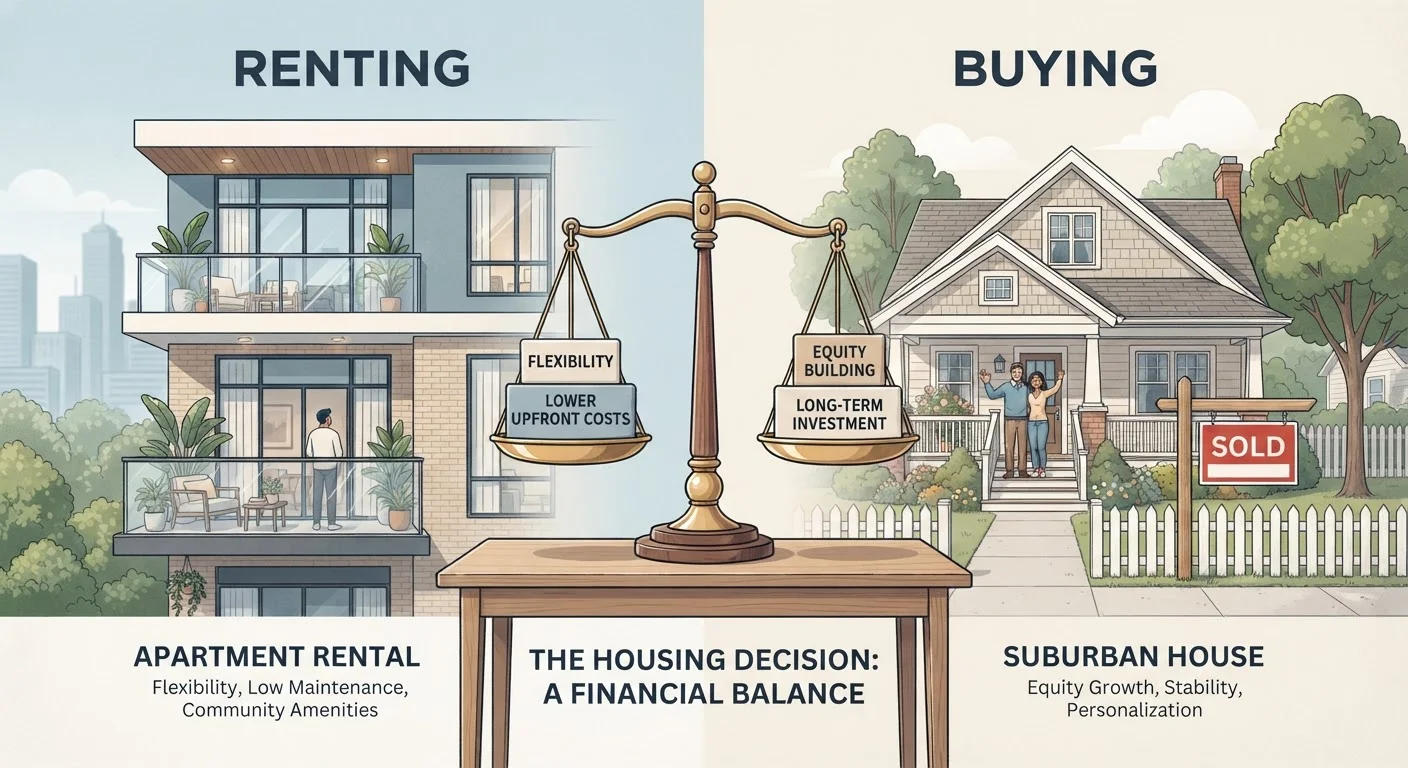
Owning a home builds equity over time but front-loads significant costs and responsibilities that renters avoid entirely. Renting preserves flexibility and liquidity but offers no asset accumulation. The financially stronger choice depends heavily on how long you plan to stay, local market conditions, and your capacity to absorb irregular ownership expenses.
| Best for | Recommended |
|---|---|
| Those planning to stay in one location for seven or more years | Owning |
| Those prioritizing flexibility or living in a high-cost market | Renting |
| Those with limited savings for emergencies beyond a down payment | Renting |
| Those seeking long-term wealth building through asset appreciation | Owning |
Why the Monthly Payment Comparison Misleads You
Most people start the rent-vs-buy conversation by comparing a monthly rent figure to an estimated mortgage payment. It's an understandable starting point — but it's incomplete in ways that can cost thousands of dollars in unpleasant surprises.
A mortgage payment covers principal and interest, but homeownership layers on property taxes, homeowner's insurance, private mortgage insurance (PMI) if your down payment is under 20%, HOA fees, and routine maintenance. Renters, meanwhile, face their own costs beyond base rent: security deposits, renters insurance, parking fees, and annual rent increases. For a fuller picture of what renting actually costs, see The True Cost of Renting.
The only way to make a fair comparison is to account for every line item on both sides — and then factor in what happens to your money over time.
| Cost Category | Renting | Owning | |
|---|---|---|---|
| Monthly base cost | Rent payment | Principal + interest | |
| Property taxes | Not applicable | 1–1.5% of value annually | |
| Insurance | Renters insurance (~$15–$30/mo) | Homeowner's insurance (~$100–$200/mo) | |
| Maintenance & repairs | Landlord's responsibility | 1–3% of home value per year | |
| Upfront costs | Security deposit (1–2 months rent) | Down payment + closing costs (7–25%) | |
| Equity building | None | Yes, over time via amortization | |
| Flexibility to relocate | High (lease terms) | Low (transaction costs) | |
| Exposure to market risk | None on property value | Yes, values can decline |
The Real Annual Cost of Owning a Home
Industry benchmarks suggest homeowners should budget 1–3% of their home's value annually for maintenance and repairs alone. On a $350,000 home, that's $3,500–$10,500 per year — before touching property taxes or insurance. These costs are irregular and lumpy: a new roof or HVAC system can easily run $10,000–$20,000 in a single year.
Property taxes vary significantly by state and county, but the national average hovers around 1–1.5% of assessed value annually. Homeowner's insurance typically adds another 0.5–1%. Layer in HOA fees where applicable, and the ongoing cost of ownership can add 2–4% of home value per year beyond the mortgage itself.
For a comprehensive breakdown of these recurring costs, The Full Financial Picture of Owning a Home walks through each category in detail.
Build a Maintenance Reserve Before You Buy
Financial planners commonly recommend setting aside 1–1.5% of your home's purchase price in a dedicated savings account before closing. This reserve cushions against the first major repair — roof, HVAC, water heater — which statistically tends to occur within the first few years of ownership. Treating maintenance as a predictable expense, rather than a surprise, is one of the clearest ways to protect your household budget.
The Opportunity Cost Renters and Owners Both Face
One of the most overlooked factors is opportunity cost — what your money could have earned if deployed differently. Homeowners tie up a down payment (typically 5–20% of purchase price) in an illiquid asset. That capital cannot be easily redirected while it's locked in home equity.
A renter who keeps $60,000 in savings rather than using it as a down payment has options: investing it in a diversified portfolio, maintaining a larger emergency fund, or remaining agile for career moves. Whether those alternatives outperform home appreciation depends on local real estate markets and investment returns — neither of which is guaranteed.
Owners, in turn, benefit from leverage: a 10% appreciation on a $400,000 home generates $40,000 in gain on a $40,000 down payment — a 100% return on that capital. But leverage works in reverse during downturns, too. This is general financial education, not a prediction of returns; consult a qualified financial adviser before making decisions based on your individual situation.
1–3%
Annual maintenance cost as share of home value
A widely cited industry benchmark used by housing economists and financial planners to estimate homeowner repair budgets.
5–7 years
Typical break-even horizon for buying vs. renting
Housing researchers generally find that ownership's financial advantage over renting emerges after five to seven years in most stable markets.
2–5%
Typical buyer closing costs as share of purchase price
The Consumer Financial Protection Bureau cites this range as the standard cost of closing on a home purchase in the United States.
Time Horizon: The Factor That Changes Everything
Transaction costs make short-term ownership expensive. Buying a home typically involves closing costs of 2–5% of the purchase price. Selling later adds real estate agent commissions (commonly 5–6% of sale price) plus potential capital gains considerations. A homeowner who buys and sells within two or three years often doesn't accumulate enough equity to offset those friction costs.
The general rule of thumb used by housing economists is that owning typically makes stronger financial sense after five to seven years in a stable market. Below that threshold, renting often preserves more wealth simply by avoiding transaction costs.
If you're weighing the decision holistically — not just financially — Renting vs. Buying: How to Think Through the Decision offers a structured framework for both financial and lifestyle factors. You can also explore the financial and lifestyle trade-offs side by side for additional context.
Don't Ignore Selling Costs in Your Break-Even Math
Many buyers calculate whether they can afford to purchase but skip the math on what it costs to sell. Agent commissions, transfer taxes, and concessions to buyers can total 8–10% of a home's sale price. If you sell within a few years of buying, those exit costs can wipe out any equity you've built — and then some. Always model both the purchase and the eventual sale before concluding that buying is the financially stronger move.
Building a Fair Side-by-Side Comparison for Your Situation
Rather than relying on headlines or rules of thumb, you can construct a rough personal comparison using a few inputs:
- Total monthly ownership cost: Add mortgage P&I + property tax estimate + insurance + HOA + 1.5% of home value divided by 12 for maintenance reserve.
- Total monthly rental cost: Add base rent + renters insurance + any parking or utility premiums not covered by landlord.
- Annual rent escalation: Historically, rents in many US markets have risen 3–5% annually, though this varies substantially by region.
- Equity accumulation: Use an amortization table to see how much of each mortgage payment reduces your loan balance in the early years (it's less than most expect).
- Down payment opportunity cost: Model what that lump sum might grow to over your time horizon in a conservative investment scenario.
No calculator produces a guaranteed answer, but this exercise reveals which assumptions are doing the most work in your decision. For a broader look at how ownership decisions play out across different asset types, see our Renting Basics hub for foundational guidance.
This article is for general informational and educational purposes only and does not constitute financial, tax, legal, or investment advice. Consult a qualified financial adviser or real estate professional before making decisions specific to your circumstances.