
Renting vs. Buying a Home: Understanding the Financial and Lifestyle Trade-Offs

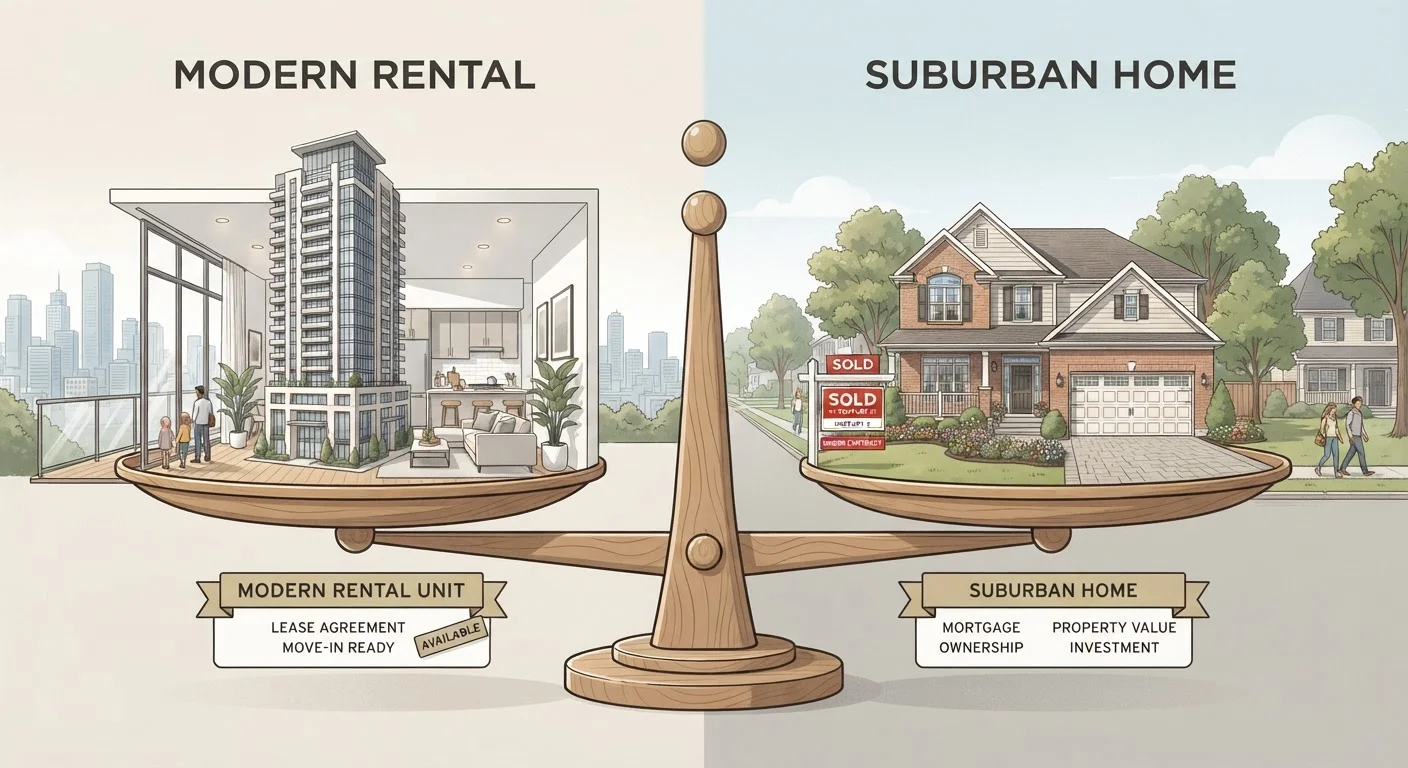
Key Takeaways
- Renting offers flexibility and lower upfront costs, while buying builds equity over time.
- Homeownership carries hidden costs — maintenance, taxes, and insurance — beyond the mortgage payment.
- Your local housing market, financial stability, and life plans all shape which option makes more sense.
- Neither renting nor buying is inherently "throwing money away" — both serve legitimate financial purposes.
- The break-even timeline for buying typically ranges from five to seven years, depending on the market.
Low upfront financial commitment to get started
Renters typically need a security deposit and first month's rent — a fraction of the down payment and closing costs required to buy. This preserves capital for other financial goals.
Geographic flexibility to move when life changes
Renters can relocate for jobs, relationships, or lifestyle preferences at lease end without the complex, costly process of selling a home.
No exposure to property maintenance costs
Major repairs — a failing HVAC system, roof damage, plumbing failures — are the landlord's financial responsibility, shielding renters from unpredictable large expenses.
Equity grows with each mortgage payment made
A portion of every mortgage payment reduces the loan principal, gradually increasing the owner's stake in the property — a form of wealth accumulation renters don't directly access.
Fixed-rate mortgages provide long-term payment predictability
Unlike rents, which can rise at renewal, a fixed-rate mortgage locks in the principal and interest payment for the loan's lifetime, making long-term budgeting more stable.
Freedom to personalize and renovate the property
Homeowners can repaint, remodel, landscape, or make structural changes without seeking landlord permission, tailoring the home to their specific needs.
Rent increases can erode budgeting stability
Landlords may raise rent at each lease renewal, sometimes significantly in competitive markets. Renters have limited control over long-term housing costs.
No equity accumulation from monthly rent payments
Rent payments fund housing access but do not build ownership stake or a recoverable asset, unlike mortgage principal repayment.
High transaction costs make short-term buying expensive
Buying and later selling a home within a few years often results in a net financial loss once agent commissions, closing costs, and moving expenses are accounted for.
Maintenance and repair costs fall entirely on owners
Homeowners should expect to spend 1–2% of their home's value annually on upkeep — costs that can spike unexpectedly with aging systems or storm damage.
Large illiquid asset reduces financial flexibility
A significant portion of a homeowner's net worth may be tied up in home equity, which cannot be accessed quickly without selling or borrowing against the property.
Lease non-renewals can force disruptive moves
Landlords can choose not to renew a lease, leaving renters with limited notice to find alternative housing — a situation particularly stressful in tight rental markets.
Our Verdict
Renting and buying are both sound choices when matched to the right circumstances. Buying generally makes more financial sense for people who plan to stay put for at least five to seven years, have stable income, and can absorb homeownership's ongoing costs. Renting is often the smarter move for those who value flexibility, are in career or life transition, or live in markets where purchase prices are extremely high relative to rents.
Buying suits financially stable individuals with long-term location commitment; renting suits those prioritizing mobility, lower upfront costs, or living in high price-to-rent-ratio markets.
Why the Rent-vs.-Buy Question Has No Universal Answer
The decision to rent or buy a home is one of the most consequential financial choices most people make — yet there is no single correct answer. Local market conditions, personal finances, career stability, and lifestyle priorities all interact in ways that make blanket advice misleading.
A common misconception is that renting is "wasting money" while buying always builds wealth. In reality, renting can be the financially rational choice in high-cost markets or during uncertain life phases, while buying can be a poor decision if you move before recouping transaction costs. See our fact-check of common home-buying myths for a closer look at where this reasoning breaks down.
A more useful framework examines the real trade-offs on both sides — financial and personal — so you can weigh them against your own situation.
The Price-to-Rent Ratio: A Quick Market Check
The price-to-rent ratio compares a home's purchase price to its annual rental equivalent. To calculate it, divide the asking price of a home by the annual rent for a comparable unit in the same area. Ratios below 15 generally suggest buying may be financially advantageous; ratios above 20 often indicate renting is more cost-effective. This is a rough screening tool, not a definitive guide — local tax rates, future appreciation, and personal circumstances all matter. For a fuller comparison, see our guide to thinking through the rent-vs-buy decision.
The Case for Renting: Flexibility, Lower Entry Costs, and Predictability
Renting provides advantages that are often undervalued in popular discourse. Before committing to either path, it helps to understand what renting actually costs beyond monthly rent — deposits, utilities, and fees included.
Low upfront financial commitment to get started
Renters typically need a security deposit and first month's rent — a fraction of the down payment and closing costs required to buy. This preserves capital for other financial goals.
Geographic flexibility to move when life changes
Renters can relocate for jobs, relationships, or lifestyle preferences at lease end without the complex, costly process of selling a home.
No exposure to property maintenance costs
Major repairs — a failing HVAC system, roof damage, plumbing failures — are the landlord's financial responsibility, shielding renters from unpredictable large expenses.
Equity grows with each mortgage payment made
A portion of every mortgage payment reduces the loan principal, gradually increasing the owner's stake in the property — a form of wealth accumulation renters don't directly access.
Fixed-rate mortgages provide long-term payment predictability
Unlike rents, which can rise at renewal, a fixed-rate mortgage locks in the principal and interest payment for the loan's lifetime, making long-term budgeting more stable.
Freedom to personalize and renovate the property
Homeowners can repaint, remodel, landscape, or make structural changes without seeking landlord permission, tailoring the home to their specific needs.
Renting also offloads maintenance responsibility to the landlord, which has real dollar value. Homeowners commonly budget 1–2% of their property's value annually for upkeep and repairs — a figure that can reach several thousand dollars per year on a median-priced home.
The Case for Buying: Equity, Stability, and Long-Term Control
Homeownership offers benefits that extend well beyond a monthly cost comparison. Mortgage payments gradually reduce your loan balance, building equity — a form of forced savings that renting does not replicate directly. Over decades, that equity can become a significant asset.
Low upfront financial commitment to get started
Renters typically need a security deposit and first month's rent — a fraction of the down payment and closing costs required to buy. This preserves capital for other financial goals.
Geographic flexibility to move when life changes
Renters can relocate for jobs, relationships, or lifestyle preferences at lease end without the complex, costly process of selling a home.
No exposure to property maintenance costs
Major repairs — a failing HVAC system, roof damage, plumbing failures — are the landlord's financial responsibility, shielding renters from unpredictable large expenses.
Equity grows with each mortgage payment made
A portion of every mortgage payment reduces the loan principal, gradually increasing the owner's stake in the property — a form of wealth accumulation renters don't directly access.
Fixed-rate mortgages provide long-term payment predictability
Unlike rents, which can rise at renewal, a fixed-rate mortgage locks in the principal and interest payment for the loan's lifetime, making long-term budgeting more stable.
Freedom to personalize and renovate the property
Homeowners can repaint, remodel, landscape, or make structural changes without seeking landlord permission, tailoring the home to their specific needs.
Ownership also provides stability: fixed-rate mortgage payments don't rise the way rents sometimes do. For a deeper look at how mortgage structures affect long-term costs, see our guide to fixed-rate vs. adjustable-rate mortgages. Buyers also gain control over their space — the ability to renovate, keep pets, or make the home their own without landlord approval.
5–7 years
Typical break-even timeline for buying vs. renting
Real estate analysts generally estimate that buyers need to stay in a home for at least five to seven years to recoup transaction costs and come out ahead financially compared to renting.
1–2%
Annual home value budgeted for maintenance
Industry guidance commonly cites 1–2% of a home's purchase price as a reasonable annual maintenance budget, meaning a $400,000 home may require $4,000–$8,000 per year in upkeep.
5–10%
Upfront costs as share of home purchase price
Between down payments, closing costs, inspection fees, and moving expenses, buyers should typically budget 5–10% of the purchase price in out-of-pocket costs before moving in.
The Real Drawbacks of Each Path
Neither option is without significant downsides. Buying involves substantial upfront costs — down payments, closing costs, inspections, and moving expenses — that can total 5–10% of the purchase price before you ever unlock the front door. Ongoing costs compound this: property taxes, homeowners insurance, HOA fees, and maintenance are detailed thoroughly in the homeownership costs hub.
Rent increases can erode budgeting stability
Landlords may raise rent at each lease renewal, sometimes significantly in competitive markets. Renters have limited control over long-term housing costs.
No equity accumulation from monthly rent payments
Rent payments fund housing access but do not build ownership stake or a recoverable asset, unlike mortgage principal repayment.
High transaction costs make short-term buying expensive
Buying and later selling a home within a few years often results in a net financial loss once agent commissions, closing costs, and moving expenses are accounted for.
Maintenance and repair costs fall entirely on owners
Homeowners should expect to spend 1–2% of their home's value annually on upkeep — costs that can spike unexpectedly with aging systems or storm damage.
Large illiquid asset reduces financial flexibility
A significant portion of a homeowner's net worth may be tied up in home equity, which cannot be accessed quickly without selling or borrowing against the property.
Lease non-renewals can force disruptive moves
Landlords can choose not to renew a lease, leaving renters with limited notice to find alternative housing — a situation particularly stressful in tight rental markets.
Renting carries its own risks: lease non-renewals, rent increases, and limited control over the space. For a side-by-side financial comparison that goes beyond monthly payments to include taxes, maintenance, equity, and opportunity cost, see our realistic cost comparison.
Key Factors That Should Tip the Decision
Rather than asking "which is better," focus on which factors are most relevant to your position right now:
- Time horizon: Buying typically makes financial sense only if you plan to stay for at least five to seven years. Transaction costs at purchase and sale eat into returns for shorter stays.
- Price-to-rent ratio: Divide the local home price by annual rent for a comparable unit. Ratios above 20 generally favor renting; below 15 generally favor buying.
- Financial cushion: Beyond a down payment, buyers need liquid reserves for repairs and emergencies. If buying would deplete all savings, the risk exposure is significant.
- Income stability: A mortgage is a multi-decade commitment. Buyers should have reliable income and a clear sense of job security.
- Life plans: Relationship changes, family growth, career relocations — these can make flexibility more valuable than equity accumulation.
For a broader framework applicable to other rent-or-own decisions, the renting vs. buying framework for everyday items offers useful mental models. And if you're leaning toward buying, our home-buying guide is a practical next step.
This article is for general informational purposes only and does not constitute financial, legal, or real estate advice. Readers should consult a qualified financial adviser or real estate professional before making decisions based on their individual circumstances.