

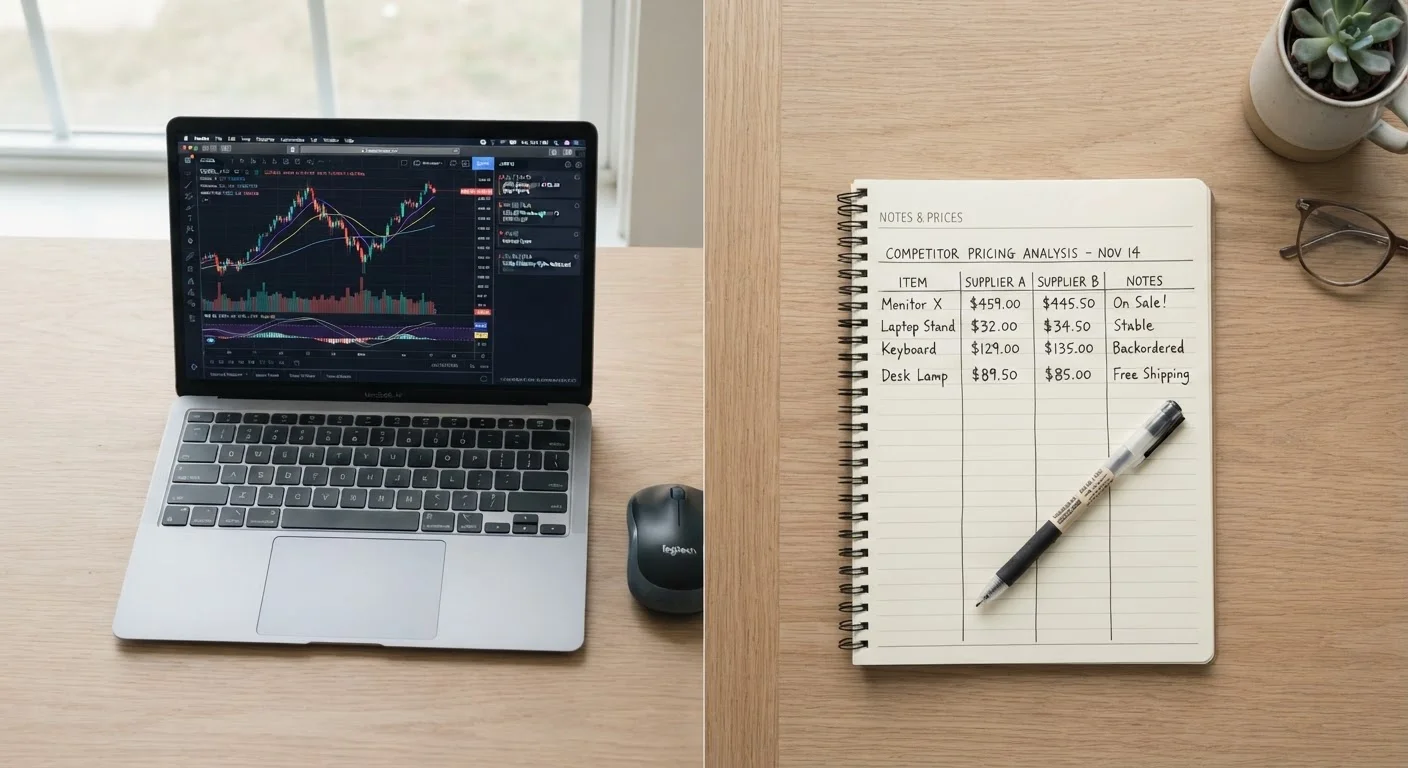
Key Takeaways
- Price tracking tools save time on repeat purchases but may miss retailer-exclusive deals or loyalty pricing.
- Manual comparison gives you full context — including shipping fees, return policies, and bundle offers — that tools can overlook.
- Most shoppers benefit from a hybrid approach: tools for monitoring, manual checks before finalising any significant purchase.
- Automated alerts can desensitise you to prices if not configured carefully — set meaningful thresholds.
- Manual comparison tends to be more reliable for categories with frequent bundling or variable product specs.
Option A
Price Tracking Tools
The automated, set-it-and-forget-it approach.
Best for: Shoppers who want ongoing price monitoring across multiple items without repeated manual effort.
Option B
Manual Comparison Shopping
The hands-on, deliberate research method.
Best for: Shoppers making infrequent, high-stakes purchases where context and nuance matter most.
If you track prices on items you plan to buy eventually
Price Tracking Tools
Automated alerts remove the need to check back repeatedly, letting you act when a price genuinely drops to your target.
If you're making a one-time, high-value purchase
Manual Comparison Shopping
The extra context you gather — warranty terms, shipping speed, seller reputation — can matter as much as the sticker price.
If you shop across many categories regularly
Price Tracking Tools
Monitoring dozens of items manually is impractical; tools handle the volume so you only act on meaningful price movements.
If you're shopping for groceries or items with complex bundling
Manual Comparison Shopping
Unit pricing, store-card discounts, and bundle deals are often invisible to automated trackers and reward hands-on research.
If you want a reliable routine before any significant purchase
Manual Comparison Shopping
A structured manual check catches hidden fees and policy differences that automation rarely surfaces.
What Each Approach Actually Involves
Price tracking tools are browser extensions, apps, or websites that monitor a product's listed price at one or more retailers over time. When the price drops to a level you specify, they notify you — by email, push alert, or in-app message. You set them up once and largely leave them running.
Manual comparison shopping means actively searching multiple retailers yourself at the time of purchase: checking each site, comparing listed prices, factoring in shipping costs, reading return policies, and sometimes calling a store directly. It's deliberate and time-intensive, but it puts you in full control of what you're comparing.
For a solid grounding in how price comparison works across both methods, see our introduction to comparing prices. Understanding the fundamentals makes both approaches more effective.
| Criterion | Price Tracking Tools | Manual Comparison Shopping |
|---|---|---|
| Time investment | Low — automated after setup | Higher — active research each time |
| Price history access | Built-in for supported retailers | Requires separate lookups |
| Covers loyalty/in-store deals | Rarely | Yes, if you check directly |
| Compares full purchase context | Limited — price-focused only | Yes — fees, terms, specs included |
| Best purchase scale | Multiple items monitored at once | Single high-value purchase |
| Risk of misleading data | Moderate — depends on data feeds | Lower when done carefully |
| Setup required | Yes — initial configuration | None — start immediately |
Where Price Tracking Tools Have an Edge
The clearest advantage of automated tools is persistence. They keep watching a product while you do other things. For items you know you want but aren't in a rush to buy — say, a kitchen appliance or a piece of electronics — a tracker can catch a genuine price drop that you'd otherwise miss by checking sporadically.
Tools also provide price history, which is arguably their most valuable feature. Knowing that a product's "sale" price is actually higher than its average price over the past three months helps you avoid being misled by inflated reference prices. For more on interpreting that data, see how price history tracking changes how you shop.
~15 min
Average time per manual multi-retailer check
Consumer behaviour researchers generally estimate that a thorough manual price check across three to five retailers takes 10–20 minutes per product.
3–6 months
Typical price history window in tracking tools
Most browser-based price trackers display 90 to 180 days of price history, which is enough to identify seasonal patterns for many product categories.
The time savings are real for high-volume shoppers. If you're monitoring ten or more items simultaneously, manual daily checks would consume significant time each week. Tools compress that effort into a single notification.
Where Manual Comparison Holds Its Own
Automated tools are only as good as the data they can access. Many retailer-exclusive discounts, in-store-only prices, loyalty card rates, and bundle deals never appear in the feeds that tracking tools rely on. A manual check of a store's app or weekly circular can surface savings that no algorithm will flag.
Manual research also lets you compare things that aren't easily quantified: seller reliability, return window length, warranty terms, and whether a product's listed specs match what you actually need. These factors matter most for higher-stakes purchases.
It's also worth noting that automated alerts can create a false sense of confidence. If a tracker shows you a price drop, it's tempting to act immediately — but the tool may not be comparing identical product configurations. Common comparison mistakes like mismatched specs or ignored restocking fees are easy to make when you're relying entirely on a tool's output.
Category matters too. For groceries, clothing, and other bundled-purchase categories, see how comparison works differently by product type — manual methods often outperform automated ones here.
Not All Retailers Are Tracked Equally
Price tracking tools typically cover major e-commerce platforms well, but smaller retailers, marketplace third-party sellers, and physical store prices are often absent from their data. If your comparison matters — especially for a significant purchase — verify the tool's coverage before relying on its output exclusively.
Building a Practical Hybrid Routine
For most shoppers, the real answer isn't choosing one method over the other — it's knowing when to use each. A workable routine looks like this: use tracking tools to monitor items you're considering over weeks or months, then switch to a focused manual check before you actually buy.
That final manual step is what catches the details automated tools miss: current shipping estimates, whether the seller is reputable, and whether a competing retailer has a price-match policy that isn't indexed anywhere. See a practical pre-purchase price-check routine for a repeatable checklist that fits this workflow.
If you want to go further, building a personal log of what things normally cost — independent of any tool — gives you a reliable reference point. Building a price memory explains how to do that without a lot of overhead.
The goal is informed action, not just faster action. Time saved means little if the purchase turns out to be a poor value once all the details are accounted for. For a broader framework on making confident purchase decisions, the complete guide to comparing prices across stores and channels covers the full picture.