
The Anatomy of a Real Deal: What Separates Genuine Discounts from Marketing Illusions

Key Takeaways
- A 'sale' price is only meaningful when compared against a price the retailer actually charged regularly.
- Artificial reference prices — sometimes called 'compare at' inflation — are a documented retail practice.
- Price history tools let you verify whether a discount is real before you buy.
- Urgency language like 'today only' is a persuasion tactic, not evidence of a genuine deal.
- Retailers discount on predictable schedules, so timing purchases matters more than reacting to promotions.
- Stacking verified discounts is one of the most reliable ways to secure genuine savings.
Genuine Discount
A genuine discount is a price reduction from the amount a retailer actually charged — or typically charges — for an item under normal conditions. It differs from a manufactured discount, where the original price is inflated specifically to make a markdown look impressive. A real deal means you pay less than you would have otherwise, not just less than a number a retailer invented.
In retail pricing, the reference price — often called the 'was' or 'compare at' price — is regulated in some US states, which require that it reflect a price at which the item was genuinely offered for sale for a minimum period.
Why 'On Sale' Doesn't Always Mean Cheaper
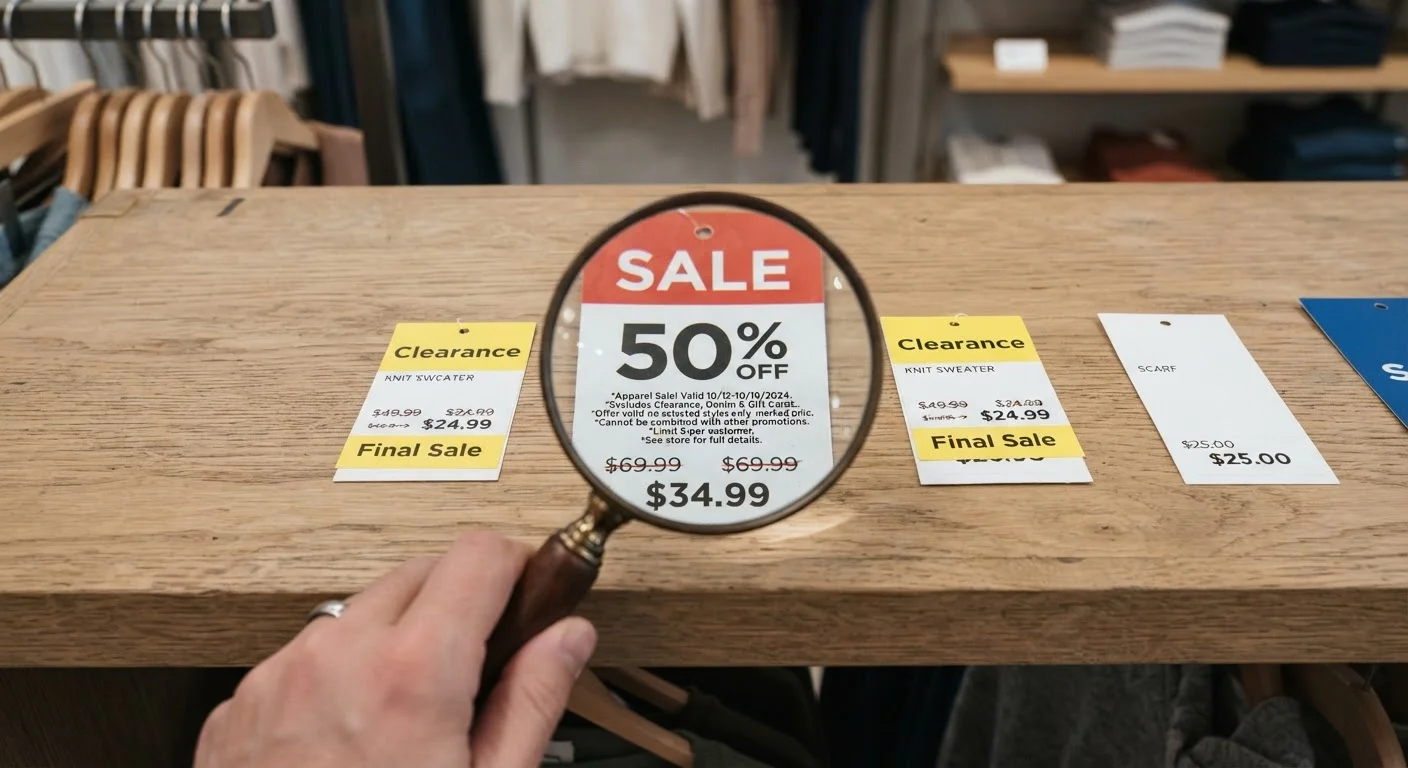
Walk through any large retailer and you'll see sale signs everywhere. The implication is simple: the price has come down. But the question worth asking is: down from what? The reference price — the crossed-out number meant to anchor your perception of value — is the key variable that most shoppers never verify.
Retailers have long used a tactic sometimes called reference price inflation: setting an artificially high original price so that a subsequent markdown looks dramatic. A jacket 'marked down' from $200 to $99 feels like a steal — unless the jacket was only ever priced at $200 for a few days before the 'sale' launched, and $99 is simply its everyday selling price.
This isn't fringe behavior. It's a documented commercial practice, and while US consumer protection rules in many states require that reference prices reflect genuine prior selling prices, enforcement is inconsistent. As a shopper, you can't rely on the law catching every instance — you need to verify prices yourself. See our guide to deal signals that reliably indicate savings for cues worth trusting.
State Laws on Reference Pricing Vary
Several US states — including California — have specific rules about how long a reference price must be in effect before it can legally be used as a comparison. However, these rules are enforced inconsistently and don't cover every seller, including many online marketplaces. Treat legal protections as a floor, not a guarantee, and verify prices independently.
The Tools That Reveal Price History
The most straightforward defense against manufactured discounts is price history data. Several browser extensions and comparison websites track the price of specific products across major retailers over time, showing you a graph of what an item actually sold for month by month. If a product's 'original' price only appeared for 48 hours before a sale event, that graph makes it visible.
When evaluating any promoted price, compare it to:
- The item's 30-to-90-day price history on the same retailer's site
- Current prices at competing retailers for the same model or SKU
- The price on a channel the retailer may not be promoting — for example, in-store versus online pricing often diverges in ways worth investigating. Our article on where prices actually differ between in-store and online explains when each channel is likely to offer genuine savings.
~40%
Shoppers who never verify reference prices
Consumer research has consistently found that a significant share of shoppers accept the 'original' price displayed at face value without independent verification.
2–3 days
Median duration some inflated reference prices are active
Pricing audits by consumer advocacy groups have found some 'was' prices are only in effect for a very short window before a promotional markdown begins.
70%+
Of major retail sales events that recur predictably
Analysis of retailer promotional calendars shows the vast majority of seasonal or event-based sales repeat on annual or quarterly schedules.
Recognizing Urgency as a Tactic, Not a Signal
Countdown timers, 'limited stock' banners, and 'today only' labels are persuasion tools. Their job is to compress your decision-making time so you buy before you have a chance to think critically. That doesn't mean every time-limited offer is fake — but it does mean urgency language is not evidence that a deal is genuine.
A practical test: search for the same promotion from the same retailer from the previous month. Many 'exclusive' or 'one-day' events recur on predictable cycles. Retailers tend to discount on calendars tied to inventory cycles, fiscal quarters, and seasonal demand — understanding those patterns lets you plan instead of react. For a deeper look, see the hidden logic behind retailer pricing calendars.
Add a Price Tracker Before You Browse
Install a price history browser extension before you start shopping, not after you've already found something you want. Checking price history after you're emotionally committed to a purchase makes it harder to walk away from an inflated 'discount.' Starting cold gives you cleaner data and a clearer head.
When a Discount Is Real: What to Look For
A genuine discount has verifiable characteristics. The price is lower than what the item sold for consistently over the recent past. The reference price reflects actual selling history rather than an inflated anchor. And the savings hold up when compared against other retailers, not just against the same store's own 'original' price.
Additional structures that can create real value — when applied to already-verified prices — include:
- Stackable offers: Combining a store sale with a promo code or cashback program can compound savings on a price that's already genuinely reduced. Learn when stacking is permitted in our overview of how to stack discounts without violating terms.
- End-of-line clearance on verified items: Clearance can reflect real inventory pressure — but always cross-check the clearance price against current market prices elsewhere before assuming it's the floor.
- Cashback on a competitive base price: Cashback returns a percentage of the purchase price, but its value depends entirely on whether the purchase price itself was fair. See our breakdown of cashback, coupons, and promo codes for how each discount type works.
For a comprehensive resource covering the full range of deal-finding strategies — from pricing psychology to timing tactics — the complete guide to finding deals as an everyday shopper is worth bookmarking.