

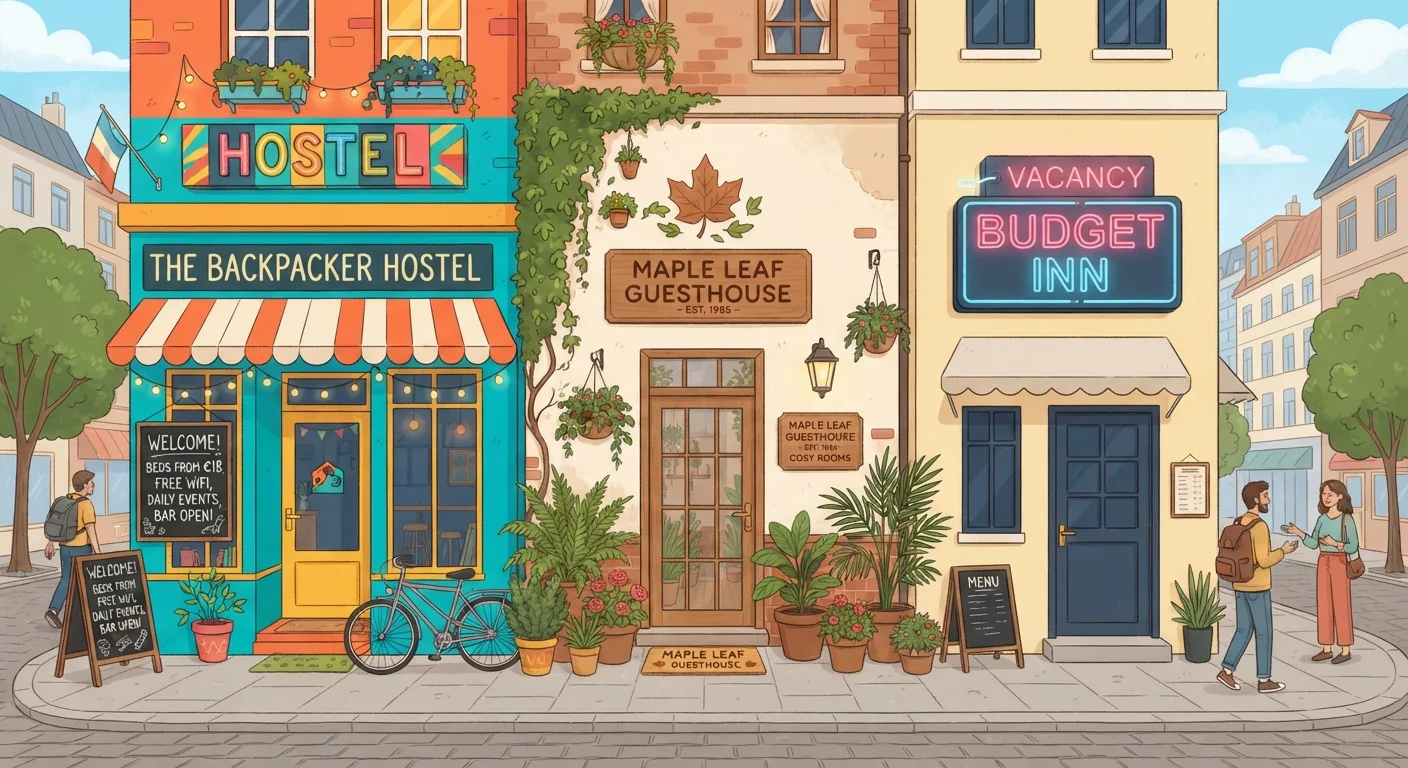
Key Takeaways
- Hostels typically offer shared dormitory rooms at the lowest per-night cost, along with common social spaces.
- Guesthouses are usually small, privately run properties offering private rooms with a more personal feel than a hotel.
- Budget hotels provide private rooms with standardized amenities but less character and fewer communal spaces.
- Privacy, price, and atmosphere are the three main variables that distinguish these accommodation types.
- Your travel style — solo backpacker, couple, or family — should guide which category suits you best.
Budget Accommodation Categories
Hostels, guesthouses, and budget hotels are three distinct types of affordable lodging, each with different ownership models, privacy levels, and included amenities. Understanding what separates them helps travelers match the right option to their priorities — whether that's cost, social atmosphere, or a quiet private room. They are not interchangeable terms for the same thing.
Lodging categories are not uniformly regulated across countries, so a property's self-designation (e.g., 'guesthouse') may not always align with the definitions below. Reading individual listings critically matters more than trusting the label alone.
Why the Label on the Door Matters Less Than You Think
Budget travelers scanning accommodation listings quickly learn that the words "hostel," "guesthouse," and "budget hotel" get used loosely — sometimes interchangeably. That ambiguity costs people money and comfort when they arrive expecting one experience and find another. Getting clear on what these categories typically mean (and where they blur) is the foundation of smarter booking.
The core difference comes down to three variables: privacy, price structure, and atmosphere. Once you understand how each accommodation type sits on those three axes, choosing becomes considerably easier.
Category Labels Vary by Country
In some countries, the term 'guesthouse' is used to describe what would be called a hostel elsewhere, and vice versa. In parts of Southeast Asia and Africa, 'guesthouse' can simply mean any small, affordable property. Always read the actual listing description and guest reviews rather than relying solely on the property type label.
Hostels: Shared Spaces, Lower Costs, Social Energy
A hostel's defining feature is the dormitory room — a shared sleeping space with anywhere from 4 to 20+ beds, typically bunk-style. Guests pay per bed rather than per room, which is why hostels consistently represent the lowest per-night price point among the three categories.
Beyond sleeping arrangements, hostels usually offer communal kitchens, common rooms, and sometimes organized social activities. That communal model is deliberately designed to encourage interaction, making hostels a natural fit for solo travelers and backpackers who want to meet people on the road.
Most hostels also offer private rooms — at a higher price — for travelers who want the hostel's social infrastructure without a dormitory. If you're new to hostels, understanding the physical layout before your first night helps set realistic expectations. See our hostel orientation guide for a room-by-room walkthrough.
Check Dormitory Size Before Booking a Hostel
A 4-bed dorm and a 20-bed dorm are very different experiences in terms of noise, privacy, and bathroom wait times. Most listings specify the dormitory size — look for it before confirming a booking. Smaller dorms generally cost slightly more but offer meaningfully better sleep quality for most travelers.
Guesthouses: Private Rooms, Personal Touch
A guesthouse is typically a small, privately owned property — sometimes a converted family home — where guests rent individual private rooms. Unlike hostels, there are no dormitories. Unlike hotels, there is usually no front desk staffed around the clock, no standardized service model, and far fewer rooms (often fewer than 15).
What guesthouses trade in formal amenities, they often make up for in character and direct host interaction. Owners may offer local dining recommendations, flexible check-in arrangements, or homemade breakfasts — or none of these things. Quality and inclusions vary considerably from property to property, which means reading guest reviews matters more here than with chain accommodations.
Guesthouses frequently land between hostels and budget hotels on price — cheaper than a hotel, but more than a hostel dorm bed — while offering more privacy than either dormitory-style lodging.
Budget Hotels: Predictability Over Personality
A budget hotel is a standardized lodging operation: private rooms, a defined set of amenities (Wi-Fi, en suite bathroom, basic furnishings), and a staffed front desk. The experience is deliberately consistent — what you see in the listing is reliably what you get. That predictability is exactly what makes budget hotels appealing for certain trips.
Budget hotels generally lack the communal social spaces of hostels and the personal warmth of guesthouses. They also tend to have more rooms than a guesthouse, which can mean less direct communication with staff but also more availability and more standardized policies around cancellations and check-in.
For multi-night trips where routine matters — reliable Wi-Fi, quiet hours, a guaranteed private bathroom — a budget hotel often provides the most frictionless experience. Compare how this stacks up against apartment-style options in our piece on short-term rentals vs. budget hotels.
4–20+
Beds per hostel dormitory room
Hostel dormitory sizes vary widely by property; room size directly affects price and privacy level.
~15 or fewer
Typical guesthouse room count
Most guesthouses operate as small, owner-run properties with limited rooms, distinguishing them from larger hotel operations.
Matching the Right Type to Your Trip
No single accommodation type is universally better — the right choice depends on who's traveling and what they need.
- Solo travelers on a tight budget often get the most value from a hostel dorm, especially in cities with well-reviewed properties.
- Couples or pairs may find a guesthouse private room hits the right balance of cost, comfort, and authenticity.
- Families or travelers prioritizing consistency typically do better in a budget hotel where room policies and amenities are predictable.
Accommodation priorities also shift by trip length, destination, and travel style. Our guide on budget stays across different travel styles explores how these trade-offs play out in practice.
Once you've identified which category fits your trip, the next step is reading specific listings critically — not all guesthouses or hostels within a category are equal. Learn what photos, reviews, and policies actually reveal in our guide to reading budget accommodation listings.