
Budget Stays Across Different Travel Styles: Backpackers, Couples, and Families

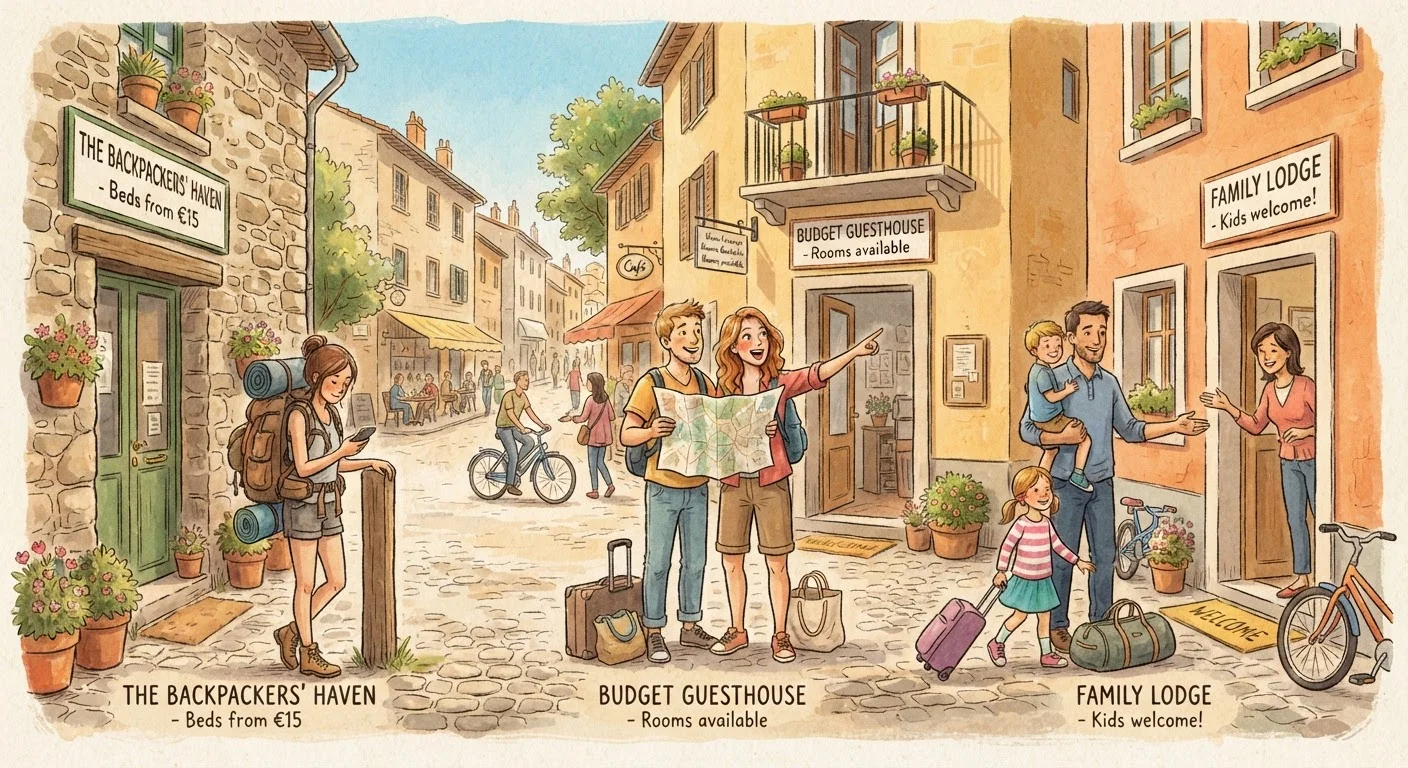
Key Takeaways
- Backpackers typically stretch budgets furthest with dorm beds and hostel common areas for social connection.
- Couples often find private hostel rooms or short-term rentals offer the best balance of privacy and value.
- Families benefit most from apartment-style rentals that include kitchens, reducing food costs significantly.
- Accommodation location affects total trip cost — a cheaper room far from attractions can cost more overall.
- Each travel group has different non-negotiables; matching lodging type to those priorities prevents wasted spending.
Our Verdict
There is no universally cheapest accommodation style — the right option depends entirely on who is travelling and what they need to function comfortably. Backpackers maximize savings through shared spaces, couples do well with private rooms in hostels or compact rentals, and families consistently save more by prioritizing self-catering capacity over nightly rate alone.
| Best for | Recommended |
|---|---|
| Solo backpackers and social travelers | Hostel dorm beds |
| Couples seeking privacy on a budget | Private hostel rooms or short-term rentals |
| Families traveling for multiple nights | Apartment-style short-term rentals with kitchens |
| Mixed groups or flexible travelers | Budget guesthouses or multi-room vacation rentals |
Why Travel Style Changes the Accommodation Equation
Affordable lodging isn't simply about the lowest nightly rate. The right accommodation for a 22-year-old backpacker moving city to city every two days looks nothing like what works for two adults celebrating an anniversary on a tight budget, or a family of four trying to keep two kids comfortable and fed.
Each group brings different priorities — privacy, social access, kitchen facilities, safety for children, space for luggage — and ignoring those priorities in pursuit of a headline price often leads to uncomfortable or expensive surprises. Understanding how your travel group's needs shape the value of different lodging types is one of the most practical skills in budget travel planning.
For a broader foundation on keeping the whole trip within budget, the Trip Planning Savings hub covers the full picture from flights to daily spending.
Backpackers: Flexibility First, Cost Second
Solo and small-group backpackers generally have the widest range of ultra-low-cost options available to them. A single person occupies only one bed, carries their own gear, and rarely needs dedicated common space beyond somewhere to charge devices and store luggage safely.
Hostel dorm beds remain the most widely used option for good reason — they are typically priced per person rather than per room, which is a structural advantage for solo travelers. Common areas in social hostels also provide built-in community, removing the isolation that can otherwise drive up spending through eating out or paying for entertainment alone. See shared dorm vs. private room in a hostel for a more detailed breakdown of when upgrading within a hostel makes sense.
Beyond hostels, backpackers flexible on timing can explore unconventional arrangements. Capsule hotels, couchsurfing, and camping each carry trade-offs worth understanding before committing. For destination-hopping travelers, the slow travel vs. multi-city hopping comparison is also worth reading — the cost difference between one and two-night stays can be substantial.
Match Your Booking Window to Your Flexibility
Backpackers who can commit to a destination a few weeks ahead often find hostel prices noticeably lower than last-minute rates, especially in popular cities. If your itinerary is loose by design, prioritize properties with free cancellation so you can lock in a price without losing the option to change plans. Even modest advance planning can make a real difference to nightly costs.
Couples: Balancing Privacy and Per-Person Value
Two people travelling together occupy an interesting middle ground. Unlike a solo traveler, a couple can split the cost of a private room — which immediately makes options that would feel expensive for one person viable for two. A private room in a hostel, for example, often costs only marginally more per night than two dorm beds, while providing full privacy and typically the same shared facilities.
Short-term apartment rentals are worth serious consideration for couples staying more than two or three nights in one place. Having a kitchen reduces the pressure to eat every meal out, which for two people adds up quickly. The short-term rentals vs. budget hotels comparison explores how that cost equation shifts depending on trip length.
Location also matters more for couples who want to explore together rather than rely on hostel social energy. A cheaper room far from a city's center can erode savings through transport costs. The article on how accommodation location affects total trip cost is directly relevant here.
| Backpackers | Couples | Families | |
|---|---|---|---|
| Best lodging type | Hostel dorm or capsule hotel | Private hostel room or rental | Apartment-style rental |
| Key priority | Lowest per-person cost | Privacy + shared cost | Kitchen access + space |
| Kitchen access needed? | Rarely essential | Useful for longer stays | Almost always valuable |
| Location sensitivity | Moderate — mobility is easy | High — explore together | High — logistics with children |
| Social features matter? | Often yes | Rarely | Rarely |
| Minimum nights for rentals to pay off | Rarely worthwhile solo | 3+ nights typically | 2+ nights typically |
Families: Total Cost Over Nightly Rate
Families travelling with children face a fundamentally different calculation. Safety, space, and access to cooking facilities are rarely optional — and many budget accommodation types simply don't accommodate a group of four or five people in a single booking without the price climbing steeply.
Apartment-style rentals tend to offer the best overall value for families, even when the nightly rate looks higher than a budget hotel room. The ability to prepare meals — breakfasts in particular — can offset accommodation costs meaningfully across a week-long trip. Two hotel rooms for a family of four, by contrast, doubles the nightly spend while eliminating the self-catering option.
Families also benefit from thinking carefully about timing. Peak vs. off-peak travel affects rental pricing noticeably, and shoulder season timing can unlock meaningfully lower rates without the full trade-offs of traveling in low season. Group cost-splitting strategies outlined in splitting costs when travelling in a group also apply when extended family or friends travel together.
Watch for Hidden Per-Person or Per-Child Fees
Some rental platforms and guesthouses list a base rate that applies to two guests, then add per-person fees for additional occupants — including children. Always check the total price for your actual group size before comparing options. A rental that looks affordable for two can become significantly more expensive for a family of four once those fees are included.
How to Approach Booking Regardless of Travel Style
Across all three traveler types, a few principles consistently reduce accommodation costs without sacrificing too much comfort. Booking flexibility — when trip structure allows — is one of the most reliable levers. Flexible vs. fixed travel dates examines how much that flexibility realistically saves.
Whether to book directly with a property or use a third-party platform is another question worth thinking through rather than defaulting to habit. Booking directly vs. using a third-party platform lays out the practical differences. And for a comprehensive resource that covers every stage of finding and evaluating affordable lodging, The Full Picture on Budget Accommodation is a useful reference to keep handy throughout the planning process.