
Vanpooling, Carpooling, and Commuter Buses: Shared Commuting Options Explained

Key Takeaways
- Carpooling, vanpooling, and commuter buses each work differently and suit different commuting distances and schedules.
- Vanpools are typically employer- or agency-organized, while carpools are usually informal neighbor or coworker arrangements.
- Commuter buses run on fixed routes and schedules, making them most reliable for riders near established corridors.
- Many employers and transit agencies offer subsidies or pre-tax benefit programs that reduce out-of-pocket shared commuting costs.
- Shared commuting generally reduces per-person fuel and parking costs compared to solo driving.
- Flexibility is the main trade-off — shared options require coordinating schedules with others.
Shared Commuting
Shared commuting means traveling to and from work with other people rather than driving alone. It covers a range of organized options — from informal carpools with neighbors to employer-sponsored vanpools and scheduled commuter bus services. The goal is to split transportation costs, reduce the number of vehicles on the road, and give riders an alternative to solo car ownership.
Shared commuting arrangements may qualify riders or employers for tax-advantaged treatment under IRS qualified transportation fringe benefit rules — consult a tax professional for details specific to your situation.
Why Shared Commuting Deserves a Closer Look
Most commuting conversations start and end with car ownership. But a large share of US workers live close enough to coworkers or transit corridors to make organized shared commuting a realistic, lower-cost alternative. The options range from a two-person carpool with a neighbor to a professionally operated commuter coach — and they work very differently from one another.
This article breaks down each major type so you know what you're actually comparing. For a broader map of transportation alternatives beyond commuting, see our overview of modern transportation alternatives.
~76%
US workers who drove alone to work
According to US Census Bureau American Community Survey data, the vast majority of American commuters travel to work solo in a personal vehicle, leaving shared options significantly underutilized.
~9%
US workers who carpooled to work
Census commuting data shows carpooling is the second most common commute mode nationally, though its share has declined over several decades.
$315/month
IRS pre-tax commuter benefit limit (2024)
The IRS sets an annual limit on the monthly amount employers can exclude from wages for qualified vanpool and transit benefits; this figure applies to 2024 and is subject to annual adjustment.
Carpooling: The Informal Option
A carpool is simply two or more people sharing a personal vehicle for a regular commute. It's the most flexible and lowest-barrier form of shared commuting because it requires no special enrollment, no employer involvement, and no fixed fee structure. Riders typically rotate driving duties or compensate the driver for fuel and wear.
The main advantages are cost reduction and simplicity. Splitting fuel and parking costs across even two people cuts each person's daily expenses noticeably. The main drawbacks are schedule dependency and the social dynamic of coordinating with another person. If your hours are unpredictable or you frequently work late, an informal carpool can become a source of friction.
Check With Your Employer Before Searching Independently
Many employers have commuter benefit programs or internal ride-matching tools that aren't widely advertised. Before spending time searching public databases, ask your HR or facilities team whether the company has any organized carpool, vanpool, or shuttle options already in place. You may find a subsidized program that significantly reduces your cost.
Ride-matching tools offered through regional transit agencies or employer commute programs can help connect workers who live near each other but don't already know one another.
Vanpooling: The Structured Middle Ground
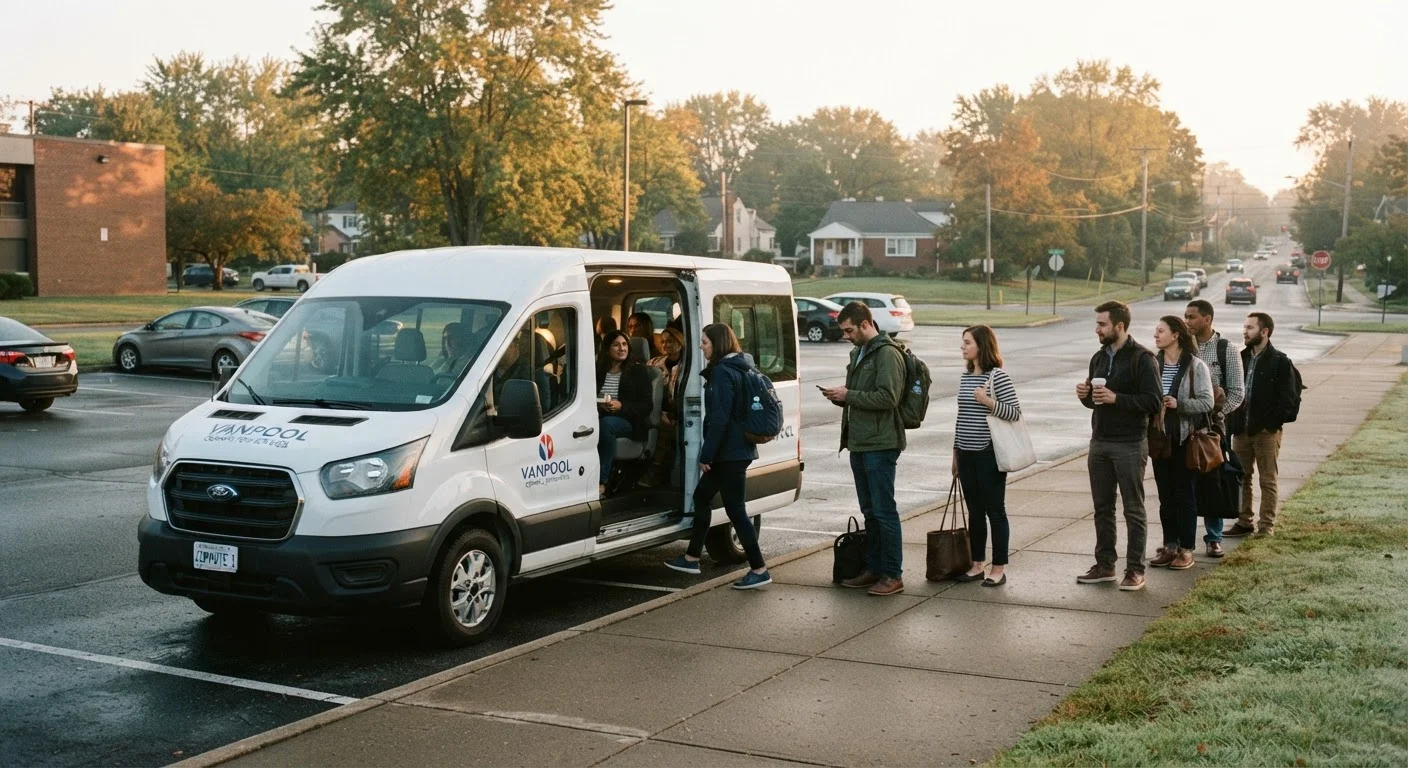
Vanpooling scales the carpool concept up. A van — typically carrying seven to fifteen passengers — travels a fixed route on a fixed schedule, usually organized through an employer, a regional transit agency, or a third-party vanpool operator. One member of the group typically drives in exchange for a reduced or waived monthly fare.
Vanpools are most common for longer suburban-to-urban commutes where transit doesn't reach. Monthly fees vary by distance, number of riders, and the program's funding source, but riders generally pay considerably less than the full cost of driving and parking alone. Some employers subsidize vanpool fees directly, and those subsidies may be provided as pre-tax benefits under federal commuter benefit rules — worth confirming with your HR department.
The structure that makes vanpools cost-effective also makes them less flexible. Riders commit to a schedule and a route. Occasional deviations — staying late, running an errand — require a backup plan. Comparing this trade-off against other options is easier with context; see how shared commuting differs from on-demand options in our article on rideshare, carshare, and rentals.
Commuter Buses: Fixed Routes, Professional Operation
Commuter buses are scheduled services designed specifically for peak-hour work travel. They differ from standard city buses in several ways: routes are typically express, stops are limited, service is concentrated in morning and evening rush hours, and amenities such as Wi-Fi and reserved seating are more common.
Operators vary. Some commuter bus services are run by regional transit authorities. Others are employer-sponsored shuttles running between office campuses and transit hubs. A smaller number are privately operated subscription services. Pricing is usually a flat monthly pass or per-trip fare — often subsidizable through employer commuter benefit programs.
Commuter buses are most useful for riders who live and work near established corridors. If your home or workplace sits outside those corridors, connecting to the bus stop may add complexity that offsets the convenience. Combining a commuter bus with another mode — biking to the stop, for instance — is one approach some commuters use. Our guide on building a multi-modal commuting routine walks through how that kind of combination can work practically.
How to Evaluate Which Option Fits Your Situation
No single shared commuting option is universally better. The right fit depends on your commute distance, how predictable your schedule is, what's available in your area, and what your employer offers. A few questions help narrow it down:
- How far do you commute? Vanpools tend to be most cost-effective for commutes of 20 miles or more. Carpools work at any distance. Commuter buses depend on whether a route exists near you.
- How fixed is your schedule? If your hours are highly variable, any shared option will require a reliable backup plan. If you work standard hours, the schedule constraint is minor.
- What does your employer offer? Some employers actively subsidize vanpools, run their own shuttles, or offer pre-tax transit benefits. Starting with HR can reveal options that aren't publicly visible.
- What does your regional transit agency have? Many metropolitan areas maintain free ride-matching databases and subsidized vanpool programs. A search for your region's commuter services office is a practical first step.
For a broader look at transportation choices that goes beyond the commute, the complete guide to getting around without driving covers additional options worth knowing.
Subsidies and Benefits Vary Widely by Employer and Region
Federal commuter benefit rules set a ceiling on pre-tax treatment, but not every employer participates, and state or local programs may add additional subsidies on top. Availability of vanpool matching programs also varies significantly by metropolitan area. What's offered in one city may not exist at all in another, so local research matters more than general averages.