

Key Takeaways
- A discounted price only means something when compared against a product's pricing history.
- Retailers regularly adjust prices up before a sale event to make discounts appear larger than they are.
- Free browser extensions and websites can display months of price data for popular online products.
- Price history is most useful for non-urgent purchases where you can afford to wait for a genuine low.
- No tool guarantees you'll catch the absolute lowest price — history informs, it doesn't predict.
Price History Tracking
Price history tracking is the practice of recording how much a product has cost over time — across days, weeks, or months — so you can see whether a current price is genuinely low or just appears that way. Instead of judging a deal by the price tag alone, you compare it against a product's actual pricing past. Free browser tools and third-party websites do this automatically for major online retailers.
Many price history tools pull data directly from retailer APIs or use web-scraping to log price changes at regular intervals, storing that data in a searchable chart. Coverage and update frequency vary by tool and retailer.
Why Today's Price Isn't the Whole Story
Walk into any store — physical or digital — and a price tag presents itself as a neutral fact. It isn't. Retailers adjust prices frequently, sometimes dozens of times a day on major e-commerce platforms. A price marked down from a "regular" price may have only been at that higher level for 48 hours before the sale launched. Without knowing what a product cost last week or last month, you have no reliable way to judge whether you're looking at a real deal or a manufactured one.
This is the core problem price history tracking solves. Rather than evaluating a price in isolation, you evaluate it against a product's record. That context changes everything. See our broader breakdown of what smart price comparison involves to understand why the sticker price is only one piece of the puzzle.
~2.5M
Price changes logged daily on major e-commerce platforms
Research by pricing intelligence firms has estimated that large online retailers adjust prices millions of times per day across their full product catalogs.
Up to 30%
How much a 'sale' price can be inflated before a discount event
Consumer advocacy research and price monitoring data have documented instances where listed reference prices were raised by significant margins shortly before promotional sales.
90 days
Typical lookback window for free price history tools
Most free-tier price history browser extensions display up to 90 days of price data by default; some offer longer windows in paid tiers.
How Price History Tools Work
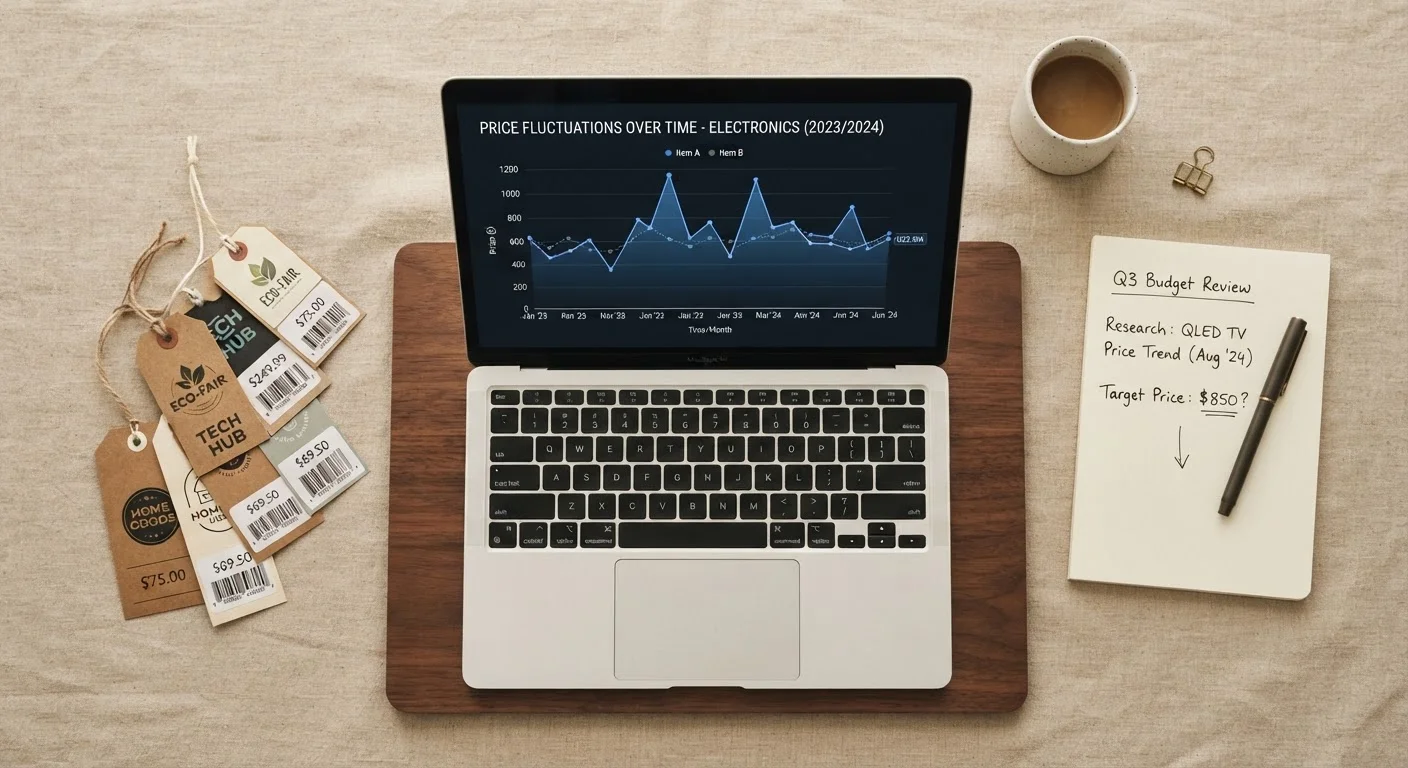
Price history tools are browser extensions or standalone websites that monitor listed prices on major retail platforms and log each change over time. When you visit a product page with an active extension installed, it overlays a chart showing that item's price journey — typically covering 30, 90, or 180 days depending on the tool and how long the product has been tracked.
The chart usually shows three key reference points: the historical high, the historical low, and a rolling average. Some tools also display price changes across multiple retailers side by side, which is useful when an item is sold in several places simultaneously.
It's worth noting that coverage isn't universal. Tools tend to perform well on major U.S. e-commerce platforms but may have limited or no data for smaller retailers, regional stores, or marketplace third-party sellers. Data gaps are common, so treat any chart as informative rather than comprehensive.
Check the Product, Not Just the Sale Banner
When you see a sale promoted by a retailer, go directly to the product page and run a price history check before assuming the discount is real. Sale banners are marketing — price history charts are data. The 60 seconds it takes to check can save you from paying a "discounted" price that isn't actually lower than normal. This habit is especially useful during major retail sale events, when inflated reference prices are most common.
Reading a Price History Chart Without Overthinking It
A price history chart can look intimidating at first glance, but the practical read is straightforward. Ask three questions: Where does today's price sit relative to the average? Has the price been this low before — and if so, how recently? Are there obvious seasonal spikes or dips that repeat?
If today's price is at or below the historical average and the product hasn't recently been at a lower level, that's a reasonably good signal. If the price spiked just before a promoted sale event and the "discount" is simply a return to the previous normal, the sale is less meaningful than it appears.
For purchases that aren't urgent, understanding retailers' predictable discount schedules can help you anticipate when a genuine low is more likely — rather than reacting to whatever sale happens to be running today.
The Limits of Price History — and What It Can't Tell You
Price history is a useful lens, not a crystal ball. A few important limitations are worth keeping in mind.
- History doesn't predict the future. A product that hit a low of $39 eight months ago may never return to that price if demand has risen or the product has been repositioned.
- Model changes matter. Electronics in particular get superseded by newer versions. A tracked price history for an older model may be irrelevant once a successor launches.
- Not all retailers are tracked equally. Some platforms limit third-party data access, so your chart may show gaps or only partial history.
- Checkout price can differ. The price logged by a tracker is usually the listed price, which may not reflect personalized pricing, coupon stacking, or loyalty discounts available at checkout.
For a deeper look at when automated tools outperform manual research — and when they don't — see our comparison of price tracking tools versus manual comparison shopping.
Price History Covers Listed Price Only
Most tracking tools record the publicly listed price on a product page, not the final price after coupons, credit card rewards, or store loyalty discounts are applied. Your actual out-of-pocket cost may differ from what the chart shows. Always verify the final checkout total before concluding whether a price is genuinely favorable.
Turning Price History into a Shopping Habit
The most practical way to use price history isn't to obsess over charts — it's to build a quick check into your research process before committing to a significant purchase. Before you buy anything above a threshold you set for yourself (many people use $30–$50 as a starting point), spend 60 seconds pulling up the price history. You're looking for a quick orientation: is this price normal, inflated, or actually low?
Over time, you develop what experienced shoppers call a "price memory" — an intuitive feel for what things actually cost. Building a personal price reference log is one way to formalize that process, especially for categories you shop frequently. Price history tools are the data foundation; your judgment about timing and need is what turns that data into a decision.
The same principle applies beyond retail. Flight price alerts work on a similar logic — tracking fare history to flag when a price represents a genuine dip — with their own set of caveats worth understanding before you rely on them.
“Consumers who understand price history don't just react to sales — they use data to decide when a price is actually worth acting on. That shift from reactive to informed buying is one of the most powerful changes a shopper can make.”
— Smart Shopping Editorial Team, Consumer research and price intelligence analysis