

| Most common price ending | .99 (Widely documented in retail pricing literature) |
| Purpose of .97 endings | Often signals clearance or markdown pricing at select retailers (Common convention; varies by chain) |
| Round-number pricing association | Premium or prestige positioning (Consumer behaviour research) |
| Yellow/bright tag common meaning | Promotional or sale price (Standard in many US supermarkets and big-box stores) |
| Red tag common meaning | Clearance — item may not be restocked (Common in apparel and general merchandise retail) |
| Tag colour standards | Set individually by each retailer — not universal |
Why Retailers Don't Just Write a Round Number
Walk through any grocery store, big-box retailer, or clothing shop and you'll notice almost no price ends in a clean, round digit. That's not an accident. Retailers use specific pricing conventions — number endings, tag colours, and formatting choices — to influence how shoppers perceive value. Once you know what to look for, a price tag becomes much more readable.
| Most common price ending | .99 (Widely documented in retail pricing literature) |
| Purpose of .97 endings | Often signals clearance or markdown pricing at select retailers (Common convention; varies by chain) |
| Round-number pricing association | Premium or prestige positioning (Consumer behaviour research) |
| Yellow/bright tag common meaning | Promotional or sale price (Standard in many US supermarkets and big-box stores) |
| Red tag common meaning | Clearance — item may not be restocked (Common in apparel and general merchandise retail) |
| Tag colour standards | Set individually by each retailer — not universal |
This article focuses on the formatting signals in price tags themselves. If you also want to compare value across different package sizes, see our guide on decoding unit prices and per-ounce costs.
What Price Endings Signal
The digits at the end of a price carry meaning that goes beyond the cents you'll actually pay.
Charm Pricing
A pricing strategy that sets prices just below a round number (e.g., $9.99 instead of $10) to make them appear significantly lower. Research in consumer behaviour suggests this format influences how shoppers estimate price magnitude.
Clearance Pricing
Reduced prices applied to items a retailer wants to sell off quickly, often because stock is being discontinued or replaced. Clearance tags frequently use distinct colours or number endings to stand out from standard promotional prices.
Price Anchoring
A technique where a higher 'original' price is displayed alongside a sale price to make the discount feel more substantial. The original figure acts as a reference point that shapes how shoppers judge value.
Electronic Shelf Label (ESL)
A digital display attached to a retail shelf that shows pricing information and can be updated remotely by store systems. ESLs allow retailers to change prices quickly without manually replacing paper tags.
Unit Price
The cost of a product per standard unit of measure — such as per ounce, per pound, or per count. Unit prices allow shoppers to compare true value across different package sizes and brands.
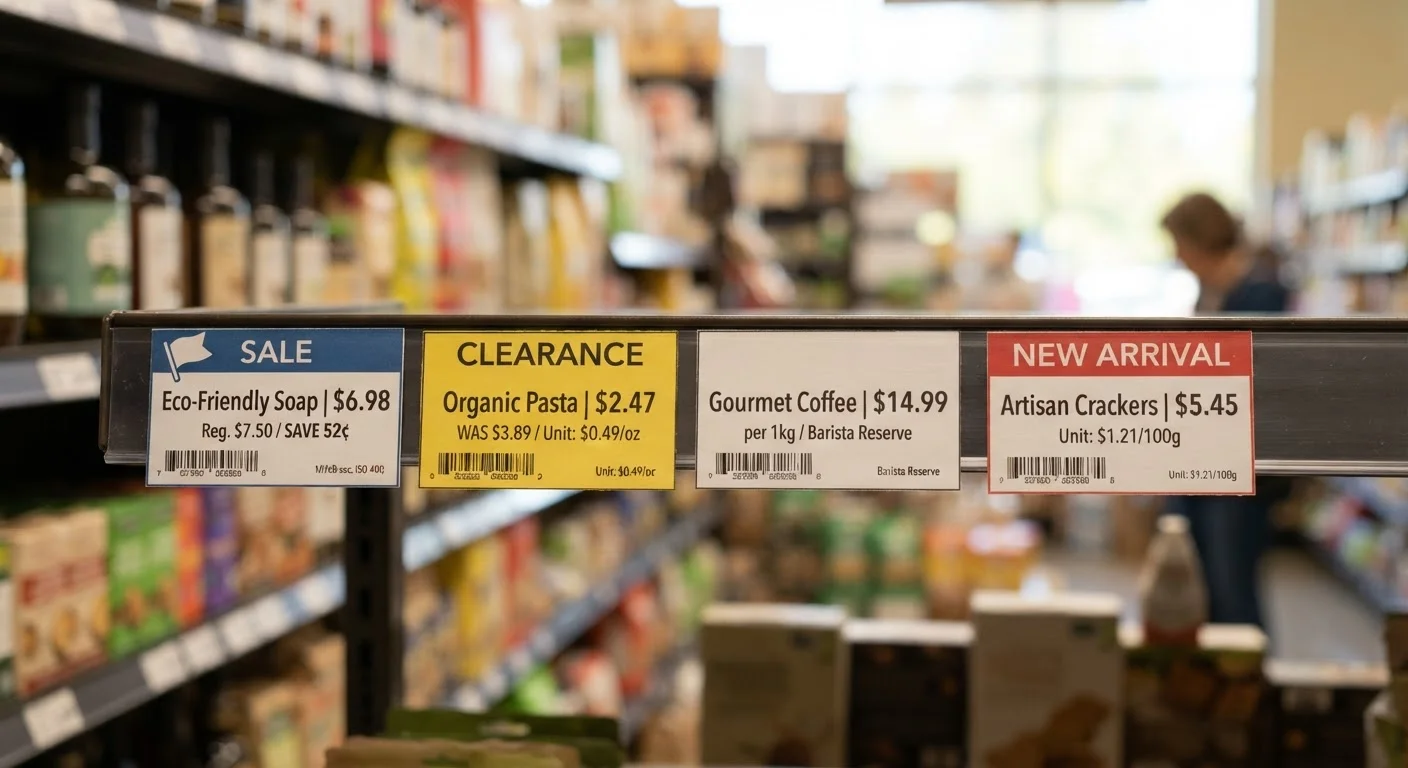
- .99 endings — Often called "charm pricing," prices ending in .99 or .95 are associated with value and deals in consumer research. The psychological effect is that $9.99 reads closer to $9 than $10, even though the difference is one cent. This is the most common pricing format in mass-market retail.
- .00 endings — Round numbers tend to appear on premium or prestige items. A price of $50.00 signals confidence and quality framing rather than a bargain pitch. Luxury goods, professional services, and some boutique retailers favour this format.
- .97 or .93 endings — These are frequently used by warehouse clubs and discount retailers to mark clearance or manager's special pricing. If you see a .97 ending, it often — though not always — indicates a markdown from a previous price. Practices vary by chain, so it's worth checking whether a retailer follows a consistent pattern in stores you frequent.
- .88 endings — Common in some large-format retailers as a secondary clearance signal, distinct from regular promotional pricing.
Knowing these conventions helps you ask a sharper question at the shelf: is this item on genuine markdown, or just formatted to look like a deal?
What Tag Colours and Formats Mean
Beyond the numbers themselves, the physical appearance of a price tag communicates intent.
Colour Conventions Vary by Retailer
There is no industry-wide standard for price tag colours in the United States. A yellow tag at one chain may signal a weekly sale, while the same colour at another store is simply their regular shelf format. When shopping somewhere new, a quick check of in-store signage or a question to staff can clarify what their colour system means — don't assume conventions transfer from store to store.
- Standard white or shelf tags — Regular, everyday pricing. No markdown is implied.
- Yellow or bright tags — Frequently used across supermarkets and big-box stores to signal a sale or promotional price. The colour grabs attention, but always compare against the original listed price to gauge actual savings.
- Red tags — Often denote clearance, end-of-line items, or deeper markdowns. In apparel retail especially, a red tag can mean the item won't be restocked.
- Digital shelf labels (ESLs) — Electronic price displays that update automatically. These eliminate printing lag and allow prices to change quickly, sometimes multiple times per day in certain retail formats.
Tag colour conventions are not universal — each retailer sets its own system. If you shop somewhere regularly, it's worth a quick look at store signage or staff explanations to understand what their colour coding means specifically.
For a broader look at comparing what you pay across stores, visit our hub on comparing prices.
Using Price Tag Knowledge in Practice
Reading price tags critically is one piece of a larger shopping strategy. A few practical habits help:
- Check the original price — When a sale tag is present, look for the "was" price. Verify it seems reasonable; inflated original prices used to make markdowns look larger are a documented retail practice.
- Look at the unit price — A lower sticker price doesn't always mean better value if the package is smaller. Our guide on unit pricing explains how to use shelf label detail to make true comparisons. You can also explore per-unit pricing tactics to stretch every dollar further.
- Understand what "sale" actually means — Promotional pricing cycles vary by category. Some items go on promotion so frequently that the "sale" price is effectively the regular price.
- Compare across stores when the stakes are higher — For big purchases, the sticker is just the starting point. See what price comparison really involves for a structured approach.
Price tags encode retail strategy. Reading them with a little more awareness puts you in a stronger position to decide when a deal is real — and when it's simply formatted to look like one.