

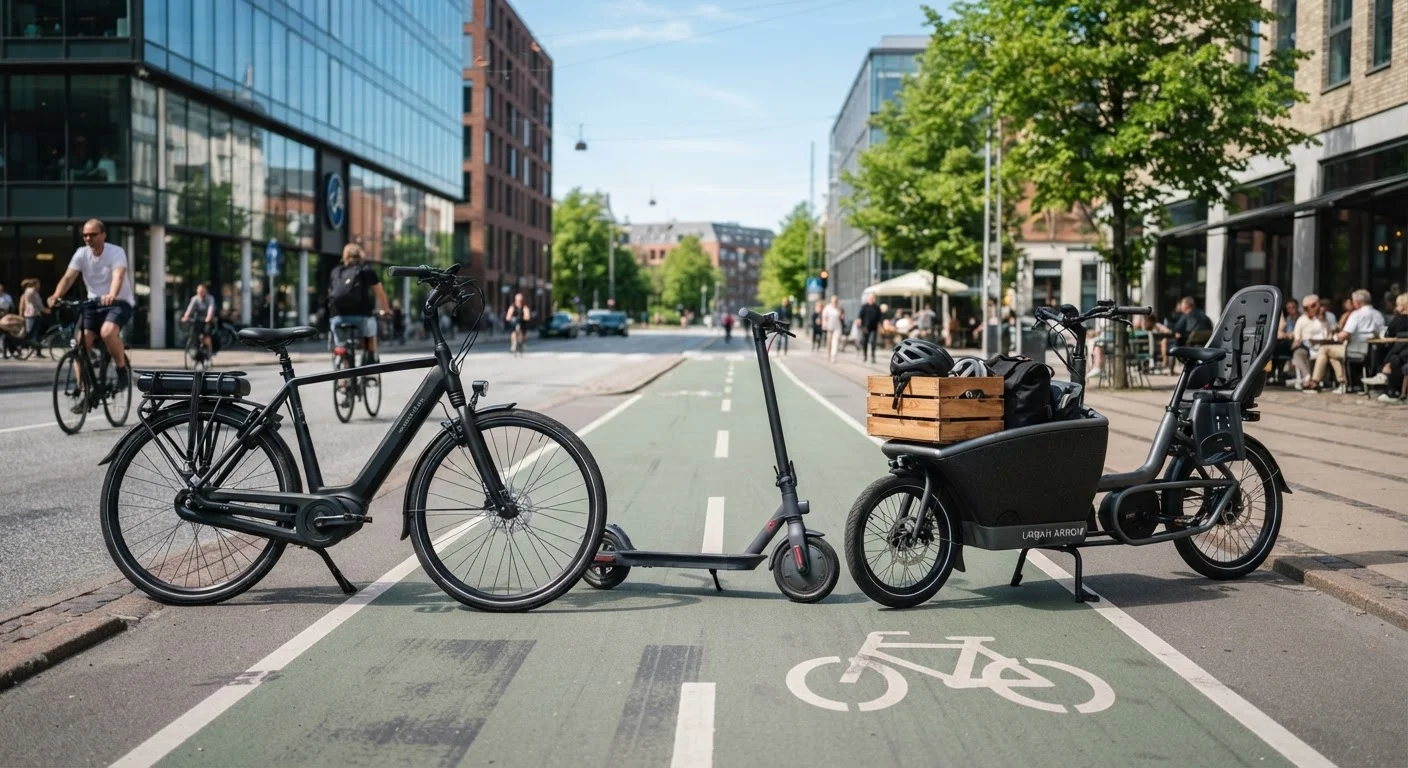
Key Takeaways
- E-bikes cover the widest range of terrain and distance for most daily commuters.
- Electric scooters cost less upfront but are limited by range, weather, and cargo capacity.
- Cargo bikes work well for families or errands but require more storage space and physical effort on hills.
- Upfront cost, commute distance, storage, and local infrastructure should all factor into your choice.
- None of these options suits every situation — knowing your route matters most.
Our Verdict
For most solo urban commuters covering short to moderate distances, an e-bike offers the most balanced combination of range, comfort, and practicality. Electric scooters make sense for very short, flat trips where storage is tight. Cargo bikes serve those with regular hauling needs — groceries, gear, or kids — willing to invest in a larger footprint.
| Best for | Recommended |
|---|---|
| Solo commuters on mixed terrain with moderate distances | E-Bike |
| Short, flat urban trips with minimal storage space | Electric Scooter |
| Families, frequent errand-runners, or those replacing car trips | Cargo Bike |
Why Micro-Mobility Is Worth Taking Seriously
More US commuters are looking past the car for daily transportation — not just to save money, but to avoid parking headaches, traffic, and rising fuel costs. Electric micro-mobility vehicles have matured considerably in recent years, and three options stand out: e-bikes, electric scooters, and cargo bikes.
Each fits a different kind of commuter. Understanding where each one excels — and where it struggles — is the starting point for a smart choice. For a broader look at how these fit into the full transportation picture, see our overview of modern transportation alternatives.
| E-Bike | Electric Scooter | Cargo Bike | |
|---|---|---|---|
| Typical range per charge | 20–60 miles | 15–25 miles | 20–50 miles (electric-assist) |
| Approximate entry-level cost | $800–$1,200+ | $400–$900 | $2,000+ |
| Cargo capacity | Moderate (rack/panniers) | Minimal | High (kids, groceries, gear) |
| Hill performance | Good with motor assist | Poor to fair | Fair with strong motor assist |
| Portability / storage | Moderate (heavy) | High (foldable) | Low (large footprint) |
| Weather suitability | Moderate | Poor | Moderate |
| Best commute distance | 5–20+ miles | Under 5 miles | Under 10 miles |
E-Bikes: The Most Versatile Option for Most Commuters
An e-bike (electric bicycle) is a standard bicycle fitted with a motor and battery that provides pedal-assist — meaning the motor kicks in when you pedal, rather than doing all the work for you. Most US e-bikes offer a range of 20–60 miles per charge, though real-world range varies with rider weight, terrain, and assist level.
E-bikes handle hills, longer distances, and mixed surfaces better than scooters. They also allow riders to arrive without being drenched in sweat — a practical concern for anyone commuting to an office. Locking and storage work similarly to a regular bike, though the added weight (typically 40–70 lbs) makes carrying them up stairs difficult.
On the cost side, entry-level commuter e-bikes generally start around $800–$1,200, with higher-end models running considerably more. Maintenance mirrors a standard bike with the addition of battery care.
Check Local E-Bike Regulations Before You Buy
US states classify e-bikes into three classes based on top assisted speed and whether a throttle is included. Class determines where you can legally ride — some bike paths restrict Class 3 (up to 28 mph) e-bikes. Check your state's Department of Motor Vehicles or transportation agency for local rules before purchasing, especially if you plan to ride on shared-use paths.
Electric Scooters: Lightweight, Limited, and Low-Cost
Electric scooters (stand-up, motorized) are the most compact option. They're easy to fold and carry into an office or onto transit — which makes them genuinely useful for the last mile of a longer commute. Many riders combine them with rail or bus in exactly this way. Our guide on building a multi-modal routine covers how to structure this kind of combination effectively.
The trade-offs are real, though. Most consumer electric scooters have ranges of 15–25 miles under ideal conditions. They struggle on wet pavement, rough surfaces, and any significant incline. Carrying capacity is essentially zero beyond a small bag or backpack. Safety is a legitimate concern: smaller wheels are more vulnerable to road debris, and rider visibility is lower than on a bike.
Upfront costs are lower — quality commuter scooters often fall in the $400–$900 range — but cheaper models tend to have shorter battery lifespans and less reliable components.
Scooter Safety on Public Roads
Electric scooters are subject to varying local regulations across US cities and states — some require helmets, others restrict riders to bike lanes or sidewalks, and some ban them from certain road types entirely. Riding a scooter in traffic without understanding local rules can result in fines or unsafe situations. Always verify the rules in your specific municipality before commuting by scooter.
Cargo Bikes: Built for Hauling, Not Speed
A cargo bike — often electric-assisted — is designed to carry significant loads: children, groceries, tools, or gear. Configurations vary from long-tail designs (extended rear rack) to front-loading box bikes. Electric assist makes them genuinely usable for everyday errands and school runs without needing to be in peak physical condition.
The practical limitations are size and cost. Cargo e-bikes are large — often over six feet long — and require dedicated, secure storage. They're not practical for apartments without cargo bike parking. Prices typically start around $2,000 and rise steeply for quality models. They're also heavier than standard e-bikes, which matters if you ever need to maneuver them by hand.
Where cargo bikes genuinely shine is in replacing short car trips entirely. Families who might otherwise make multiple car trips per week for school drop-off or grocery runs can find real utility here. For commuters with similar hauling needs, it's worth also reviewing overlooked transportation options that might complement or replace cargo trips.
How to Choose: Four Questions to Ask First
Before deciding, work through these practical questions:
- How far is your commute? Under 5 miles, a scooter may be sufficient. Over 10 miles, an e-bike is generally more reliable.
- What's your terrain like? Hills reduce scooter range significantly and make cargo bikes harder to manage without strong motor assist.
- Do you have secure storage? Cargo bikes need space. E-bikes and scooters can often be stored indoors with more ease.
- Are you carrying anything? If your commute regularly involves cargo — including children — a cargo bike is the only option purpose-built for it.
If your commute involves other modes — transit, rideshare, or walking — it's also worth understanding how Mobility-as-a-Service platforms can help you coordinate multiple options in a single routine. And if you share a commute corridor with others, shared commuting options may complement or replace a micro-mobility vehicle on longer legs.
~$0.06
Estimated cost per mile to charge an e-bike
Based on typical US residential electricity rates and average battery capacity; actual costs vary by region and model.
5%
US workers who commuted by bicycle in any given week
According to US Census Bureau American Community Survey data on transportation to work; cycling commuting rates vary significantly by city.